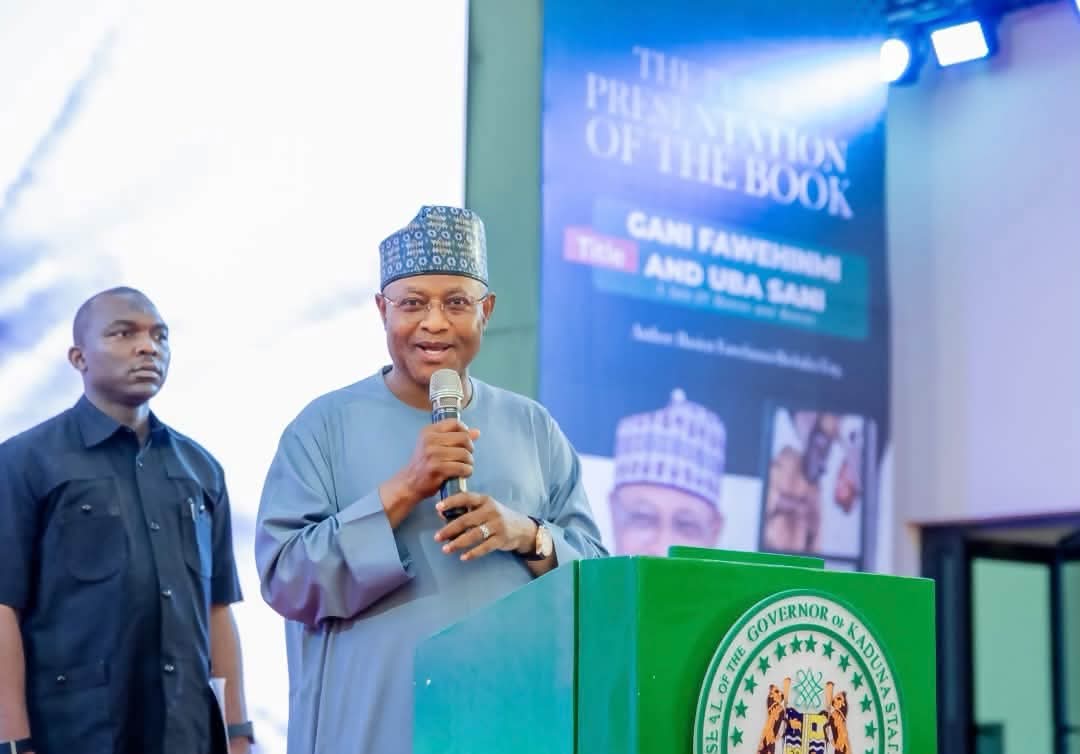
Kaduna State Governor, Uba Sani, has called the late human rights lawyer and pro-democracy activist, Gani Fawehinmi, a key player in opening Nigeria’s political space for opposition parties and allowing for political diversity.
Mr Sani noted that one of Mr Fawehinmi’s major contributions to Nigeria’s democracy was his successful challenge against efforts to limit the registration and participation of political parties.
He spoke on Saturday in Kaduna during the public presentation of a book titled Gani Fawehinmi and Uba Sani: A Tale of Mentor and Mentee, written by Basirat Fawehinmi-Biobaku.
Looking back at the struggle for political party registration, Mr Sani mentioned that many human rights activists had become very frustrated with the strict rules set by the Independent National Electoral Commission (INEC) on groups wanting to register as parties.
Despite this, Mr Fawehinmi did not let that frustration derail their fight for democracy.
“At a serious meeting, we told Chief Fawehinmi, our leader, that we were beginning to lose faith in democracy. But he would not permit frustration to become despair.
“He told us to have faith in the judiciary, faith in the rule of law and faith in democracy itself. Rather than abandon the democratic process, we would use the democratic process to defend democracy.”
According to the governor, Mr Fawehinmi and the former Kaduna State governor, Balarabe Musa, took legal action against INEC’s stance.
He said the legal fight lasted over two years before the Court of Appeal ruled in their favor.
“I recall that the ruling was delivered by Justice Dahiru Mustapha in 2002. INEC appealed to the Supreme Court, but in January 2003, the Supreme Court again ruled in our favor,” Mr Sani said.
The governor said this court victory had a big impact on Nigeria’s democracy.
“The verdict opened the political space in Nigeria and paved the way for the emergence of more political parties,” he said.
Mr Sani urged Nigerians to remember the struggles that made political diversity possible. He said many politicians enjoying the freedom to operate on various platforms today may not understand the sacrifices made by earlier activists.
“Whenever we celebrate political plurality in Nigeria, whenever new parties emerge and whenever citizens exercise their rights to organize politically, we should remember those who fought to make that space possible,” he said.
“Democracy has a history, and every freedom has a cost,” he added.

Mr Sani also described Mr Fawehinmi as more than just a campaigner for political freedom. He called him a true pan-Nigerian who believed that Nigeria’s progress depended on the growth of all parts of the country.
He said the late activist fought for the empowerment of citizens regardless of their region, ethnicity, religion or social status.
The governor highlighted Mr Fawehinmi’s dedication to education. He remembered how he helped set up the Gani Fawehinmi Scholarship Foundation.
Mr Sani said he was given the job of coordinating the foundation’s work in Northern Nigeria and convinced Mr Fawehinmi to start a major scholarship program for talented but needy university students in the region.
This initiative eventually helped more than 1,000 students across northern Nigeria.
“We traveled across northern universities to find deserving beneficiaries,” he said. Many of the beneficiaries have gone on to become doctors, lawyers, academics and engineers, helping the country develop.
Mr Sani recalled that when the scholarship scheme started in northern Nigeria 26 years ago at Arewa House, Kaduna, Mr Fawehinmi challenged northern leaders to tackle the region’s educational issues.
He warned that if the region’s educational problems were not urgently addressed, they could become a “monster.”
According to the governor, that warning is still relevant today. He argued that many of the issues facing northern Nigeria now are linked to a lack of investment in education.
Mr Sani described Mr Fawehinmi as one of the strongest Nigerians of his time. He said the late activist had the courage to put principles above personal comfort and justice above convenience.
“He used the law as a tool for freedom, defended ordinary citizens against abuse of power and contributed greatly to Nigeria’s fight for democracy, accountability and human dignity,” he said.
The governor congratulated the book’s author, Mrs Fawehinmi-Biobaku, for telling the story of a relationship that began as personal mentorship and grew to have national importance.
“This is not just the story of a mentor and his mentee. It is a story about courage, the fight for democracy, social justice, education, leadership and the duty of one generation to prepare the next for service,” Sani said.



Drop your comment
No comments yet — be the first to drop the gist 👇