When a court convicts someone and gives them a prison sentence, we expect them to go to jail immediately.
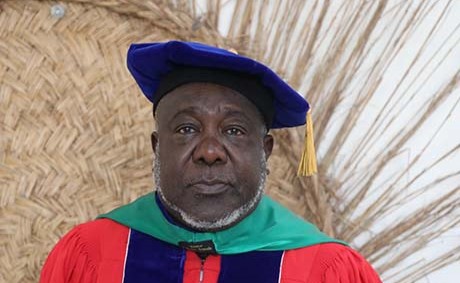
But in the case of Bello Magaji, a former military officer, he did not serve his five-year prison sentence for sodomy. This sentence was given by the General Court Martial and later confirmed by the Supreme Court.
Instead, former President Goodluck Jonathan pardoned him many years after the Supreme Court's decision. The Nigerian Army also changed his dismissal status to voluntary resignation, gave him a military service certificate, and returned all benefits for retired officers.
Mr Magaji continued his education and found teaching jobs in universities in Nigeria and Uganda. Last year, he became the Dean of the Faculty of Law at the American University of Nigeria (AUN) in Yola, Adamawa State. The university, where he also works as an associate professor, said it was not aware of his conviction and is currently looking into it.
Despite this, Mr Magaji insists he is innocent. After the Supreme Court upheld his conviction, he sought various ways to avoid punishment.
He took his case through Nigeria’s court system, starting from the General Court Martial to the Court of Appeal and then to the Supreme Court. He also approached the National Human Rights Commission (NHRC) and the Human Rights Violations Investigation Commission (HRVIC), known as the Oputa Panel, which was set up in 1999 by then-President Olusegun Obasanjo.
Even though the Supreme Court confirmed his conviction and five-year sentence, he never served the time in jail.
“At no point did I serve any sentence pursuant to a conviction by a General Court Martial in 1997,” Mr Magaji told PREMIUM TIMES. “What occurred was an initial military detention at the Officers’ Mess, after which a stay of execution of the court martial proceedings was granted. I was subsequently released and continued to challenge the matter through all available legal and constitutional avenues.”
Momoh-Jimoh Umaru, a law professor at Usmanu Danfodiyo University, Sokoto, told PREMIUM TIMES that Mr Magaji should have served his five-year jail term after the Supreme Court's ruling, before receiving a presidential pardon five years later.
Mr Umaru noted that Mr Magaji's long absence from prison after the Supreme Court's ruling shows a weakness in how criminal justice is managed and enforced in Nigeria.
He said many people may see this as evidence that powerful individuals can escape punishment, but the real issue is the legal and judicial process itself.
“It’s the justice system that gives the leeway for him to work around as if he is a free man, but he is not a free man because the conviction is still hanging on his neck,” he told our reporter over the phone.
With the presidential pardon, Mr Umaru explained, “There’s no way he can be asked to go and serve because there’s already a presidential pardon.”
Mr Umaru explained that when someone is convicted and is in custody, correctional officials are supposed to return the person to prison after the court's decision.
In many cases, agencies like the Economic and Financial Crimes Commission (EFCC) are responsible for arresting and sending convicts to jail as ordered by the court. For example, the EFCC recently arrested former Minister of Power, Saleh Mamman, who was convicted and sentenced to 75 years in absentia, and sent him to serve his time. If this is the standard, then the Nigerian military, which prosecuted Mr Magaji, should have ensured he went to jail according to his sentence.
Magaji’s Offense
In 1996, Mr Magaji, a military police officer in the Nigerian Army, was accused of sexual offences against four men, including a 17-year-old. Although he was not charged with rape, two victims and one witness testified that he got them drunk before having sex with them.
The military charged him with sodomy, and on 6 February 1997, the General Court-Martial found him guilty, sentencing him to seven years in prison, which was later reduced to five years.
According to court documents, Mr Magaji lured the four young boys with false job promises.
In his pre-trial statement, Mr Magaji admitted to what the Supreme Court called a “naked romance” with the boys. He said they massaged him, including his private parts, while they were naked, but denied the sodomy charge.
“…I had some passes with them short of sexual intercourse,” he wrote, adding, “…they massaged me. I have to state that on the day in question the massage they did to me included my private parts and I had romances with them. We were naked.”
At that time, he was married to two wives and had seven children. He claimed his actions were due to “psychological and psychiatric problems” that began two years before the incident.
During the General Court Martial trial, he did not testify or call witnesses in his defense and relied solely on the prosecution's evidence.
Appeals
After the GCM convicted him, he rejected the ruling. He first appealed to the Armed Forces Disciplinary Appeal Committee (AFDAC) and then to the Lagos Division of the Court of Appeal, according to a petition he wrote to the Oputa Panel in July 1999.
The appellate court dismissed his appeal on 30 June 2004.
Still unhappy, he went to the Supreme Court, where the case was heard on 13 December 2007.
On 7 March 2008, the five justices of the Supreme Court, led by Justice Niki Tobi, unanimously dismissed the appeal for lacking merit.
Justice Ikechi Ogbuagu, one of the judges, was furious and said the initial five-year sentence was too light.
Justice Ogbuagu said Mr Magaji’s request for reinstatement and payment of entitlements showed he had no remorse for his actions against the young boys, who thought they were getting jobs.
“Speaking for myself, since there is an appeal against (the) sentence, I should have increased/enhanced the term,” Justice Ogbuagu said in his ruling, of the four judges who supported the lead judgment by Justice Tobi.
“I believe the Appellant deserves to be locked away from society for a long time, where his supposed problem can be taken care of by a Psychiatric Doctor.”
The judge was concerned since Mr Magaji was a lawyer. He had earned a Bachelor of Laws (LL.B) from Usmanu Dan Fodio University, Sokoto, in 1989 and was called to the Bar in 1990 after graduating from the Nigerian Law School, Lagos.
Petition to Oputa Panel
Meanwhile, Mr Magaji insisted that his trial and conviction were a setup due to his involvement in prosecuting some military officers.
In his petition to the Oputa Panel, he accused the military of victimization, unlawful arrest, inhuman treatment while in detention, torture of him and his children, and denial of justice.
He said his problems started after he refused to cooperate with then Commander of the Lagos Garrison Command, Patrick Aziza, a brigadier general, to weaken the case against some officers accused of illegally importing vehicles.
Mr Magaji claimed that Mr Aziza sent someone to him to ask for his cooperation, after the then Chief of Army Staff, Ishaya Bamaiyi, appointed him to prosecute the case.
He also claimed that in December 1996, while serving as the National Chairman and Acting Legal Officer of the Task Force on Telecommunications and Postal Offences, he resisted pressure from another officer to interfere in a case involving a forged cheque.


PREMIUM TIMES cannot verify Mr Magaji's claims against the named individuals.
But he maintains that refusing to be influenced made him enemies in the military, leading to allegations of sexual offences against him.
In his appeals, he claimed that the court martial denied him a fair hearing and that the process had many irregularities. The Supreme Court dismissed these claims in its final ruling on the case.
From Dismissal to Retirement
Mr Magaji found relief in 2013 when President Goodluck Jonathan granted him a presidential pardon along with other convicted military officers and former Bayelsa State Governor Diepreye Alamieyeseigha, who was convicted of corruption. This pardon faced public backlash. The Nation newspaper called it a “Presidential Jailbreak.”
In 2015, the Nigerian military restored all of Mr Magaji’s honours, including his rank, pension, and benefits for retired officers. Then-Chief of Army Staff, Tukur Buratai, a major general, awarded him a certificate of military service.
The Army Headquarters also changed his status from “cashiering” to “voluntary retirement” effective from 6 February 1997, the date of his conviction. Cashiering is for military officers dismissed in disgrace for serious offences.
“On behalf of the commander-in-chief, the army council, and the Nigerian Army, the Chief of Army Staff wishes to express gratitude for your dedication and unblemished years of service,” reads a November 2015 letter seen by this newspaper, reinstating Mr Magaji.
“During your 19 years and 28 days of service, you demonstrated good conduct. You are entitled to gratuity, pension, certificate of military service, and retired officer’s identity card.”
Life After Conviction
Mr Magaji told PREMIUM TIMES he never served his jail term because he kept appealing until he got a presidential pardon. Legal experts say he should have served the sentence from 2008 to 2013 when he received the pardon, but he didn’t.
He later earned a Master of Laws (LL.M) degree from Ahmadu Bello University, Zaria, in 2008 and a Doctorate degree in Law (PhD) from the same university in 2017.
On the AUN website, he said his career started at the Federal Polytechnic, Kaduna, where he taught law for 15 years, rising from Lecturer III to Senior Law Lecturer. He then moved to the Nigeria Police Academy, Wudil, Kano, as Law Lecturer and Examination Officer for the faculty.
He has also taught at Kampala International University and was a visiting Law Lecturer at Nkumba University and the Islamic University in Uganda.
At IUIU, he served as Dean of the Faculty of Law before returning to Nigeria to join AUN.
Late last year, AUN appointed him as Dean of the Faculty of Law.
On his profile at AUN, Mr Magaji does not mention his military background.
Mixed Reactions
Opinions about Mr Magaji’s role in academia vary.
Emmanuel Okorie, a legal officer with Hope Behind Bars, said there is no legal reason to stop a former convict from holding an academic leadership position after they have served their sentence.
Mr Okorie believes that once a person completes their punishment, they should not face discrimination because of past convictions.
“After serving his time, he is seen as a free man,” he said, even though Mr Magaji never served the jail time given to him by the General Court Martial and confirmed by the Supreme Court.
“It does not stop him from going to academics. If it was a problem, he wouldn’t have gotten the job. He went through the process and there is nothing stopping him from being the dean.”
He added that there are no known legal restrictions preventing Mr Magaji from being appointed dean.
He stressed that current justice principles promote the reintegration of ex-convicts into society instead of excluding them from opportunities for growth.
Professor Umaru also said that whether an ex-convict can work in a university depends on the institution’s rules.
He mentioned that federal universities in Nigeria do not bar ex-convicts from holding such positions.
“If there’s no rule against it, then there’s no legal reason to prevent him from holding academic or administrative positions,” he said.
“I see no reason why there should be any condition preventing him from rising to whatever rank,” he added.
“But morality is different from law. So, I see no reason why he cannot be the dean.”
On the other hand, a professor of teacher education, who preferred to remain anonymous, said private institutions have more flexibility in appointments than public universities, which follow strict procedures, elections, and regulations.
This professor, a former president of ASUU at a federal university, said these practices would be hard to maintain in public universities because staff and unions would challenge such decisions.
University and Magaji Respond
The American University of Nigeria initially told PREMIUM TIMES that it did due diligence before hiring Mr Magaji, stating he wasn’t the same person as the convict. The university registrar, Daniel Okereke, called it “a very ugly coincidence of name.”
This newspaper later informed the university that our findings showed he was indeed the same person. Mr Okereke said the university would take a closer look at the situation and make a decision.
Mr Magaji told PREMIUM TIMES that Nigerian labor law does not require him to disclose his conviction unless asked, especially since he got a presidential pardon.
“Employers are responsible for conducting proper checks before hiring,” he said. “This is why there are standard processes, including referees and verifiable records, which I provided. At no time did I misrepresent or hide anything.”
“Regarding my appointment as dean of the law faculty, I have conducted myself with integrity throughout my career, and I am confident that the full and accurate record will speak for itself,” Mr Magaji added.

Drop your comment
No comments yet — be the first to drop the gist 👇