Standing in floodwater, Viviane Tavershima looked over her farm in Agada, Benue State. Her farm manager called her earlier in September 2021 to say the farm was flooded.
She had planted 12 hectares with hibiscus, melon, groundnut, rice, maize, soybeans, and tubers.
“I didn’t know that place was prone to flooding until the previous year,” she said.
Wading through flooded farmland is tough. For Ms Tavershima, it is even harder. Due to a spinal condition that affects her mobility, she walks with crutches and wears specially adapted sandals. Moving in muddy areas is very difficult for her.
Ms Tavershima said she begged the villagers for help to save the crops.
“The flood hadn’t covered it completely. I asked the locals around to assist because we could dig. They refused. What they did was steal the crops instead,” she said.
The flood destroyed about eight hectares of crops. She managed to save some tubers, including yam and orange-fleshed sweet potato.
Despite her losses and physical challenges, she talks calmly about her experiences, often smiling while sharing some of the hardest moments of her farming journey.
A study by the Advocacy for Women with Disabilities Initiative found that at least 1,118 women with disabilities farming across 27 states reported facing big barriers to farming and livelihoods. Climate change is making things worse, leading to flooding, extreme heat, and unpredictable rainfall. The study showed that women farmers have a 30 percent yield gap compared to men due to limited access to land, farm inputs, and extension services.
Most respondents earned less than ₦50,000 per month. Many had no access to credit, assistive technologies, or disability-inclusive agricultural programs, leaving them especially vulnerable to climate-related shocks.
Why the risks are growing
Climate change expert Esther Ajah said rising temperatures, prolonged heatwaves, erratic rainfall, and flooding have worsened conditions for Nigerian farmers in recent years.
She pointed out that data from the Nigerian Meteorological Agency (NiMet) has consistently warned of extreme weather events, including delayed rainfall and heat stress.
“The heatwaves recorded in the last two to three years have been particularly severe. Farmers are increasingly experiencing crop losses as a result of excessive heat, while food spoilage has become more common,” she said.
Ms Ajah said climate change has sped up land degradation and led to lower agricultural yields. She mentioned that one-third of the world’s agricultural land is already degraded, while over 700 million people lack access to basic food, showing the growing link between climate change and global hunger.
In Nigeria, she said, the effects are clear in many sectors. Farmers are losing livestock, crop production is down in many areas, and fishing communities are catching less fish.
“Many fishing communities report that fish stocks are no longer what they used to be. Climate change is affecting aquatic ecosystems and reducing productivity,” she said.
Ms Ajah also highlighted that poor storage and cooling facilities cause major post-harvest losses. She noted that weak storage infrastructure continues to hurt food security and Nigeria’s agricultural export potential.
She pointed to the cocoa sector, a significant contributor to Nigeria’s non-oil export earnings, as an example of an industry facing challenges from lack of investment, land degradation, and poor storage systems. Similar issues affect the oil palm sector too.
Aside from climate-related problems, Ms Ajah identified human-induced issues worsening environmental degradation. These include poor waste management, careless land clearing, inadequate environmental checks, and badly designed infrastructure projects.
She explained that blocked drainage systems, dumping waste in waterways, and poorly constructed flood-control structures often worsen flooding in vulnerable communities.
“Climate change is not acting alone. Human activities like poor waste management and unsustainable land-use practices are making its effects worse,” she said.
The expert warned that climate change is deepening existing social and economic problems, including insecurity and rural poverty. According to Ms Ajah, smallholder farmers, indigenous populations, women, and other vulnerable groups are among those most affected.
She said climate-related disruptions lead to lower food production, higher food prices, and less access to nutritious food for millions.
“Climate change is increasing existing vulnerabilities and raising the number of people without enough food and quality nutrition,” she added.
Studies show rising temperatures, changing rainfall patterns, and more flood incidents across Nigeria.
A 2024 study found that very strong heat stress now affects large areas of the country, while flood extents increased a lot between 2018 and 2024.
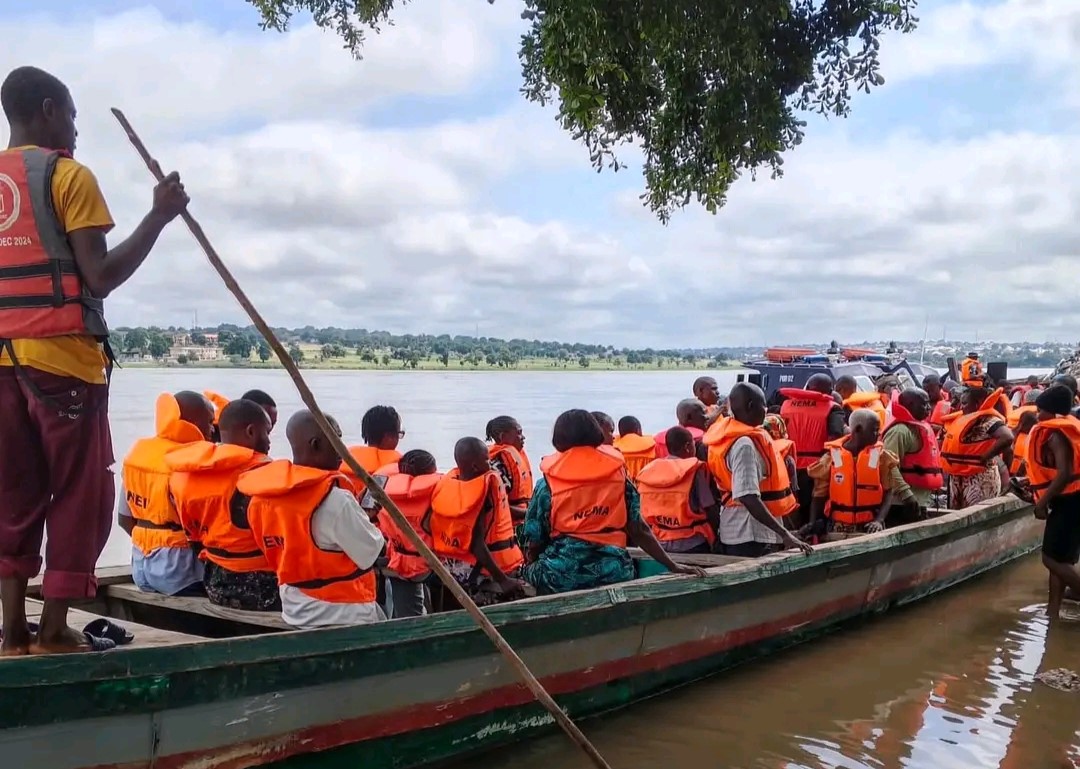
According to the National Emergency Management Agency (NEMA), over 5.2 million people were affected by floods in 35 states in 2024, with more than 1,200 lives lost.
Beyond the flood
For Ms Tavershima, farming challenges go beyond one flooding event.
Moving around the farm is already hard because of her disability, but climate events often make it worse. During the rainy season, wet and muddy areas can make movement impossible, forcing her to hire people to carry her.
“The least I pay is N2,000 for someone to carry me. The other time I paid a guy N5,000 to carry me around, but the work was too much, and he even got tired. They brought a wheelbarrow halfway. We crossed the water, and when we reached another flooded part, he carried me again,” she said.
Ms Tavershima was also given a government-supported farming site in Bamada, Benue State, where boreholes were provided for dry-season farming. But insecurity in the area stopped her from making full use of the opportunity.
Besides flooding, extreme heat is another issue. She said high temperatures cause discomfort, reducing the time she can spend on the farm. The heat also lowers crop yields, leading to financial losses.
“Apart from our environment not having workable systems, global warming is doing a lot,” she said.
She pointed out that many local farmers still use traditional farming methods even as changing weather calls for new approaches.
“These local people insist on local seeds. I use hybrid seeds and fertilizer. Anything hybrid, if you don’t use fertilizer, you won’t get results,” she said.
“Because of global warming and these changes, their farms are no longer yielding. They now see your own farm as an escape route because they live there and visit your farm regularly. Some end up stealing from you.”
She believes that many farmers refusing to adapt to changes are making food insecurity worse in their communities.
“All these things fail because they won’t heed advice. When the effects of global warming take place, everybody is at a loss. They have land, but they are getting hungry because they are refusing to adapt to the environmental changes that are coming.”
When climate shocks become financial crises
The losses from flooding were not just a one-time issue. Successive farming seasons pushed Ms Tavershima deeper into debt and made her rethink her future in agriculture.
She remembered losing about N4 million after a failed farming season in 2022. She hoped to recover by investing again, but the returns never came.
“This year again, I cultivated three hectares and spent over N1 million. I didn’t get anything in return,” she said.
According to her, the repeated losses have hurt not only her farming but also her food-processing business, which relies on farm produce.
She planned to use money from farming to buy processing equipment and lessen her dependence on contract manufacturers. Instead, she struggles to keep both businesses going.
“The main reason for my insistence on farming was to get enough money to buy machines for my processing business,” she said. “But every year, I go deeper into debt.”

Ms Tavershima currently has two NAFDAC-certified products but says a shortage of raw materials and working capital has forced her to stop production for months.
“Since last December, I haven’t sold any processed products because I don’t have the money to buy raw materials,” she said.
After years of losses, she decided to cut back on farming and focus on processing.
“I officially quit. It’s not worth it anymore,” she said.
Getting credit has also been hard. She thinks financial institutions don’t want to lend to farmers because of agriculture risks and are even less willing to help farmers with disabilities.
“They will inspect the farm, ask you to open accounts and meet all the requirements, but in the end, nothing happens,” she said.
Similar experiences, different realities
Theresa Odu, a farmer in Abuja, said she lost her vegetables repeatedly in 2023 and 2024.
“Between March and April of 2023 and 2024, the weather was very hot, my vegetables were dying,” she said.
She began watering the vegetables using a hose, but it was not effective. “It takes a long while to water with a hose,” she said.
Another farmer, Dorcas Taarzor, also talked about changing weather patterns.
“We expected rain from April or May, but up till now nothing. We usually plant rice by April or early May. For the three-month variety, by August, you should be harvesting. But we can’t harvest it by August because the weather is really changing things.”
Like Ms Tavershima, Ms Taarzor has also faced losses from flooding.
“Last year and two years back, my three hectares rice farm were all flooded. It was a big loss. My maize farm was also affected last year. Two hectares lost.”
Adapting to changing climate
With rising temperatures and unpredictable weather, some farmers are changing their farming methods.
Mrs Odu turned to irrigation in 2025, after losing vegetables to extreme heat.
“I spent about N10 million. To go into this drip irrigation system, you need a borehole, solar, and other accessories.”
For Ms Taarzor, adaptation means changing planting schedules and choosing crop types that can better handle floods.
“The flood normally comes by September, so I plant very early, especially if it is maize, so that before September, I harvest. For rice, I plant a variety that I can harvest at that time, too. Some varieties of rice can withstand floods. It is called Odo-Odo. We’ve tried to adjust our planting date and all that,” she said.
Little or no support
The women interviewed had different experiences with support from government and development programs.
Ms Odu has never benefited from any support, but Ms Taarzor was part of projects backed by GIZ and the Federal Ministry of Agriculture.
“After my service, I was recommended. I did a program with FMARD (Federal Ministry of Agriculture and Rural Development). I applied for the N-Power program and I was shortlisted. I was among the enumerators of farms. We go to your farm, we capture you and all that.
“Based on my performance, I was recommended by the Benue office when this company came and said they needed extension agents to help farmers with mechanization.
“They recommended me based on my performance in agriculture. I’ve trained farmers for over four years on good agricultural practice under GIZ. They give you a machine to render services to people on their farms. I’m here in Agasha helping other farmers with mechanization.”
Ms Odu’s experience was frustrating.
“I’m a member of the Poultry Association of Nigeria, Abuja chapter. They asked us to open an account with either Bank of Industry or Bank of Agriculture. We paid either N5,000 or N10,000. Up till today, I have not received my account number, not to talk of a loan.”
Policy gaps
Nigeria has policies to improve women’s participation in agriculture and strengthen climate resilience. The Revised National Gender Policy in Agriculture (2025, 2030) identifies women and persons with disabilities as priority groups for agricultural support and climate adaptation.
Yet the experiences of the women interviewed show a gap between policy intentions and what is happening on the ground.
Government response
Responding to concerns about climate change's impact on women farmers, a gender specialist at the Federal Ministry of Agriculture and Food Security (FMARS), Wasiu Oyeleke, said the government is implementing climate-smart agriculture programs for vulnerable groups, including women and youth.
Mr Oyeleke said the ministry, along with the Nigerian Meteorological Agency (NiMet) and development partners like the World Bank, provides farmers with seasonal climate forecasts and early warning information to help them prepare for droughts, flooding, and changing rainfall.
He added that government programs are also promoting drought-resistant and pest-resistant crop types. According to him, the ministry is currently supporting farmers through the Korea-Africa Food and Agriculture Cooperation Initiative (KAFACI), which encourages climate-smart agriculture and drought-tolerant rice varieties to boost yields and improve food security.
What needs to change?
Environmental researcher Ebere Akwuebu said many women farmers already have local knowledge to identify climate-related risks and disasters.
She believes government actions need to be more targeted and responsive to local realities.
According to her, the government should create toolkits tailored to the specific climate challenges women face in different regions and improve awareness around early warning systems.
She pointed out that climate impacts differ by region, with erosion and flooding more common in southern Nigeria, while drought and water scarcity are serious issues in northern areas due to their closeness to the desert and the shrinking Lake Chad Basin.
Ms Akwuebu also highlighted insecurity as an emerging challenge that worsens the effects of climate change on rural livelihoods.
“The government should enhance awareness-raising on early warning systems,” she said, adding that adaptation measures must reflect the realities and needs of women in various communities.
A delayed rainy season in 2026 pushed the planting cycle back to late April and May, leaving rural communities vulnerable to seasonal floods. For female farmers, these changes lead to an immediate economic downturn.
New beginning
After years of dealing with floods, heatwaves, crop losses, and growing debt, Ms Tavershima is planning her next steps.
She wants to move to Enugu to focus on food processing. For now, she travels between Nasarawa and Benue states for her farming activities. For her, adapting now means starting over.
Drop your comment
No comments yet — be the first to drop the gist 👇