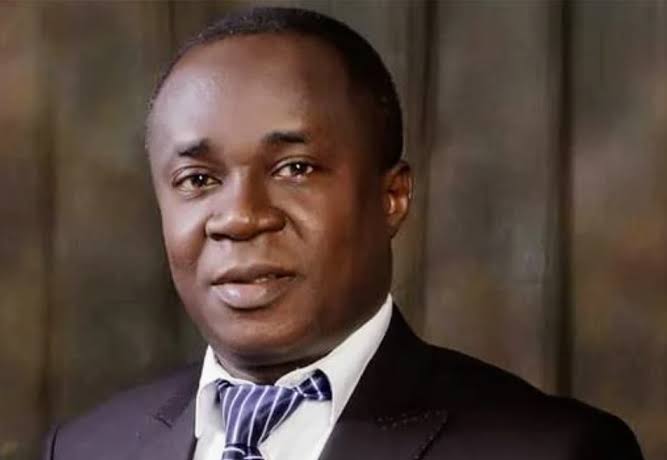
Uche Uwaleke, an expert in the economy and capital markets, wants the Federal Government to change its cash transfer program.
Mr Uwaleke, who is a professor and the President of the Capital Market Academics of Nigeria (CMAN), shared his thoughts in an interview with the News Agency of Nigeria (NAN) in Abuja.
He stated that the cash transfer program, which is one of President Bola Tinubu’s main efforts to reduce poverty, needs a major redesign to boost transparency and public trust.
The expert believes this program can help provide temporary relief and protect vulnerable families from serious economic issues.
But he said its success relies on identifying beneficiaries correctly, ensuring payment integrity, providing enough transfer amounts, and being able to track the results.
Mr Uwaleke pointed out that a program where beneficiaries are not verifiable risks leaving out deserving families and opens the door for misuse, which can damage public trust.
"I recommend that the government should replace the existing approach with a more transparent, independently verifiable and better targeted social protection framework."
He added that there should be a strong social register that is regularly updated and linked to reliable data from relevant government bodies, with appropriate privacy protections.
"Community-based verification should complement digital identification to ensure that people in remote and underserved communities are not excluded," he noted.
He also suggested a payment system that allows tracking, alongside easy ways for people to voice complaints and regular assessments of the program's impact.
Addressing Food Production
On food production, Mr Uwaleke urged the government to revive the Directorate of Food, Roads and Rural Infrastructure (DFRRI) program.
He believes this revival would help tackle challenges affecting food production, rural access, and basic infrastructure across Nigeria.
According to him, national development cannot happen if investment is only focused on big cities.
He pointed out that rural areas, where much of Nigeria’s food is produced, need better connections to markets and essential services.
Mr Uwaleke explained that the goal of the program is to bring development closer to rural areas by focusing on food production, rural access, and infrastructure.
He stated that a renewed DFRRI program should not repeat past mistakes but should be designed as a community-focused initiative for rural productivity and infrastructure.
The initiative should involve the federal, state, and local governments, with clear accountability and measurable outcomes.
He emphasized that these commitments must become part of a coordinated national agricultural productivity program with clear targets, responsibilities, and funding.

"Its priorities should include feeder roads, small-scale irrigation, rural electrification, water supply, produce aggregation centres, storage facilities, primary healthcare access and market infrastructure."
This program can boost grassroots development by linking farming communities to markets, cutting transportation costs, improving access to agricultural inputs, and creating jobs through rural projects.
Mr Uwaleke said the focus should be on increasing output per hectare, boosting multiple cropping, improving yields, cutting post-harvest losses, and strengthening links between farmers, agro-processors, and local markets.
He added that this program would help ensure that economic recovery reaches communities that have missed out on national growth.
"The focus must be on functional infrastructure and productive assets rather than politically distributed projects that have little lasting economic value," he said.
Energy and Infrastructure Challenges
Mr Uwaleke pointed out that beyond agriculture, the cost of energy remains a big issue for local production.
He noted that manufacturers, small businesses, and service providers face high costs because of unreliable electricity and dependence on alternative energy sources.
The CMAN president stressed that expanding gas infrastructure, renewable energy, embedded generation, and reliable grid supply must be key parts of the government's agenda for prosperity.
He said lowering energy costs would help improve industrial competitiveness, promote local production, reduce reliance on imports, and create job opportunities.
"The same logic applies to transportation and logistics."
He believes that finishing important roads, railways, ports, and logistics infrastructure should be prioritized based on their economic benefits and ability to lower transportation costs.
"A well-connected agricultural or industrial production center can create much more economic value than an isolated project with few connections to productive activities."
Mr Uwaleke stressed that infrastructure investments should be judged not just on how much is spent or how many kilometers are built but also on how they contribute to productivity, trade, and jobs.
He added that Nigeria needs a clear plan to boost local manufacturing, strengthen agro-processing, develop industrial clusters, and support the production of goods where the country has an edge.
He noted that achieving this requires more than just incentives and policy announcements.
It needs reliable energy, efficient ports, affordable long-term financing, predictable taxes, effective trade facilitation, and a stable regulatory environment.
Mr Uwaleke also called for better coordination between fiscal and monetary authorities.


Drop your comment
No comments yet — be the first to drop the gist 👇