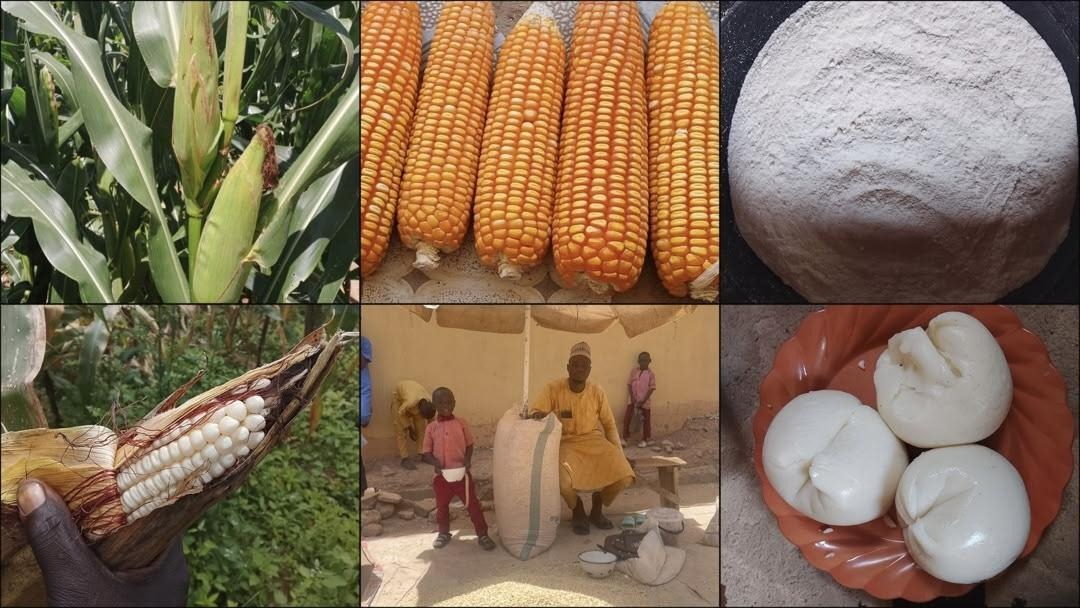
As the sun began to set in Bichi, Kano State, Hauwa Saminu opened a sack of maize she bought at the local market that day.
Buying maize is something she does often. She carefully checked the grains before picking the best ones and negotiating prices. The maize is taken to a milling shop and cooked at home to make tuwo, a dish her family of 12 enjoys for dinner, usually with Miyan kuka, and sometimes for breakfast the next day.
Hauwa has no idea if what she bought is the traditional maize she has eaten for years or the new genetically modified TELA maize.
"I always buy maize. Nobody has ever told me whether it is TELA maize or conventional maize," she said, pausing as if she just heard the name for the first time.
She mentioned that she buys 10 mudu, about 2.4 kg, each week for N900 to N950 per mudu.
Hauwa's experience is similar to many Nigerians.
Over 13 months, from June 2025 to July 2026, I traveled through Kano, Kaduna, and Niger states. I traced TELA maize from research labs and demonstration farms to grain markets, milling shops, roasted maize sellers, and family kitchens.
But what is TELA maize, and do Nigerians know what they are eating?
To find out, PREMIUM TIMES spoke to regulators, scientists, seed companies, farmers, grain traders, processors, consumers, nutrition experts, and biotech critics. We also looked at regulatory documents and scientific assessments to follow the crop's journey from lab to table.
What we found is a story that goes beyond science. It raises issues about transparency, consumer awareness, and Nigerians' right to make informed choices.
From pest problem to scientific answer
Maize is a key food in Nigeria. It is eaten daily in many ways, like tuwo, pap, and roasted corn. Millions of farmers rely on it for their income. But for years, two big problems have threatened maize farming: long droughts due to climate change and the fall armyworm (FAW).
FAW was first found in Nigeria in 2016. It spread quickly, ruining farms and forcing farmers to spend heavily on pesticides while still facing major losses.
The Federal Ministry of Agriculture and Food Security (FMAFS) warns that FAW can wipe out an entire maize field if not controlled, putting food production and farmers' income at risk. Local maize production is about 10.5 million metric tonnes yearly, while demand is around 15 million tonnes. The ministry says pests like FAW can cause losses of up to 70 percent.
Scientists believed that biotechnology could help solve this issue, leading to the TELA maize project.
The TELA maize project is a research initiative involving multiple countries, led by the African Agricultural Technology Foundation (AATF). They partnered with the International Maize and Wheat Improvement Centre (CIMMYT), Bayer Crop Science, and national agricultural research institutes in Nigeria, Kenya, Ethiopia, Mozambique, and South Africa.
The Bill & Melinda Gates Foundation and the United States Agency for International Development (USAID) fund the project. They support developing drought-resistant and insect-resistant maize for smallholder farmers in sub-Saharan Africa.
In 2019, a collaboration agreement allowed AATF, CIMMYT, and Monsanto, now part of Bayer, to commercialize TELA maize technology across Africa. AATF received a royalty-free license to manage this process according to national regulations.
The TELA maize project is based on over a decade of research from the Water Efficient Maize for Africa (WEMA) project. According to AATF, "TELA" comes from a Latin word meaning protection, highlighting the crop's ability to defend itself against pests and endure drought.
TELA maize has a Bt gene from Bacillus thuringiensis, a soil bacterium that produces proteins targeting pests like FAW and stem borers.
Muhyideen Oyekunle, from the Institute for Agricultural Research (IAR), said these proteins harm the pests' digestive systems when they eat the plant, protecting it from damage. The drought-tolerance trait helps the crop survive during dry spells.
In Nigeria, IAR developed this technology at Ahmadu Bello University in Kaduna, working with AATF.
While scientists worked on TELA maize for many years, questions about how much Nigerians know about this technology and the food they consume remain.
Nigeria’s path to commercial farming
TELA maize went through years of research and assessment. The National Biosafety Management Agency (NBMA), Nigeria's regulator for genetically modified organisms (GMOs), evaluated the crop and found it safe for both people and the environment.
Hauwa Ahmed, a director at NBMA, said the crop underwent thorough checks.
"The approval of TELA maize followed a strict, multi-stage biosafety risk assessment as per the NBMA Act and Nigeria's commitments under the Cartagena Protocol on Biosafety," Mrs Ahmed told PREMIUM TIMES.
She added that researchers conducted years of Confined Field Trials (CFTs) in Nigeria to gather data, assess environmental risks, and check possible effects on non-target organisms before seeking commercial release.
Public participation was part of the regulatory process. The agency published notices in three national newspapers and made application documents available for public comments for 21 days. The National Biosafety Committee and National Biosafety Technical Sub-Committee reviewed the scientific documents and made recommendations.
In October 2021, NBMA granted IAR permission to release TELA maize after assessing factors like molecular characterization, toxicology, allergenicity, nutritional equivalence, environmental risks, and comparisons with conventional maize. Socio-economic factors were also considered.
"The pre-approval risk assessment ensures that all potential risks are identified and management strategies suggested before approval for commercial release," Mrs Ahmed said.
The assessment drew from experiences in countries like Argentina, Brazil, Canada, China, Japan, and South Africa, as well as EU member states.
Trials were conducted in various ecological zones in Nigeria before the National Committee on Naming, Registration and Release of Crop Varieties, Livestock Breeds/Fisheries reviewed them.
On 11 January 2024, the committee officially approved four varieties in Nigeria: SAMMAZ 72T, SAMMAZ 73T, SAMMAZ 74T, and SAMMAZ 75T.
Mr Oyekunle explained that SAMMAZ refers to "Samaru maize," named after the institute's location in Samaru, Zaria. The numbers identify the varieties, while the letter "T" shows they are TELA varieties.
Though the four varieties have the same biotechnology traits, they vary slightly in adaptation zones, plant features, and yield potential. They are recommended for different agro-ecological zones like Guinea savannah, Sudan savannah, and rainforest zones, with potential yields of about 9.4 to 10.4 tonnes per hectare under good farming practices.
The developers see this technology as a tool to improve food security, cut pesticide use, and help farmers adapt to climate change.
The federal government launched TELA maize in 2024 to promote its adoption across Nigeria.
According to NBMA, FMAFS manages agricultural policies and deployment for TELA maize in Nigeria, including adoption and support programs for farmers. The NBMA oversees biosafety approval.
I contacted the Federal Department of Agriculture to clarify its role in the TELA maize program and the government's stance on its adoption.
An anonymous official said the ministry does not independently approve GMOs. Instead, it creates a supportive environment for agricultural technology.
He mentioned that the ministry looks at findings from IAR and other research agencies to see if a technology fits agricultural policy.
Meanwhile, NBMA handles GMO regulatory approval, and the National Agricultural Seeds Council certifies varieties for seed multiplication. The official noted that TELA maize's resistance to FAW, stem borers, and drought could boost production and help with Nigeria's food supply gap.
On adoption, he said more farmers are using TELA maize as Agricultural Development Programs (ADPs) educate farmers with demonstration plots to compare TELA with conventional varieties. But he pointed out that seed availability and affordability are major issues. He stressed that farmers need to follow recommended farming practices, like proper spacing and nutrient application, to get good yields.
Data from AATF shows that around 8,000 to 10,000 farmers planted TELA maize in the 2024 season. This number does not include farmers who saved seeds for future planting.
Kaduna, Kano, and Niger had the most farmers, with about 1,800 in Kaduna, 1,500 in Kano, and 1,200 in Niger. Benue had around 1,100, and Katsina about 1,000. Other states, including Kwara, Oyo, Ogun, Edo, Delta, Nasarawa, and the FCT, had about 3,400 farmers combined.
Muhammad Yahaya, a plant breeder at IAR, said developing TELA maize took over a decade.
"The development of TELA maize took more than a decade, around 10 to 15 years."
This process involved discovering genes, laboratory work, confined field trials, multi-location trials, and regulatory checks on toxicity, allergenicity, nutritional equivalence, and environmental risks.
The trials covered areas like Kaduna, Kano, Niger, and Jigawa.
Mr Yahaya mentioned that post-release monitoring is crucial because regulators and researchers continue to check field performance, environmental impact, farmer experiences, and adherence to stewardship requirements.
"Commercial release includes ongoing responsibilities," he said, adding that biosafety is "an ongoing process, not just a one-time event."
While regulators say the crop is safe and more farmers are adopting it, another question remains: After leaving research stations and demo farms, who eats TELA maize? Do Nigerians know they are consuming it?
Tracking the seed
Agric Seed Care Limited is a licensed distributor of TELA seeds through AATF.

Mr Ochoche, the CEO of the company based in Hotoro, Kano, said TELA seeds were initially imported into Nigeria. This delay meant farmers missed the first planting season in 2024. By the time the seeds arrived, many farmers had already planted other crops. He noted that the situation has improved, as seeds are now produced locally.
Mr Ochoche recalled that TELA maize seeds sold for as much as N9,500 per kilogram during the first two years. Now the price has dropped to between N4,500 and N7,000 per kilogram.
For conventional hybrid maize seeds, the current price is between N1,200 and N1,500 for a two-kilogram pack in many areas, he said.
Nagari Seed Company Limited in Kaduna, another licensed producer and distributor of TELA maize seeds, also multiplies foundation seeds into certified seeds for farmers. Marketing manager Tachio Boman told PREMIUM TIMES that the seeds are produced in two stages: foundation and certified.
He explained that the foundation seed was initially imported from South Africa while local production systems were being set up. Now, EcoBasic Seed Company works with IAR to produce seeds locally for certified multiplication and supplies them to licensed Nigerian seed companies, including Nagari. The certified seeds are distributed to farmers through AATF channels.
AATF Hybrid Seed Market Development Manager Olawale Ojo said the organization uses a licensing system with qualified Nigerian-owned seed companies.
AATF, along with EcoBasic Seed Company Limited, sub-licenses TELA maize hybrids to qualified seed companies, including Agric Seed Care Limited, Nagari Seed Company Limited, Premier Seed Nigeria Limited, Techni Seed, Chinmade Nigeria Limited, Da-Allgreen Seeds Limited, Lifted Agro Limited, Boom Seed Limited, GoldAgric Nigeria Limited, Ingachi Seed Company Limited, Mastrotun Global Limited, and Beta Seed Company Limited.
Once seeds entered Nigeria’s farming system, misinformation started spreading.
“There were many rumors. Some believed the maize was brought to harm Africans. Others claimed crops would never grow again on land where TELA maize was planted," Mr Ochoche remembered.
To fight misinformation, AATF and FMAFS created demonstration plots where farmers could see the crop and learn about cultivation and stewardship practices.
Mr Ojo said these plots and training helped clear up many concerns.
"People are often scared of what they don't understand. Once farmers see the crop and ask questions, many myths fade away," Ojo said.
He added that certified TELA maize seeds carry National Agricultural Seed Council certification tags, QR codes, and SeedCodex authentication to reduce counterfeiting.
Salisu Buhari, an official with Kaita Agricultural Multipurpose Cooperative Society in Kano and an agro-dealer, said members learned about TELA maize at a 2024 stakeholders meeting organized by Kano ADPs and FMAFS.
He explained that only a small number of farmers received the seed at first because commercial quantities were not ready. Distribution grew in 2025 through demonstration plots in communities like Bichi and Bagwai LGAs in Kano State.
Mr Buhari said TELA maize started appearing in local grain markets, though it still made up a small part of maize sold.
"The biggest challenge now is availability and affordability. Many farmers want the seed, but they don’t know where to buy it, and when they do find it, it's expensive," Mr Buhari said.
Farmers see better yields, fewer pests
Abdullahi Muhammad, a farmer in Bichi Local Government Area of Kano State, was among the first to plant TELA maize.
He farms almost one hectare and has worked as an extension officer for over 20 years.
“I asked many questions because they told us from the start that it was genetically modified,” he said.
“After the explanations, I was satisfied.”
He planted TELA maize in 2025 and again in June 2026.
He received training on planting methods, spacing, fertilizer use, and stewardship practices.
He found the crop resistant to FAW and stem borers, needing less pesticide treatment.
“Conventional maize suffers heavy pest attacks, but with TELA maize, we hardly needed pesticides for fall armyworm,” he explained.
With good management, he estimates that TELA could yield between 80 and 100 bags per hectare, compared to 40 to 60 bags for conventional maize.
His 2025 harvest was below expectations due to poor rainfall, which he blamed on the weather, not the seed.
He later planted cowpea on the same land, which thrived. He dismissed claims that TELA seeds harm the soil.
Mr Muhammad has trained other farmers, including 363 in Bichi through AATF programs.
But he pointed out that awareness is still a big hurdle.
“Whenever a new farming technology comes out, people are usually scared of it. That is why we need more education,” he said.
His family has eaten TELA maize since 2025, including roasted and boiled maize and Tuwo, without any health issues, contrary to claims made about the seeds.
Seed cost is still a concern. TELA seeds cost about N4,500 to N7,000 per kilogram, while conventional seeds are about N1,500 for a two-kilogram pack.
Other farmers in Kano, Kaduna, and Niger also reported better harvests, fuller cobs, less pest damage, and drought tolerance, though experiences varied.
Cost and availability are common worries.
Tajudeen Gambo, a farmer in Marke village, Makarfi Local Government Area of Kaduna State, said he saw better yields after planting TELA maize.
He has farmed for around 15 years. He planted TELA from the AATF program on roughly 0.3 hectares in 2025 and used fertilizer from the program.
“I got a better yield with my TELA maize,” he said.
He wanted to plant TELA again in 2026 but lost access to his rented farm.
He also expressed concerns about the seed's cost and availability.
“People worry about the seeds' marketing monopoly, that farmers must buy seeds every year at a high price. Other than that, I do not have any issues with TELA maize,” he stated.
In Niger State, Tamiru Danbaba planted TELA maize for the first time.
He noted that the crop survived a long dry spell in July while nearby farms suffered losses. He estimated his harvest was about 25 to 30 percent higher than expected under similar conditions.
“It's a relief to see a crop that doesn’t get destroyed.”
Mariya Lawal, a farmer in Bagwai LGA, Kano State, and Ismail Ibraheem in Zaria, Kaduna State, also reported better harvests.
Ms Lawal said TELA produced fuller cobs, larger grains, and more flour.
Tamatu Idi, a small-scale farmer in Kano, said her TELA maize withstood a two-week dry spell.
But farmers like Ms Lawal and Mrs Idi continue to express concerns about seed costs.
In response to these concerns, an official from the Federal Department of Agriculture said the government is working to increase seed production, including through subsidies.
The official added that more investment could boost supply and lower prices.
After the 2025 harvest, TELA maize began to spread beyond farms.
It started moving through grain markets, flour mills, and food vendors, eventually reaching Nigerian homes.
This investigation is in two parts. The second part will look at how TELA maize gets to consumers and if they have enough information about what they are buying.




Drop your comment
No comments yet — be the first to drop the gist 👇