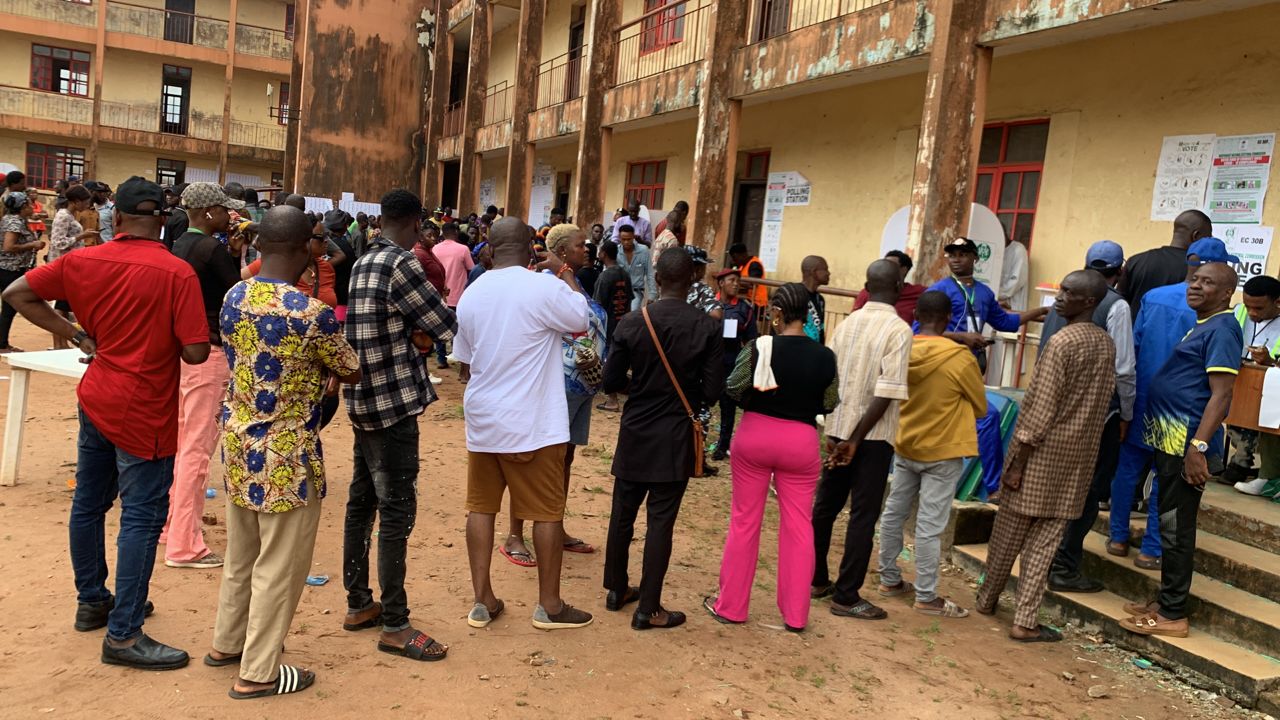
The Independent National Electoral Commission (INEC) has revealed that some of its registration officials misused their access to create fake voter records. These included profiles with false pictures and changed biometric details.
Lawrence Bayode, the Director of ICT at INEC, said he is gathering evidence against the officials involved. He plans to submit his findings to the commission for review and possible punishment.
Mr. Bayode spoke on Channels Television’s Politics Today on Sunday. When asked about the extent of the issue, he said, “It’s bad.” He added, “I’ve seen what they did, and it’s horrible.”
During the 2026 Continuous Voter Registration (CVR) exercise, over 11 million people registered. When INEC checked these records using its Automated Biometric Identification System (ABIS), around 1.5 million were marked as suspicious. Out of these, 1,277,252 were confirmed invalid and removed before releasing the preliminary register. This left about 268,000 records that still need checking.
“The business rule of the ABIS is that you don’t remove any suspect. Any suspect has to be adjudicated,” he explained. This means flagged records must be reviewed by people before any decision is made.
Some suspicious records had AI-generated pictures or images taken from calendars. “You use a fake camera to deceive the system because it is a web-based application,” he said.
In other cases, the same photo showed up on multiple voter profiles. This pattern raised alarms about the honesty of the registrations. “You cannot find seven, eight people, even if they are from the same family,” he said.
Mr. Bayode warned against assuming that every altered photo by artificial intelligence is a sign of fraud. Some applicants used phone apps that automatically enhanced their pictures when they registered online. He said these voters would not be excluded just for that reason. “You can’t exclude such a person, because it was the AI on the phone that did that,” he added.
Some officials also misused their login details to create the questionable profiles. One method involved taking advantage of a special registration option for people with disabilities who lack all their fingers. Allegedly, these officials registered fake individuals by claiming they had no fingers, allowing the system to accept their records without the usual fingerprint details.
“They went through the special registration, capturing without fingers, pretending that this person has no fingers,” he said. The ABIS flagged these records because it found faces without matching fingerprints.
Mr. Bayode noted that INEC faced similar problems during the 2023 voter registration but not as severely as this year. He mentioned that the rise of AI has made it harder to spot these cases. “We saw things like this, but not to this extent. AI has not evolved then. AI is evolving now,” he said.
When asked if outsiders were involved in the registration issues or if the officials acted alone, Mr. Bayode said he could not confirm how the scheme was set up. He mentioned the irregularities were found in some states but not nationwide.
He also ruled out the idea that the officials could escape blame by claiming their login details were stolen. “You can’t even say that to the commission now, because before you use this system, that system must send an OTP to your email or your phone number,” he said. This means if anyone used their login, it suggests they were in on it.
Mr. Bayode said INEC has taken back access from the implicated officials. The CVR exercise has also ended. He has not yet submitted his report to INEC because he wants to make sure the evidence against the officials is solid.
“You don’t just go and implicate somebody. You need to have watertight evidence,” he said. He also mentioned that the commission would look over the findings and decide what to do based on proper procedures.
Mr. Bayode suggested the officials might face tougher penalties than those given to staff involved in similar issues in 2023. “Because of this great embarrassment, maybe the punishment now will be bigger than what they experienced,” he said.


He acknowledged that the situation has hurt public trust in the commission. “The trust is on ground zero,” he admitted.
The commission released the preliminary register with some suspicious records still included because the biometric screening took longer than expected. The deadline for finishing the exercise was approaching.
INEC had planned to release the register on October 6 but pushed it to October 9 as they continued screening the records. “We didn’t calculate very well the time it would take to run this ABIS,” he noted.
He explained that the commission had to balance completing the screening with its legal responsibilities under the Electoral Act. The law requires a seven-day public display of the preliminary register, followed by 14 days for claims, objections, and corrections.
Mr. Bayode said holding back the register could also lead to legal issues. “There’s actually a criminal aspect to it,” he said. He added that the commission must avoid mistakenly removing eligible voters whose records were flagged.
“I need to confirm before you go and exclude an eligible voter,” he said. INEC plans to release the final certified register on December 15, according to Mr. Bayode.
He also defended the Bimodal Voter Accreditation System (BVAS), which will check voters at polling stations on election day. “The facial is there. The safeguard is already there. It will not allow you to cast your vote on the day of election,” he said.
Mr. Bayode explained that BVAS will use facial verification to check voters’ identities, making it hard for those with fake registrations to vote.
When asked if an independent body could check the register, Mr. Bayode said INEC would make that decision. “If the commission decides to bring a third party to scrutinise, then they can bring them,” he stated.
He added that Nigerians could ask for certified true copies of the register to see how the commission is operating. On removing deceased voters, Mr. Bayode said INEC would act based on reliable evidence. He mentioned that states were already sending in names of deceased individuals, just like they did during the 2023 exercise.
He also said the commission postponed a planned voter revalidation exercise until after the elections because they worried it might disenfranchise eligible voters.
Addressing concerns from the technical issues that affected the 2023 elections, Mr. Bayode said INEC has fixed the results-upload system and is planning a larger mock exercise before the next election.
“We have done all that we need to do humanly, and we have committed everything to God,” he said. He urged Nigerians to keep faith in the commission’s efforts to run credible elections. “I can assure Nigerians that the commission is trying its best to conduct a credible election,” he said.
The controversy over the voter register arose in October 2026 after INEC uploaded its preliminary register online. Nigerians who checked the portal found several problems, including duplicate entries, names of deceased individuals, and photographs that seemed to have been created by artificial intelligence.


Drop your comment
No comments yet — be the first to drop the gist 👇