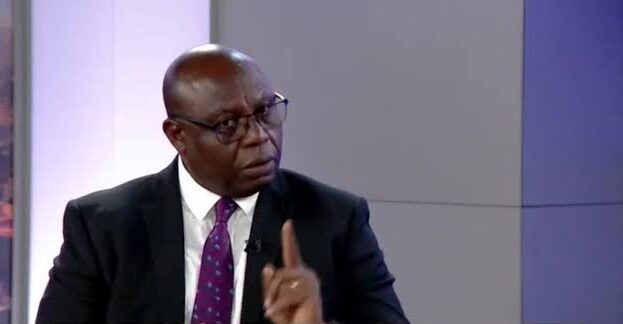
Former National Commissioner of the Independent National Electoral Commission, Festus Okoye, on Tuesday, explained the difference between sending election results for collation and uploading polling unit results to the INEC Result Viewing (IReV) portal.
Mr Okoye spoke on Channels Television’s Morning Brief. He urged INEC to educate the public about this difference ahead of the 2027 general elections.
He emphasized that better education about key parts of the electoral process is necessary to avoid confusion as Nigeria approaches its general elections.
“So I think that the commission should do a lot to educate people aggressively on some of these issues because failure to understand these provisions could fuel confusion about the electoral process,” he said.
According to Mr Okoye, section 60(3) of the Electoral Act 2026 talks about electronic transmission to IReV, while section 60(5) addresses results transmission for collation.
INEC introduced the IReV technology in 2020 to improve transparency. It was first used during the general elections in 2023.
But many polling unit results were not uploaded on time, going against INEC’s promise. A lot of results came in after election day, after INEC declared President Bola Tinubu the winner.
INEC later said the system had a glitch that caused the delays. This explanation did not convince many Nigerians who suspected that INEC manipulated results to favor the ruling All Progressives Congress. Two main presidential candidates, Atiku Abubakar of the Peoples Democratic Party and Peter Obi of the Labour Party, challenged the election result up to the Supreme Court, which confirmed Mr Tinubu’s victory.
Three and a half years after the election, INEC still struggles with the trust crisis from the 2023 IReV delays. Mr Okoye, who served as INEC commissioner during the IReV introduction and the 2023 crisis, said that IReV results are meant for transparency, while results for collation come from presiding officers and assistant presiding officers.
These officers send results to the next level where collation officers check the original Form EC8A from each polling unit. He added that collation officers review the results on the physical forms and settle any discrepancies.
Mr Okoye held office as INEC commissioner from July 2018 to August 2023, shortly after the 2023 elections. He said the distinction between the two processes is vital for public understanding of elections. He urged INEC to explain the legal provisions more clearly.
Looking back at the 2023 elections on Monday, Mr Okoye noted that technical issues impacted the real-time uploading of presidential election results.
He mentioned that INEC was ready for the election and that uploading results for the House of Representatives was going well until problems arose with the presidential results.
“Technology can malfunction at any time. Technology can disappoint you,” he said.
He pointed out that the main issue was that presidential election results were not uploaded in real-time, not that they were not uploaded at all. This perception created a credibility issue for the election.
Mr Okoye confirmed that the results were eventually uploaded. He stressed that the situation showed the need to differentiate between electronic publication of results and the collation process.
When asked if the problem was the law, Mr Okoye said Nigeria’s electoral challenges cannot be solved just by making new laws. He explained that political actors who benefit from electoral manipulation do not want free and fair elections.


“The law alone cannot conduct elections. Even if we amend the law 100 times, it may not conduct elections. The human element is also very important. It is very, very fundamental,” he said.
He said the Electoral Acts of 2010, 2022, and 2026 could help conduct credible elections, but they depend on how political actors behave.
Mr Okoye expressed concern that “what is missing is that at each point, those who benefit from election rigging and election manipulation want to manipulate the process.”
He noted that political parties often do not campaign on clear ideas and instead focus on making sure voters’ choices do not count.
He said that vote-buying has become more advanced. Drawing from his experience watching the Ekiti and Osun governorship elections, he explained that vote-buyers now use methods to track how voters cast their ballots.
“They have gone digital, they have upgraded their act, they have optimized the way they do vote-buying,” he said.
Mr Okoye noted that those involved try to position voting booths so they can see how voters mark their ballots before telling them to collect money.
He pointed out that he has not seen anyone prosecuted for vote-buying in the two elections, even with security agents present.
He called on Nigerians, the media, and civil society groups to look beyond INEC when judging the credibility of elections. He argued that political actors also share the blame for electoral failures.
“INEC has paid staff, but they are limited to polling units. The poll workers include corps members and students of tertiary institutions, university lecturers and professors, and government workers,” Mr Okoye said. “Elections are a multi-stakeholder venture.”
The Electoral Act 2022 was repealed and replaced by the Electoral Act 2026, which President Bola Tinubu signed in February. This followed weeks of controversy over electronic transmission of election results and protests at the National Assembly.
Initially, the Senate rejected a proposal for mandatory real-time electronic transmission of results to IReV, leading to protests from civil society groups and others.
After more discussions, the final law allowed for electronic transmission but included a fallback: if electronic transmission fails, the signed Form EC8A is the main source for collation and declaration of results.
Mr Okoye’s call for INEC to educate voters about the law and results processing comes as the preparations for the 2027 general elections are underway.
INEC’s new timetable sets the presidential and National Assembly elections for 16 January 2027, with governorship and state assembly elections on 6 February 2027. Campaigns for the presidential and National Assembly elections have already started.
Drop your comment
No comments yet — be the first to drop the gist 👇