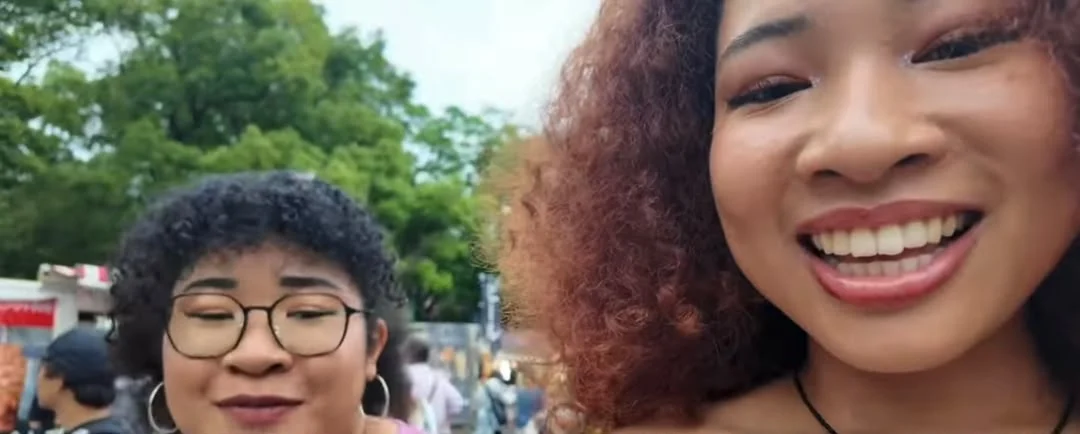
Popular Nigerian-Japanese content creator, Katy Igwe, also known as Ada Igbo, has received a lot of praise online after sharing a video of her chatting with another Japanese-Igbo woman who speaks fluent Igbo. Many social media users were surprised by their conversation.
The vlog was shared on YouTube on Thursday and spread across various social media platforms. It quickly gained thousands of views and positive comments. Many people praised the two women for keeping their Igbo culture alive despite growing up in Japan.
Igwe, who comes from Oguta in Imo State but lives in Tokyo, Japan, makes content about cultural exchange, fashion, and blending Nigerian and Japanese lifestyles.
In the video, Igwe attended an African and Caribbean festival in Japan. There, she met another woman who called herself Ada Amaka from Imo State.
When Igwe asked if she could speak Igbo, Ada Amaka replied in Igbo, "Yes, I speak Igbo. I even prepare cassava."
Ada Amaka also shared that even though she has Japanese roots, her father insists she should proudly say she is Igbo when she visits Nigeria. "You know, my dad, he doesn’t allow me to, like, tell people that I’m from Japan, that kind of thing. If I go to Nigeria, he expects me to tell people I am an Igbo woman. He wants me to stand my ground and proudly own my identity as an Igbo woman," she said.
The two women also talked about their favorite Nigerian meals. Ada Amaka mentioned that Oha and Egusi soups are her favorites. She admitted she does not cook traditional soups often because her relatives usually take over the cooking. Still, she can prepare jollof rice and fried rice.
Igwe was clearly impressed by Ada Amaka's fluency. She said she finally understood why people were often shocked when she spoke Igbo. "But I finally understand why, when I end up speaking small Igbo, they are shocked. Because me, I’m so shocked that she’s speaking like this fluent… She speaks Japanese, too… So now I finally understand why people are always like, ‘I’m hearing my people, but I’m not seeing my people,'" she explained.
Ada Amaka talked about how she grew up embracing both her Japanese and Igbo backgrounds. Igwe noted that while her own spoken Igbo was not as strong, she understood everything her fellow creator was saying.
Since the video was posted, it has received praise on YouTube, TikTok, and Instagram. Many users have commended the women’s parents for helping them keep their native language while living abroad.


One YouTube user, @omoregbeekhator4517, wrote, "I am loving it because all of their parents did well to ensure they speak the language. Love it so well."
Another user, @jamidesutv, called the pair "beautiful" and praised their fluency in both languages. On YouTube, @jamidesutv commented, "Amaka is so beautiful and it’s wonderful that she’s fluent in both languages!"
Another user, @omoregbeekhator4517, added, "I am loving it because all of their parents did well to ensure they speak the language. Love it so well," while @chibi0109 simply wrote, "Wow, she speaks Igbo, love that!"
On TikTok, user OZIOMA joked, "And me wey Dey Nigeria no Dey fluent," while Maxmian Silvestre said, "My ears don’t believe my eyes." Another user, Yagazie, lamented, "My baba no try teach me at allllll."
Similar reactions were seen on Instagram. User @kennedyexcel noted, "They even speak Igbo language very well pass some of our Igbo people wey dem born for Lagos and Abuja and northern side…"
Another user, @chiiluxuryempire, shared, "And there’s me that both parents are Igbo, I can barely speak. Omo I need Igbo friends for Lagos abeg."
One commenter, @liki_likriz0, used the video to reflect on broader issues of identity, writing, "This is how tribes should take over, by planting seeds and doing business, not by killing and displacing innocent people from their lands. Let it be known that the children of those who have been murdered will grow up one day and come after you all, God is not asleep."
This viral exchange has sparked ongoing conversations about keeping Nigerian languages alive among children living abroad. Many viewers see the video as proof that cultural identity can be preserved across generations, no matter where people grow up.




Drop your comment
No comments yet — be the first to drop the gist 👇