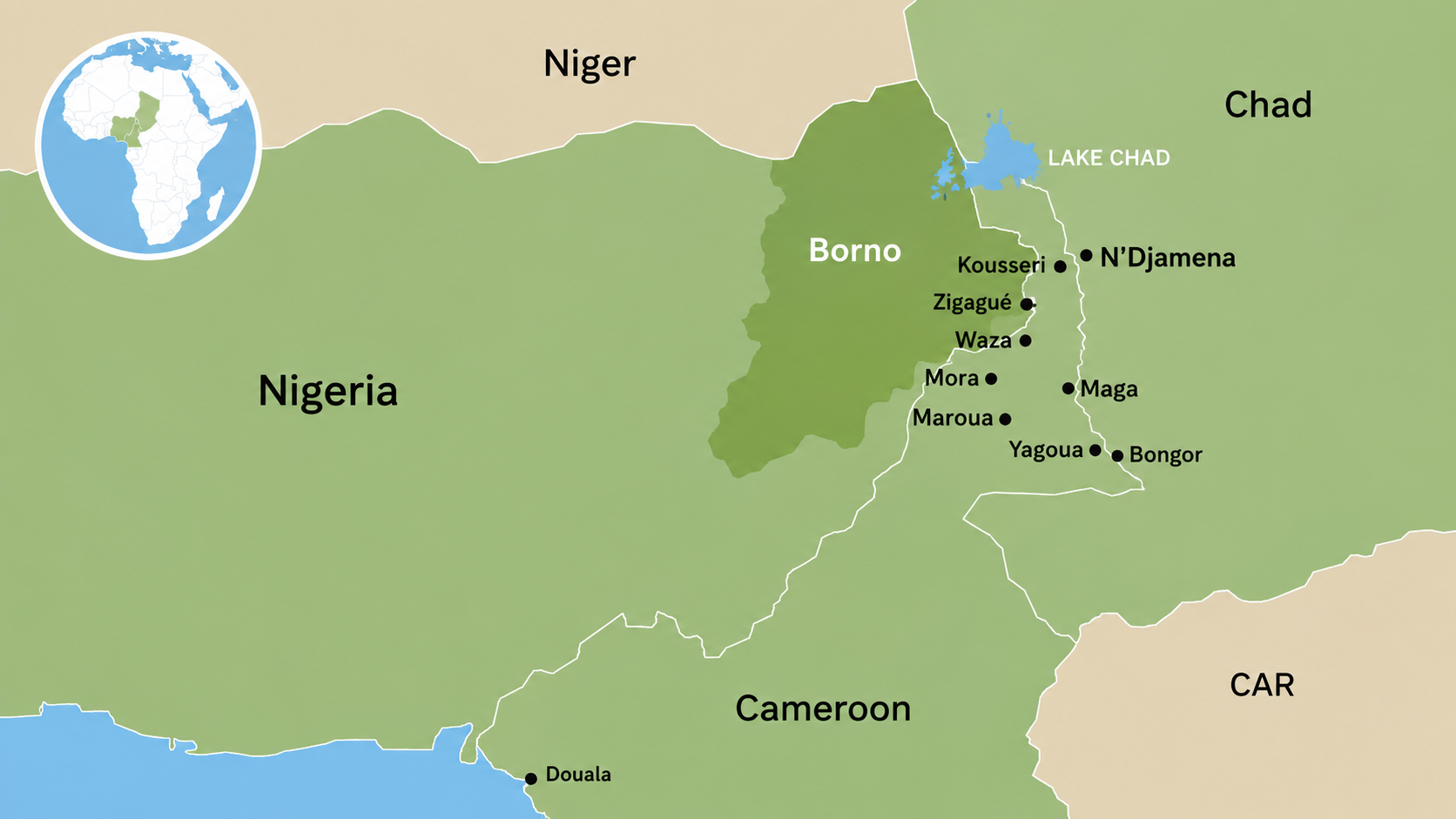
Kidnappings, killings, and other attacks have increased over the past year along Cameroon’s main road connecting the capital Yaoundé in the south to Kousséri, a border town with Chad. Boko Haram groups are targeting passengers and freight trucks almost every day, despite a strong military presence along this important trade route. As the 2026 rainy season approaches, the already bad road conditions make travel and trade even harder.
The Maroua-Kousséri-N’Djamena route is crucial for landlocked Chad and for Nigerian exporters and Cameroonian communities near this road. Cameroon’s Douala port is key to Chad’s supply lines. Trade between both countries relies on goods moving from the port to N’Djamena. There is a mix of formal trade and a large informal market worth over CFA 174 billion ($303 million) for Cameroon, mainly involving food and livestock.
The danger along this route has increased and become more complicated for three main reasons.
First, there is a partnership between criminals and terrorists in kidnapping and human trafficking. This is worsened by the rise in weapons and ammunition in the area. Criminals work with Boko Haram groups and share details about potential targets for this profitable crime.
For example, on 14 August 2025, suspected Boko Haram fighters kidnapped 11 passengers near Zigagué on the Maroua-Kousséri road. They were released a week later after Cameroonian military action in Nigeria and the arrest of local accomplices.
Interviews with former hostages and ex-fighters show that in the Mora-Waza area, armed bandits mix with the local community. They kidnap people and sell them to the Jama’atu Ahlis-Sunna Lidda’Awati Wal-Jihad (JAS) Boko Haram faction. JAS then asks for ransom from the victims’ families. This shows a shift from kidnapping to human trafficking, involving both criminals and terrorists.
The second reason for rising security threats is a renewed insurgency. Since January 2025, the Islamic State West Africa Province has launched several major attacks on military posts along the national highway. These attacks have caused significant losses for Cameroon’s army. This has made it easier for kidnapping and banditry to grow.
The third reason is poor road conditions, especially during the rainy season from June to October. This makes it easier for ambushes since travelers can take days to cover less than 300 km.

Besides the increasing insecurity, the regional economy is also suffering. Reduced cross-border trade leads to huge losses for national economies. Travelers, traders, and transporters have to take longer, more expensive routes that can damage vehicles and delay goods delivery. Supply chain problems lead to shortages of basic goods, rising prices, and higher transport costs.
Police and customs harassment adds to the difficulties. For instance, on a 7 km detour between Yagoua (Cameroon) and Bongor (Chad), 17 checkpoints were found. After protests from carriers and road users, Chadian authorities cut down the number of checkpoints on their side in May. In Cameroon, truck drivers claim there are more checkpoints on the road through Maga than on the entire national highway.
Efforts to repair the Mora-Kousséri section of the highway are commendable, but security issues remain. This route is close to Nigeria’s Borno State, the center of the Boko Haram insurgency. While the Cameroonian side has many villages leading to Kousséri, the Nigerian part is largely uninhabited, providing a safe haven for Boko Haram and armed bandits.
In addition to a military presence along the trade corridor, joint military operations between Cameroon and Nigeria are needed. Raising awareness in communities could help reduce the entry of criminals. This could be part of the military cooperation agreement signed by both countries on 16 June 2026 in Yaoundé.
Moreover, the construction of the 280 km Maga-Kousséri road embankment announced in 2013 could allow traffic to avoid Boko Haram attack sites. If these road links become effective, they would lower risks and create economic chances for nearby communities.
For now, the governments of the affected countries should make it easier for people using alternative routes, especially through Chad, starting with cutting down on checkpoints and roadside harassment.


Drop your comment
No comments yet — be the first to drop the gist 👇