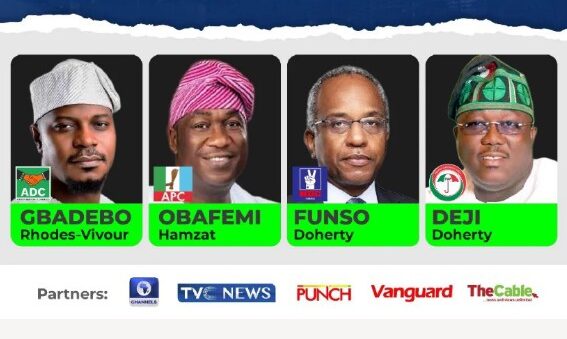
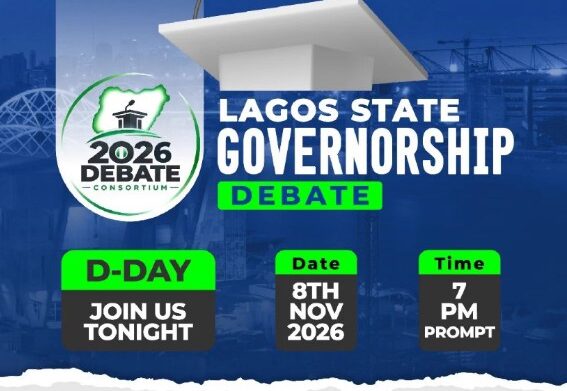
Candidates in the Lagos State governorship debate have shared different ideas to tackle traffic jams and improve healthcare. Their plans include expanding public transport, increasing hospital funding, and offering free medical treatment for mothers and children.
The World Bank has pointed out that traffic congestion is a big issue in Lagos. Commuters spend an average of about four hours daily on the road. A report from September 2025 looked into the challenges of public transport in the city and efforts to expand mass transit.
The African Democratic Congress (ADC) candidate, Gbadebo Rhodes-Vivour, spoke at the debate on Sunday. He said that poor urban planning and a weak transport system are part of the reasons people spend so long commuting. He mentioned that traffic has become a part of life, and many people accept spending hours just to get to work, losing time with their families.
"Traffic is not a lifestyle and we should not have to work to get to work," Mr Rhodes-Vivour said. He suggested spreading development across the state and expanding the rail network with private funding. He believes that infrastructure finance companies could fund the expansion. This would mean the projects could finish in two and a half years, and the state would not bear all the financial weight.
Mr Rhodes-Vivour also proposed shorter bridges linking the eastern foreshore with the Ibeju-Lekki area to create alternative routes for drivers. On water transport, he called for more ferry services, better terminals, and cable cars to support the rail network. He wants commuters to park their cars at ferry terminals and continue their journeys by water.
He suggested creating dedicated bicycle lanes, improving roads in communities, and setting up local centres across local governments. This would help reduce the need for residents to travel far for basic services.
The Deputy Governor, Obafemi Hamzat, who is the All Progressives Congress (APC) candidate, said his government would build on the current bus rapid transit (BRT) system. He wants to improve connections between road, rail, and water transport. He noted that the BRT system has recorded 77 million passenger journeys since it started. He plans to increase the number of buses from about 1,000 to 4,000, mainly using compressed natural gas (CNG), to move about one million passengers daily.
Mr Hamzat also proposed dedicated BRT lanes linking Marina with Epe and Badagry, among other routes. He wants commuters to use ferries, trains, and BRT buses with a single payment system. This would allow people to switch between different transport services without making separate payments. He plans to use electric ferries to lower operating costs and boost passenger numbers, with routes connecting Oworonshoki, Ikorodu, Epe, and Badagry.
Mr Hamzat mentioned that the government has identified busy traffic junctions for intervention to ease congestion. These proposals fit into the Lagos State Government's larger transport plans. The Lagos Metropolitan Area Transport Authority (LAMATA) says its Strategic Transport Master Plan supports an integrated system with rail, BRT, waterways, and other transport services.
The candidates disagreed on whether private investors could finance the rail network expansion without significant government support. Mr Rhodes-Vivour stated that private financing is possible. He said he had spoken with infrastructure financiers who had given proposals to the Lagos State Government. He believes the project is commercially viable and should not take long to complete.
Mr Hamzat disagreed, stating that no sub-national government in Africa has built a rail network solely through private financing. He recalled that the Lagos government spent three years under former Governor Babatunde Fashola looking for private investors for the Blue and Red rail lines but had no success.
He said the government must first invest in rail infrastructure before thinking about concessions to private operators. Mr Hamzat also warned that relying only on passenger fares to fund rail projects could make transport too costly for ordinary people.
Funso Doherty from the Nigeria Democratic Congress (NDC) blamed part of Lagos's traffic issues on poor management of existing infrastructure and the failure to modernise public transport. He criticized the state of commercial buses, saying many are old and poorly maintained. He believes the government needs to replace the current system with modern buses that offer safer and more comfortable rides.
Mr Doherty also claimed that some people have benefited from the current transport situation. He said political factors have stopped previous governments from addressing the informal network tied to transport union fees and touts. He assured that he would have the political will to reform the system because his administration would rely on voters instead of the informal transport network for support.
Research from the International Growth Centre has looked into how Lagos's Bus Reform Initiative has affected private minibus operators. A study from 2025 found that introducing public buses impacted minibus services and drivers' earnings. This highlighted the need to consider informal operators when planning transport reforms.
Deji Doherty from the People Democratic Party (PDP) also pointed out that heavy-duty truck movements, transport union activities, bad roads, and delays in finishing the Fourth Mainland Bridge contribute to congestion. He mentioned that many local government areas have poor roads, making it hard to ease traffic without improving the roads.
He suggested more bridges, including routes connecting Oworonshoki with Epe and Ibeju-Lekki, to give drivers alternative options. Mr Doherty said that Lagos's population means commercial buses, motorcycles, tricycles, and private cars will keep operating. This makes it necessary to improve roads and provide more transportation options for commuters.
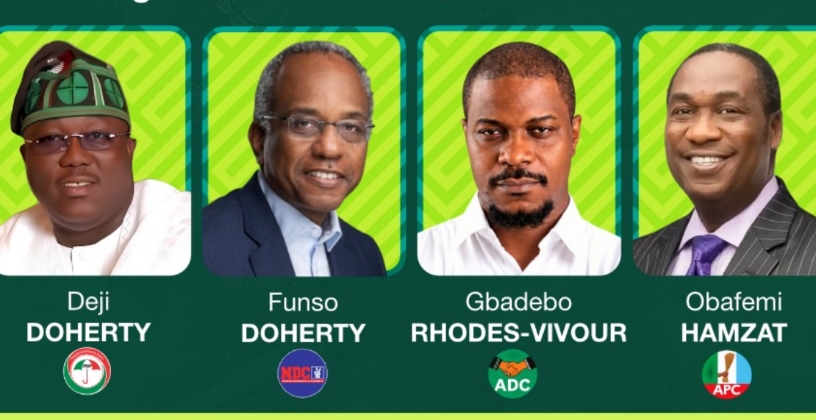

On the informal transport system, the NDC candidate said reform would need to consider the livelihoods of those who rely on it. He proposed expanding vocational training programs to help them find other sources of income. He also stated that modernising public transport would create jobs for drivers, conductors, mechanics, and others, allowing some people in the informal system to move into better jobs.
The debate's fact-checking team questioned some candidates' claims, including statements about Lagos's revenue and its elevation above sea level. They rated as false a claim made by the NDC candidate that Lagos's internally generated revenue (IGR) was higher than the combined revenue of 31 other states.
According to the fact-checkers, Lagos generated N1.77 trillion in 2025, while all 36 states and the Federal Capital Territory together generated N5.15 trillion. The other 35 states and the FCT made up N3.38 trillion, meaning Lagos contributed about 34 percent of the total.
The National Bureau of Statistics' 2025 IGR figures showed that Lagos generated N1.77 trillion out of the combined N5.15 trillion.
On healthcare, the candidates offered different solutions to address funding gaps, improve hospital services, and make healthcare more accessible for residents. The moderator raised concerns about Lagos's health budget. The state allocates between five and eight percent of its annual budget to health, which is below the 15 percent target set by the Abuja Declaration.
The candidates were asked how they would boost funding and ensure proper spending of allocations. Mr Rhodes-Vivour proposed setting up emergency response centres in all 245 wards, each with two ambulances. He believes these centres would cut down the time residents spend searching for hospital beds, oxygen, and emergency services.
He also suggested preventive healthcare programs to spot illnesses early and provide health education at the ward level. The centres would have wellness facilities for residents, especially older people, to exercise and learn about healthy living. Mr Rhodes-Vivour said he would increase healthcare funding to 15 percent of the state budget, improve doctors' salaries, train support staff, and use artificial intelligence to support diagnosis and healthcare delivery.
Mr Hamzat stated that his government would expand health insurance coverage, improve hospital capacity, and upgrade primary healthcare centres. He mentioned that the Ilera Eko health insurance scheme currently covers about 1.4 million people and he wants to extend coverage to one in every three Lagos residents.
He also noted ongoing hospital projects, including a 150-bed general hospital and the Massey Street children's hospital, as part of efforts to increase capacity. Mr Hamzat explained that Lagos has more than 300 primary healthcare centres, but only 87 are functioning as flagship facilities. He plans to raise that number to about 150 and expand 24-hour services, so residents can access medical care whenever they need it.
He also suggested starting a new university of medicine to train up to 1,000 doctors. Yet, he mentioned that just increasing the number of doctors would not solve the problem unless the government improves hospital facilities and working conditions to keep medical professionals.
The state government has admitted to funding issues. At a ministerial briefing in May 2026, Commissioner for Health Akin Abayomi stated that Lagos spends about eight percent of its budget on health, facing an estimated N100 billion gap between available funding and healthcare needs.
The NDC candidate called for more government spending on healthcare and education. He proposed that their combined allocation should go up from about 15 percent to 28 percent of the state budget in his first term. He also promised free maternal and child healthcare, including drugs and tests.
Mr Doherty said some government hospitals offer consultations but require patients to get tests done elsewhere and buy prescribed drugs themselves. This makes treatment too expensive for many families. He argued that free healthcare should cover essential treatments rather than rely mostly on insurance schemes. He admitted health insurance helps with coverage but the government should fund treatment for residents who cannot afford medical costs.
The PDP candidate said improving healthcare would need larger investments in medical staff, hospital equipment, and drug production. He called for training more doctors and nurses, stressing that the number of healthcare professionals and hospitals is not enough for a state with around 25 million people.
He also proposed supporting local manufacturers of hospital beds, medical equipment, and drugs. Mr Doherty said lowering charges on pharmaceutical manufacturers would promote local production and make medicines cheaper. He identified malaria, cancer, hypertension, and HIV as health challenges that need more focus from the state.
Drop your comment
No comments yet — be the first to drop the gist 👇