
Many Nigerians quickly dismissed last year's failed coup attempt against President Bola Tinubu as a hoax. The little information from the authorities gave only a blurry picture of the situation.
Some who thought it might be real rushed for details but found more confusing questions than answers.
Coup attempts, whether they succeed or fail, have a long history in Nigeria. They have left deep marks on the country and shaped its future. After a 30-year break, the news of a possible coup last year shocked many who understood its historical importance for Nigeria's future.
The first news about the plot came in October 2025 after a group of active and retired military officers were arrested in late September. The Defence Headquarters initially called the arrests a "routine internal process" to keep discipline in the military. Later, they admitted that the officers were under investigation for an alleged coup plot.
When the military finally went public about the plot, they shared little more than what was already known. More details came out when some suspects were charged and their trials began at the General Court Martial and the Federal High Court in Abuja, but many questions remained unanswered.
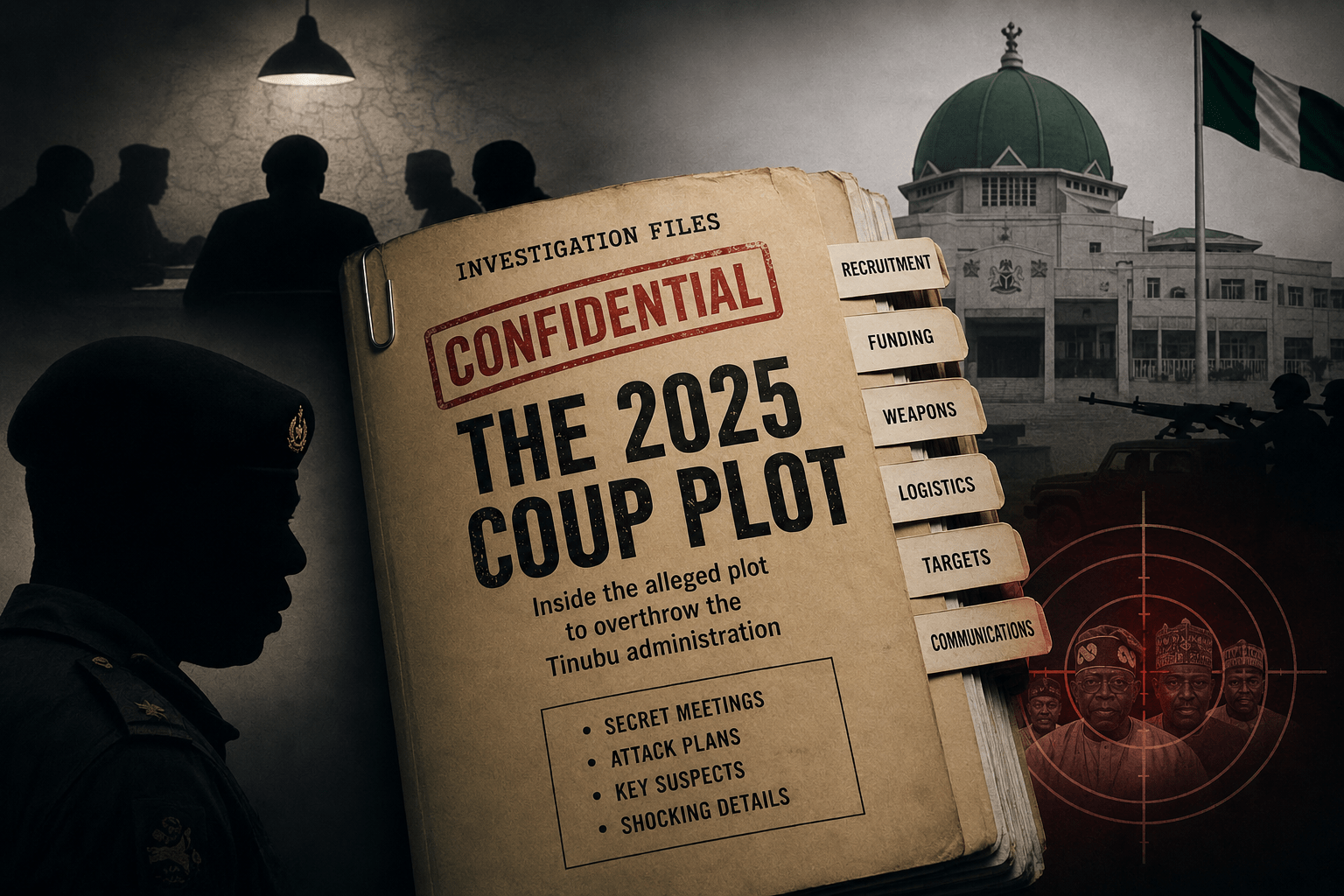
For over 17 days, PREMIUM TIMES published a series of exclusive reports about the plot, revealing missing pieces of the coup story.
From 25 July to 10 August, this newspaper published a 16-part series based on about 7,400 pages of investigation records. These included statements from suspects, bank records, secret notes, chat messages, hotel records, and other evidence.
These reports provided a clear timeline of events, from the start of the alleged plot to its collapse in September. They gave the most detailed account of the coup attempt so far.
In summary, the PREMIUM TIMES series uncovered the events, main players, and connections behind the plot.
Who Was Behind the Plot?
The main figure in the alleged conspiracy was Mohammed Ma’aji, a colonel in the Nigerian Army with experience in various military roles.
Investigators identified him as the key person coordinating the plot. His account, found in documents obtained by this newspaper, gives insight into why he wanted to overthrow the government.
Mr Ma’aji said he had failed twice to get promoted to brigadier general, first in 2023 and again in 2024. He claimed this disappointment pushed him to consider starting a movement to change the government.
He also claimed the coup was a response to insecurity, widespread corruption, bad governance, and poor treatment of military personnel. He insisted that there was real frustration within the armed forces and that many wanted change.
He shared that he faced constant pressure from others he called "like minds" in the military.
However, some others involved in the plot painted a different picture of him.
One officer told investigators that Mr Ma’aji's involvement with women and his reliance on spiritual leaders made him question his ability to lead. Another participant called him a "joker" for not organizing logistics for the coup.
Mr Ma’aji was arrested on 29 September 2025 after the military allegedly used his promotion dreams to lure him. He was called to meet then Chief of Army Staff, Olufemi Oluyede, about his promotion and arrived at Niger Barracks thinking his career was being addressed. But that was the last time he was free.
What Drove the Coup Attempt?
Documents suggest a mix of personal dissatisfaction, military issues, and general discontent with the government motivated the coup.
Mr Ma’aji told investigators that insecurity and military personnel conditions were part of his motivations. His notes also showed he wanted a military government to fix what he viewed as Tinubu’s failures.
The coup plotters were particularly focused on removing the petrol subsidy, which has worsened the cost of living crisis in the country.
A handwritten document from Mr Ma’aji included a section called “Immediate Actions.” It proposed a committee to review the fuel subsidy, salaries for military and security personnel, and ways to honor fallen military heroes.
For years, military personnel, especially junior ranks, have complained about poor welfare. Many have taken their grievances to social media, which the military has condemned.
In an unrelated move, Mr Tinubu approved an 80 percent increase in soldiers' salaries.
The series also uncovered motivational writings from Mr Ma’aji, including quotes about courage and success.
How Was the Coup Planned?
Investigators found that the alleged conspirators had a plan for executing their plot.
They divided tasks among military personnel and civilians. They bought vehicles they suspected were meant for the operation. Targets included the Presidential Villa, military bases, senior military commanders' homes, Radio House, Air House, and airports.
One officer was supposed to lead the operation at Aso Villa, while others were to take control of military bases and secure important locations. Another was assigned to Radio House to announce the takeover.
They also used coded language. They called themselves "farmers" and the movement "farming." Logistics were referred to as "fertilisers," the operation was "digital farming," clerics were "technical partners," and the execution day was "harvest."
When Was the Coup Supposed to Happen?
There was no set date for the coup when it was discovered.
Three dates kept coming up: 27 September, 1 October, and 4 October 2025.
In his statement to interrogators, Mr Ma’aji mentioned “a month after” 1 October as another possible execution day.
One of Mr Ma’aji’s allies, Major Abdulkarim Ibrahim, told interrogators that Mr Ma’aji mentioned that troop and equipment availability would determine which date would be the actual day.
The intended time for execution, called “H-hour,” was between 1 a.m. and 2 a.m., which matched the timing of past military takeovers.
Mr Ma’aji insisted that “no specific day was agreed” yet.
The final date would depend on troop, weapon, and logistics availability.
The importance of 1 October was raised by the cancellation of Nigeria's Independence Day parade in 2025. One suspect later admitted to mocking Tinubu over the cancellation without realizing that authorities were already watching the plot.
Logistics and Manpower
The conspirators knew that taking over the government would require more than just a few officers.
Documents show plans to gather troops, gun trucks, ammunition, vehicles, and other equipment from different military bases.
Some officers, including Lieutenant Colonel Shamsudeen Bappah, assured Mr Ma’aji they could provide troops and equipment.
Mr Ma’aji said he was advised to use Improvised Explosive Devices (IEDs) but decided against it. He said, “Maj Iliyasu said he had Boko Haram technicians who could make IEDs, but I told him it wasn’t necessary.”
Airports were also seen as key since the conspirators believed flights needed to be stopped during the takeover. The plan included disrupting flights in Abuja and Lagos. Two officers were given this task: a Nigerian Air Force squadron leader, Noel Zuzu (Abuja), and Lieutenant Sunday Felix (Lagos).
They also considered recruiting members of the Civilian Joint Task Force and repentant Boko Haram fighters in the North-east. This idea appealed to them since some had experience and access to weapons from counter-insurgency work. Mr Ma’aji said Major Ilyasu came up with this idea.
Money, Sponsors, and Timipre Sylva
One of the biggest revelations was the alleged funding network.
Mr Ma’aji told investigators that former Bayelsa State governor and ex-Minister of State for Petroleum Resources, Timipre Sylva, was the main financier.
According to records reviewed by PREMIUM TIMES, it was believed that over N5 billion was pooled in an account linked to financing the coup, while N785 million was allegedly transferred for execution before the plot collapsed.
The money reportedly moved through Purple Waves Limited and a bureau de change operator, who then distributed funds to people Mr Ma’aji identified. Investigators claimed some of the money came from proceeds linked to a Niger Delta Development Commission contract and loans obtained by Purple Waves.
PREMIUM TIMES found that transfers of about N474.7 million had been given to individuals and groups by the time the plot was uncovered. These transfers occurred between 10 and 30 September 2025, close to the proposed coup dates.

The funds were allegedly used to support participants in various roles and to buy items needed for planning and executing the coup.
Among the alleged recipients were military officers, civilians, and Islamic clerics. One officer linked to the Presidential Villa reportedly received N10 million, while another involved with airport operations received N5 million.
A retired naval captain, Erasmus Victor, told investigators that Mr Ma’aji asked him to seek financial support from wealthy individuals.
He claimed names like FCT Minister Nyesom Wike were mentioned, but he never approached any potential sponsors and told Mr Ma’aji that they had declined.
Mr Victor likely met Mr Wike when he was chairman of the Ogu/Bolo Local Government Area of Rivers State between 2018 and 2021 while Mr Wike was governor.
Spiritual Support
The alleged plot was not just about weapons and money.
Investigators found that Mr Ma’aji sought the support of Islamic clerics for prayers and spiritual protection.
One cleric, Goni Bukar, allegedly received about N50 million in several payments for spiritual support for the operation.
For some participants, Mr Ma’aji’s reliance on spiritualists raised doubts instead of confidence.
Mr Bappah told investigators that Mr Ma’aji’s connections with these clerics made him question the plot.
Would the Coup Have Been Violent?
Suspects showed that the coup plotters wanted to make the takeover as bloodless as possible.
Mr Ibrahim, the army major tasked with making a nationwide broadcast after the takeover, warned Mr Ma’aji against bloodshed.
He argued that history showed successful coups usually needed senior officers' cooperation rather than eliminating them. Another insider, Lieutenant Colonel Abulrahman Hayatu, also opposed killing anyone.
Their operational plan, based on suspects' statements, included interrupting flights, arresting top military officers at home, and turning off power at the Presidential Villa to sneak in and make arrests.
But Mr Umoru, who worked in the Maintenance Department at the Presidential Villa, said he warned that a sudden power cut would lead to investigations and detention of workers on duty.
From his account, the level of force the plotters planned to use depended on how much cooperation they could get from Villa insiders.
Mr Umoru, who shared his views during his interrogation session, said after warning Mr Ma’aji about the power outage, the alleged coup leader concluded he might have to use force if insiders did not cooperate.
Propaganda and Creating Public Support
The planners knew that military control alone wouldn’t make the new government legitimate.
They therefore planned a propaganda operation to make it seem like Nigerians supported the takeover.
A veteran Nollywood actor, Stanley Amandi, told investigators he was asked to coordinate public support in the South-east if the plan succeeded.
His job included organizing celebrations and engaging social media influencers to spread messages favoring the new government. He was also asked to prepare a budget for mobilization.
The plan covered more than just seizing government facilities. It included a parallel information operation to shape how Nigerians viewed the takeover.
Who Would Lead the New Government?
The conspirators didn’t stop at planning the takeover. They also discussed what would happen afterward.
Mr Ma’aji was expected to become the Head of Government if the operation succeeded. Others were promised positions too. Major Ilyasu Jamilu wanted to be an aide-de-camp while Mr Felix was promised a ministerial role. Mr Bappah aimed to head the Economic and Financial Crimes Commission.
A takeover broadcast was also being prepared.
The new government’s first actions were noted in Mr Ma’aji’s writings: review the fuel subsidy removal, review military and security personnel salaries, and honor fallen military personnel.
How They Communicated
The alleged conspirators were careful to avoid exposing themselves through regular phone calls. They used encrypted apps like WhatsApp and Zangi.
WhatsApp was used for some talks, but many mentioned that Mr Ma’aji also introduced Zangi, which is seen as more secure.
Retired naval captain Victor told investigators he downloaded Zangi just to communicate with Mr Ma’aji and another officer.
The review of these digital chats became part of the evidence used to piece together the relationships and roles within the alleged network.
Doubts and Regrets
A key theme in the reports is that not everyone involved was confident the coup would succeed.
Some participants questioned Mr Ma’aji’s ability to raise funds or organize logistics for the operation.
Naval lieutenant commander Bayawo Abdullahi said he became so doubtful that he stopped responding to Mr Ma’aji’s messages, later regretting not reporting the plan.
Mr Victor, who faces charges related to the alleged coup at the Federal High Court in Abuja, said he repeatedly advised Mr Ma’aji against the coup. He even suggested that Mr Ma’aji consider retiring from the military if getting promoted proved difficult. He suspected that the entire plan might have been a scam to defraud wealthy individuals, knowing they would not report it.
Mr Bappah said Mr Ma’aji’s alleged promiscuity and reliance on clerics made him doubt his ability to lead Nigeria.
Yet many who expressed doubts still attended meetings, took money, or stayed silent.
Recommendations to Prevent Future Coups
Beyond the coup plan, documents revealed what some conspirators thought Nigeria needed.
Mr Ma’aji's recommendations included better welfare, improved education, reversing fuel subsidy removal, and ending godfatherism, corruption, and budget padding in the military.
Some suggested a platform for personnel to voice concerns without fear of retaliation from senior officers.
But these suggestions were tied to a plan to overthrow an elected government instead of pursuing change through proper channels.
Investigation Continues
The 16 reports do not confirm a completed coup. They reveal a conspiracy that officials say was interrupted before execution.
Several suspects are facing trial at the General Court-Martial and the Federal High Court in Abuja.
Defendants at the Federal High Court have challenged the admissibility of their statements and video evidence, claiming they were taken under improper conditions. The prosecution wants the court to accept the evidence.
The allegations against those named in the reports are still to be decided in court.
Drop your comment
No comments yet — be the first to drop the gist 👇