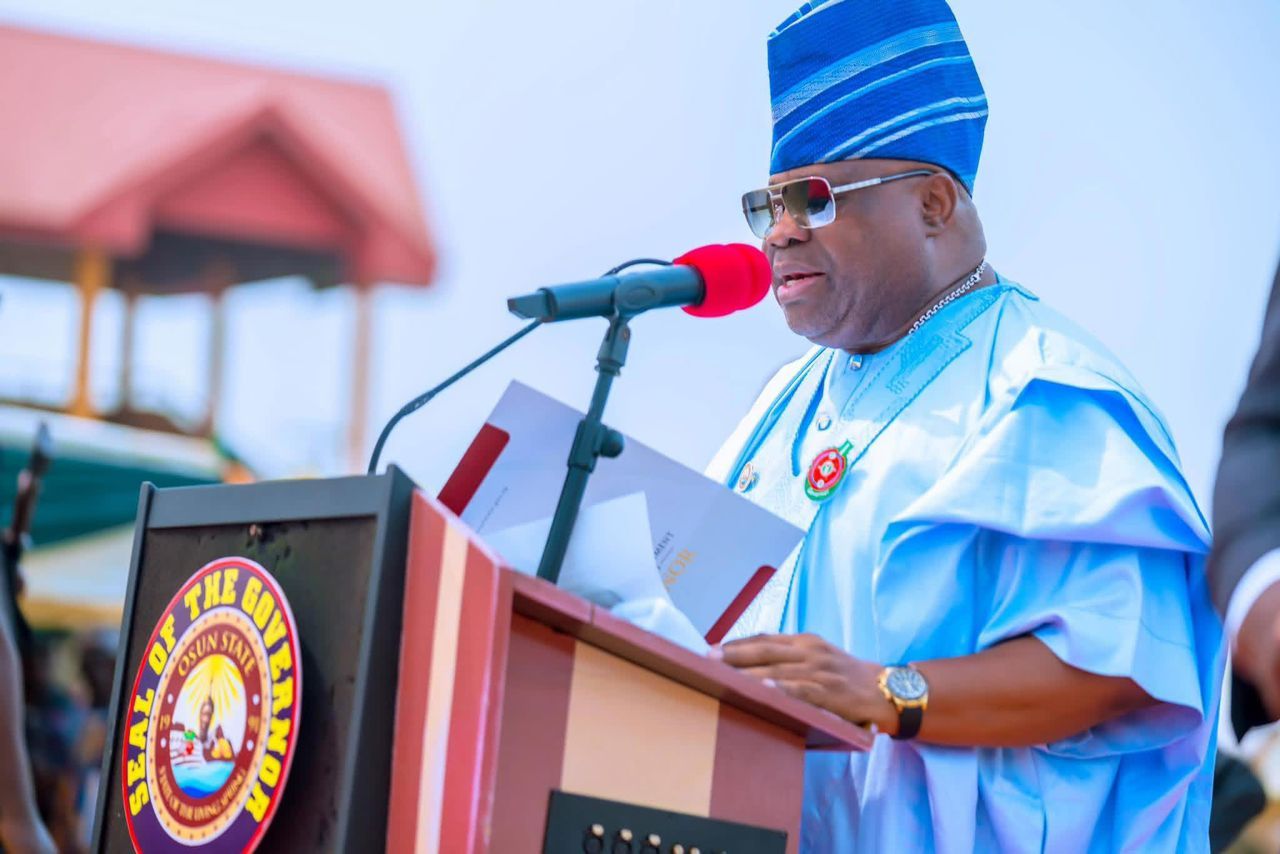
In November 2022, Ademola Adeleke became the governor of Osun State. He won against the incumbent, Gboyega Oyetola of the All Progressives Congress (APC), with 403,371 votes to Oyetola's 375,027.
Mr Adeleke ran on a five-point agenda focused on workers' welfare, economic development, infrastructure, social services, and agro-industrialisation. His goal was to create jobs and improve wealth for the people.
He promised to ensure that public resources would benefit the people of Osun State.
After taking office, Mr Adeleke said he inherited a state with heavy obligations. This included salary and pension arrears, poor infrastructure, and a public sector burdened with debts.
The governor, elected under the Peoples Democratic Party (PDP), claimed that Mr Oyetola left a debt of N75 billion in salaries and pensions. This claim contradicted the former governor's statement, where he said he left N14 billion in the state's account and did not take loans during his time in office.
As Osun voters prepare to return to the polls, the question is not just about Mr Adeleke's past promises. It is whether the changes his government claimed to have made have actually improved the lives of residents.
An assessment by PREMIUM TIMES shows mixed results from the administration.
The government has reduced the state’s debt, increased revenue from internal sources, and paid parts of the salary and pension obligations it inherited. There are visible investments in roads and infrastructure, along with projects in education, healthcare, and agriculture.
But opposition parties argue about the quality and distribution of some projects. Concerns about education spending, public management, and a long-running local government crisis complicate how people view the administration's performance.
Infrastructure: A Visible Area of Achievement
Infrastructure is where the administration’s impact is most noticeable.
In 2022, Mr Adeleke promised to focus on local infrastructure and fix Osun’s neglected roads and facilities.
Since he took office, his administration has worked on road repairs, construction, and major dualisation and flyover projects.
In October 2023, the governor launched a N100 billion infrastructure plan to address deficits across sectors and boost the state's economy. This plan includes fixing 345 primary healthcare facilities, providing clean water, rebuilding 31 schools, and constructing five flyovers with street-lighting projects in Osogbo.
In March 2025, the administration announced a second-phase infrastructure plan worth N159 billion, covering roads, healthcare, education, and more.
This second plan set aside N2.76 billion for renovating 124 primary healthcare centres, N1.98 billion for school renovations, and over N101 billion for road improvements.
The government highlighted that it has constructed and repaired over 350 kilometres of roads. This includes dualising roads in Ilesa, Ila, and Iwo, and building flyovers in Ile-Ife and Osogbo.
At an ARISE town hall last Monday, Mr Adeleke said his administration had worked on about 10 federal roads for which the state had not yet received repayment.
But not all projects are complete as elections approach, raising questions about the administration’s effectiveness. Critics from opposition parties have raised concerns about the quality of some projects.
In late July, PREMIUM TIMES reported that the newly built LAMECO Flyover in Osogbo had cracks, sparking a political disagreement over project quality. Opposition parties accused the government of cutting corners on projects.
This situation shows both sides of Mr Adeleke’s time as governor. His administration has invested heavily in visible projects. But success should be measured not just by how many roads or projects are announced, but by their quality and how they affect residents.
Workers' Welfare
Workers' welfare was a key promise of Mr Adeleke’s 2022 campaign. He said he would prioritize salaries, gratuities, and pensions.
His government has paid parts of the salary and pension debts it inherited. They also approved promotion arrears for workers. The government implemented the new national minimum wage and continued to pay inherited obligations.
At the 2025 Workers' Day event, Osun NLC chairman Christopher Arapasopo praised the administration for paying salary and promotion arrears and for the new minimum wage.
The government claims it paid nearly N100 billion in inherited pension debt. While these payments show improvement, they have not completely solved workers' welfare issues.
The administration also approved promotion exams in 2026 and financial support in public service agencies. They have engaged in recruitment through teaching commissions to fill staffing gaps in public schools.
Debt Reduction
Debt reduction is another measurable success of Mr Adeleke’s time in office.
According to figures from the Debt Management Office, the state’s domestic debt fell from N148.37 billion in December 2022 to N83.32 billion by March 2025, a drop of 43.84 percent. The external debt also decreased from $91.78 million to $75.14 million during this time.
The administration reported a significant rise in internally generated revenue (IGR), from N27.72 billion in 2023 to N54.7 billion in 2024, nearly doubling in just a year.
These figures are good news. But simply having higher IGR and lower debt does not mean the state’s finances are stable.
Osun still relies heavily on federal funds, and its budget has grown significantly.
For example, in 2025, PREMIUM TIMES reported that the state budget increased to about N427.75 billion, with N251.67 billion expected from FAAC and about N109.87 billion projected from IGR.
Education
Mr Adeleke promised skills-based education and social services focused on people.
His administration has reported school renovations and other efforts, and education has received considerable funding in recent budgets.
But improving education is more than just counting renovated schools.
One way to measure success is student performance. Osun had a 72.64 percent pass rate in the 2025 NECO Senior Secondary School Certificate Examination, according to an analysis by this newspaper.
This is promising, but it would be wrong to credit all of this success to the Adeleke administration without considering longer-term trends, teacher quality, student backgrounds, and school conditions before 2022.
In January 2026, Mr Adeleke received the BusinessDay Award for the state’s strong performance in Education and Human Capital Competitiveness.
A PREMIUM TIMES analysis of the 2026 budgets for South-west states found that Osun allocated only 12 percent of its budget to education. This is below the 26 percent benchmark set by Nigeria’s National Policy on Education. The analysis also showed that the state spent 73.2 percent of its education budget in 2025.
The picture is mixed. Osun has seen good examination results and made school improvements, but funding and implementation are still issues for an administration that promised wider changes in education.
Healthcare
Healthcare is another area in Mr Adeleke’s record.
The administration has organised medical and surgical outreach programs, reported the renovation of health facilities, and continued improvements in primary healthcare.
Its infrastructure plans have included extensive rehabilitation of healthcare facilities. The government stated that its first infrastructure program covered hundreds of primary healthcare centres, and the second phase included N2.76 billion for renovating 124 of them.
But critics say that simply fixing health facilities does not solve ongoing problems like shortages of medical staff, equipment, drugs, and health insurance for the poor.
Agriculture and Jobs
Mr Adeleke promised agro-industrialisation to create wealth and jobs, especially for youth and women.
His administration has promoted agricultural mechanisation, bought tractors, and started youth-focused agricultural programs. They also expanded cooperative financing and helped small businesses.
But in this area, the government’s public messaging seems stronger than the actual evidence of economic change.
The Local Government Crisis
If infrastructure is one of Mr Adeleke’s strengths, the local government crisis stands out as a major problem.
The fight for control of Osun’s 30 local governments led to a long political and legal struggle between the PDP-led state government and former council officials backed by the APC. This clash resulted in the deaths of five people.
In February 2025, Mr Adeleke’s administration held local government elections and swore in new chairpersons. He then told them not to occupy the council offices immediately because rival officials backed by the APC were still there.
This dispute led to the withholding of local government funds by the federal government, disrupting grassroots governance.
The Adeleke administration blamed the federal government and the APC for the withheld funds. The federal government said it was due to legal issues around the councils.
The Supreme Court later dismissed Osun’s suit against the federal government, ruling that the state’s Attorney-General lacked the legal right to file the case for the local governments. The court also criticized the federal government for withholding the funds.
Regardless of the political arguments, this situation had serious effects on governance.
Local governments are supposed to provide basic services to residents. The ongoing uncertainty about who controls their finances and institutions hurts grassroots administration and distracts from service delivery.
This is an area where Mr Adeleke’s administration cannot just blame political opponents. The dispute tested political management and institutional restraint, and Osun's local government system ended up weakened.
Drop your comment
No comments yet — be the first to drop the gist 👇