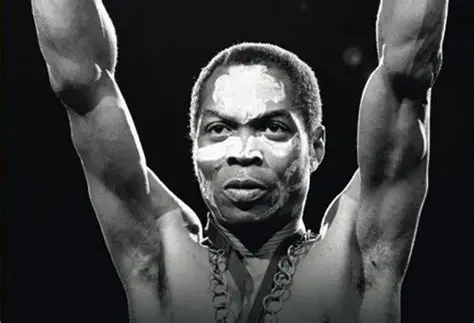
Nigerian singer Augustine Okechukwu, known as Tekno, has started a new discussion about Afrobeat and Afrobeats. He believes the late music legend Fela Anikulapo-Kuti should not be seen as the only creator of the genre.
Tekno shared his thoughts during an interview on Hot 97 on Thursday. He talked about Fela’s impact on Nigerian music and urged people to recognize other artists who contributed to Nigeria’s music scene.
Growing up in eastern Nigeria, Tekno listened to highlife music. He mentioned the great Oliver De Coque as one of the artists who shaped his understanding of African music.
“There are legends like Oliver De Coque. He’s a legend that makes pure highlife music, and highlife is also Afrobeats,” Tekno said.
He also spoke about his own song, Rara, saying it was inspired by Fela’s music. “I have a record of mine, Rara, that is really big and is heavily inspired by Fela because I heard his tune as well and he’s a legend.”
Tekno recognized Fela’s role in bringing Afrobeat to the world. But he insisted that other Nigerian music pioneers also deserve credit. “He obviously stamped the Afrobeats thing on the world map, but we have some other legends that sang very good music that if you heard today, you wouldn’t even believe that those songs were made in those times,” he said.
“People don’t know them as much, but my dad used to play these records, and it was so many artistes that made it, but Fela gets the credit because he kind of travelled and he had the band that went around the world. To some people, he’s the originator of Afrobeats, but to me, there are a lot of them.”
His comments sparked a lively debate on X. Nigerians were split between those who supported him and those who felt he was misrepresenting music history. Some also pointed out the difference between Afrobeat and Afrobeats, with the former being a distinct genre and the latter being a broader term.
Supporters of Tekno
Some users agreed with Tekno that Nigeria’s music history should not focus only on Fela. Eshin iwaju, #purnishmentmar1, said Tekno was careful with his words and deserved praise for highlighting musicians from earlier times. “Yeah he’s been careful with his words but kudos to him putting their legends on the map as well,” the user wrote.
Obiahu Emmanuel Egwu, #macofbillions, said Oliver De Coque deserves more recognition for his impact on Nigerian music. “Whenever I listen to Oliver De Coque’s music, I feel genuinely disappointed that his enormous contribution to Nigeria’s entertainment and music industry isn’t talked about enough,” he wrote.
Umeh, #UmehWrites, said many Nigerian musicians and traditions helped shape contemporary Afrobeats. “Tekno said what a lot of people are afraid to say. Oliver de Coque, Osadebe, Sunny Ade, Ebenezer Obey and co. contributed to highlife music, part of which transitioned into Afrobeats,” the user wrote.
“Fela is a catalyst to the revolution, but he is not the originator of Afrobeats.” Pascal Ayinor, #pascalayinor, stated that African rhythms existed long before Fela and should not be solely credited to him.
“Afro + beat = African rhythm. Any music made with African percussion and vocals before, during, or after Fela’s time is an ‘afrobeat,’” the user wrote. “Therefore, Fela didn’t create it; he just gave the existing African sound a catchy, shortened name.”

DJ BRYTOS, #DJbrytos, also supported the idea that other artists shaped the global story around Fela and Afrobeat. “If Seun Kuti comes for Tekno over that ‘Fela no start Afrobeat’ talk, Tekno go start regretting why him mouth no get brake,” the user said.
Critics of Tekno
Others disagreed with Tekno, insisting that Fela is the creator of Afrobeat and that highlife is different from both Afrobeat and Afrobeats. Begin, #Inviiin, said much of the argument comes from not understanding the difference between Afrobeat and Afrobeats.
“People are actually getting the whole thing wrong. Afrobeat is completely different without the ‘s’. With the ‘S’, it is a fusion of afro sounds and not a genre,” the user wrote. “Without the ‘S’, it is a solid genre created by Fela! Period.”
Drawn Out of Water, #meo_joule, echoed that highlife and Afrobeat are not the same. “Highlife is highlife. Afrobeat is afrobeat. S/o to Tekno for shining a light on the highlife legends, but highlife is not afrobeat,” the user wrote.
Uncle Jay, #Joeitatu, criticized Tekno for not understanding the differences in musical traditions. “I’m sure you really don’t know better! High Life is not Afrobeat,” the user said.
Amenze Iyamu, #AmenzeIyamu, believed that Fela created Afrobeat, while the term Afrobeats came later to describe modern African pop music. “How can he be ignorant about music history? Fela created Afrobeat. Ghana owns High Life. What we call Afrobeats today is not what Fela sang,” the user stated.
Damilare Samuel, known as Quiv, #_Quivira, said Fela should not be denied his recognition in African music. “Fela doesn’t even get any credit beyond the work he did, he did put Afrobeat on the global map,” he said.
A Middle Ground
Some users did not fully reject Tekno’s argument but felt he did not explain it well. RN_Gabriella, #gabriella_oma, said highlife influenced Afrobeat but should not be called the same. “People insulting Tekno in the comments. I think he didn’t describe it well. Highlife inspired Afrobeat. Without Highlife, there wouldn’t be Afrobeat,” the user wrote.
Iyanda Koko Bi OTA, #Pentroi2, said Tekno raised a good point about recognizing other musicians but claimed Oliver De Coque was not among the first to influence Afrobeat. “Oliver is not even among the first 3 pioneers of music that generated into Afrobeat,” the user said.
The debate comes months after Fela’s legacy was also discussed when his son, Seun Kuti, defended his father against comparisons with modern Nigerian artists. Tekno’s comments have reopened the conversation, touching on highlife, juju, African rhythms, and the many musicians who shaped Nigerian popular music.
While Fela is widely seen as the pioneer of Afrobeat, the renewed debate shows the need to separate the genre he created from the broader Afrobeats sound linked to today’s African music. For some Nigerians, recognizing other pioneers does not lessen Fela’s legacy. For others, calling highlife and older music styles Afrobeats blurs important lines in Nigeria’s music history. The disagreement seems far from finished.

Drop your comment
No comments yet — be the first to drop the gist 👇