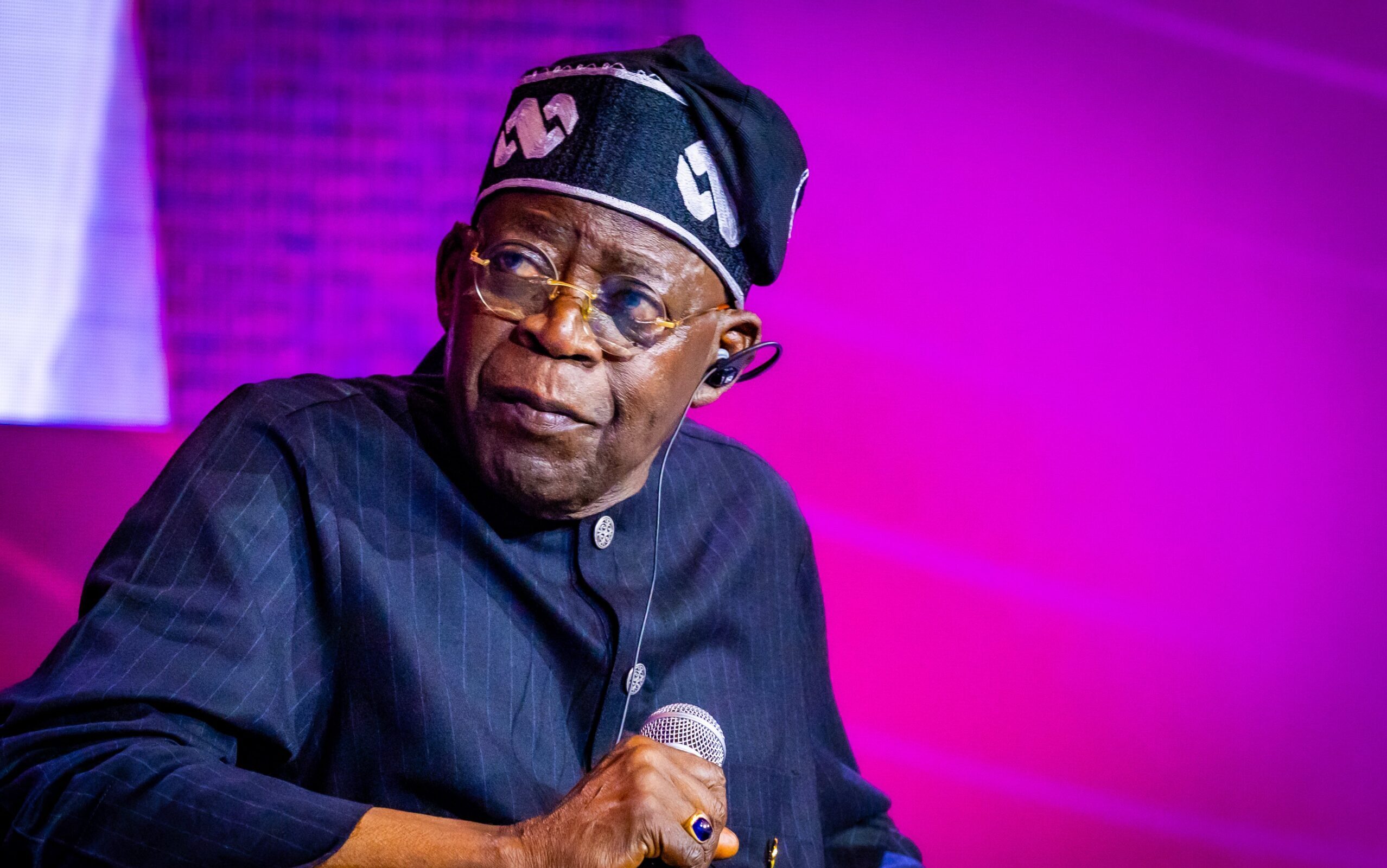
The setup of President Bola Tinubu’s 2027 presidential campaign council has raised concerns about mixing government roles with party politics. The most talked-about decision is the appointment of leaders from two important public agencies to the campaign council.
Zacch Adedeji, who heads the Nigeria Revenue Service (NRS), was named deputy director of Fundraising. Bisoye Coker-Odusote, director-general of the National Identity Management Commission (NIMC), was appointed director of Data Management. These appointments are causing a stir.
The worries extend to Tanimu Yakubu, director-general of the Budget Office of the Federation, who was named secretary, Finance/Treasurer. The list also includes serving ministers and other high-ranking officials in campaign roles. This includes Minister of Information Mohammed Malagi, Minister of Works David Umahi, and Minister of Interior Olubunmi Tunji-Ojo.
People are not just concerned about their political ties or ability to support the president’s re-election. The focus is on the public offices they hold.
The appointments raise a bigger question: where should the duties of a public servant stop, and where should the political goals of a party aiming to stay in power start?
On 22 August, the ruling All Progressives Congress (APC) revealed its 2027 Presidential Campaign Council. President Tinubu is the chairman, with Vice President Kashim Shettima as vice chairman. Former Zamfara Governor Abdulaziz Yari is the director-general. Imo Governor Hope Uzodimma is the secretary, and Ogun Governor Dapo Abiodun is the director of Fundraising, with Mr Adedeji as his deputy. Ms Coker-Odusote is in charge of Data Management, while Mr Yakubu is secretary, Finance/Treasurer.
This campaign council comes as the 2027 election campaign kicks off, with Mr Tinubu seeking a second term amid debates about his economic policies, security challenges, and living costs.
The three appointees in focus
The most striking part of the appointments is that they put officials responsible for three different areas of government power into key roles for the campaign’s financial and data management.
Mr Adedeji is tasked with fundraising. Ms Coker-Odusote handles campaign data. Mr Yakubu is in charge of the campaign’s finances.
Their positions give them access to vital information on taxpayers, identities of Nigerians, and government finances. Although their roles in the APC do not mean they have compromised their public duties, it raises a hard question: what keeps their access to information and influence in public roles separate from the political campaign they are now part of?
The fundraising issue
Mr Adedeji’s appointment has stirred the most controversy.
The NRS is not just any government agency. Formed by the Nigeria Revenue Service (Establishment) Act 2025, it replaced the Federal Inland Revenue Service. This agency is responsible for assessing, collecting, and accounting for federal revenue. It can assess corporations, companies, and individuals for tax obligations.
The NRS oversees taxes like company income tax, value-added tax, withholding tax, and stamp duties. It also provides taxpayers access to their tax profiles and records.
His role in the campaign raises concerns. As Deputy Director of Fundraising, he will help gather financial support for Mr Tinubu’s campaign. This places the head of Nigeria’s main tax agency in a position where his campaign role might connect him with individuals and businesses that are subject to government taxes and regulations.
This brings up issues of perception and potential conflicts of interest. A company asking for donations from a senior campaign fundraiser might also be a taxpayer whose dealings fall under the authority of the person requesting the funds.
Even if no confidential information is shared and no threats are made, the situation can create the impression that a political appeal comes from someone who also has power over their tax affairs.
That is why the opposition’s concerns are significant.
Former Kogi West Senator Dino Melaye plans to challenge Mr Adedeji’s appointment in court. He argues that the NRS chairman’s role in fundraising for a political campaign conflicts with his duties.
“Zacch Adedeji cannot be the chairman of the NRS and, at the same time, be a fundraiser for the presidential campaign of a sitting President. There is a conflict of interest, and we want to test it in a court of law to show and expose the desperation of the APC and President Bola Tinubu,” he said.
The issue is not about Mr Adedeji’s ability to raise funds. It is whether the head of a tax authority should be raising money for the political campaign of the government that appointed him while still overseeing the country’s revenue.
The Budget Office role
Mr Yakubu’s appointment brings another layer to the mix that hasn’t received much attention.
As the Director-General of the Budget Office, Mr Yakubu is central to Nigeria’s federal budget process. This office coordinates the preparation of the annual budget and provides fiscal information that supports budget planning and execution.
Now, he is assigned to a sensitive role: Secretary, Finance/Treasurer for the campaign. Unlike the fundraising team, which mainly focuses on gathering contributions, the Finance/Treasurer team manages campaign finances.
The Director-General of the Budget Office has access to extensive fiscal information due to his public duties. This includes government finances, budget allocations, projections, and priorities.
There is no proof that Mr Yakubu has used any government financial information for the APC campaign. But his role raises similar questions: what safeguards are in place to separate the financial information linked to his public role from the political campaign?
It also raises questions about how the public sees this. Someone in a senior role responsible for government spending is now managing the finances of the current government’s political campaign.
The difference between these roles may be clear to the officials. But for many Nigerians, it can be hard to understand.
This is important because campaign finance is more than just accounting. Political fundraising and spending can create ties with businesses, contractors, wealthy individuals, and others who also deal with the government.
The data management issue
Ms Coker-Odusote’s appointment raises questions about something very sensitive: identity.
NIMC is responsible for Nigeria’s identity management system. Its National Identity Database holds biometric and personal information collected from Nigerians and legal residents.
NIMC tells citizens to keep their National Identification Number secure and not share it freely.
Mr Tinubu has praised Ms Coker-Odusote’s role in gathering reliable identity data for government programs, especially for security and infrastructure. In April 2026, he commended her work in expanding identity data processing.
This makes her role in the campaign particularly noteworthy. The campaign’s data director is also the head of the agency central to Nigeria’s national identity system.
This situation raises legitimate questions about safeguards.
Under the NIMC Act 2007, access to the National Identity Database was restricted. Access to information about registered individuals was only allowed with NIMC’s permission and usually needed the individual’s consent.
The law has changed since then. Mr Tinubu signed the NIMC Act 2026 into law, which replaced the 2007 Act and strengthened NIMC’s role in Nigeria’s digital identity management. The new law aims to enable secure data exchange across government and private sectors.
This change makes institutional safeguards even more crucial.
Why the appointments matter
Each appointment raises questions about governance. Together, they create a larger concern.
The NRS holds vast information about economic activities and taxpayers. NIMC manages crucial identity information, while the Budget Office is central to government budget planning and financial data.
The campaign council has placed the heads of these three institutions in key roles that align closely with their public responsibilities.
This connection makes the appointments particularly sensitive.
A modern political campaign relies on two main resources: money and information. Effective financial management determines how these resources are used.
Money pays for advertising, mobilization, logistics, polling, communication, and outreach to voters. Good financial management allows a campaign to collect, manage, and use the funds needed for these activities.
The concern is not that Messrs Adedeji and Yakubu or Ms Coker-Odusote plan to misuse their roles. It is that the structure creates the possibility or perception that the governing party’s campaign could benefit from access to state resources, information, and connections.
This distinction is crucial in a democracy. A conflict of interest does not require proof that an official has misused their position. Sometimes, the purpose of conflict-of-interest rules is to prevent situations where an official’s private or political interests can be seen as competing with their public duties.
What does the law say?
Nigeria’s Public Service Rules limit political activities.
Rule 030422 states that, without government permission, an officer cannot hold an office in a political organization, show support or opposition for a party or candidate, or campaign for political candidates.
It says, “No officer shall, without the express permission of the government, whether on duty or leave of absence: (b) offer himself/herself or nominate anyone else as a candidate for any elective public office, including membership of a Local Government Council, State or National Assembly. (c) indicate publicly his support of or opposition to any party, candidate or policy; (d) engage in canvassing in support of political candidates.”
Rule 030423 adds that an officer wishing to engage in political activities should resign.
“Resignation is necessary before seeking elective public office. Any officer wishing to engage in partisan political activities or seek elective public office shall resign his/her appointment forthwith.”
The Federal Government has used these rules to remind civil servants against engaging in partisan politics. In 2022, the Head of Service referenced a legal opinion from the then Attorney-General, Abubakar Malami, which stated that these Public Service Rules still apply to civil servants.
But the legal situation is not as simple as saying that every public official in a political campaign has broken the law.
Public officials have constitutional rights to freedom of association, and courts have looked at the balance between these rights and the restrictions of the Public Service Rules.
The status of Mr Adedeji and Ms Coker-Odusote under the relevant employment rules would need to be checked before declaring their campaign roles illegal.
But even if an appointment passes a legal test, propriety and ethics are separate issues.
A public institution must not only comply with the law; it must also be independent enough to earn public trust.
The Electoral Act provides another important guideline.
Section 95(2) of the Electoral Act 2022 states that state resources, including the media, should not be used to benefit or harm any political party or candidate during an election.
The principle behind this rule is clear: government resources are meant to serve the state, not to help a political party gain an advantage.
Whether the involvement of serving agency heads in a party campaign breaks the law would depend on the facts and application of the relevant law.
But the potential conflict needs to be examined.
What about corruption?
The controversy around the campaign council is not just about serving public officials.
The opposition African Democratic Congress (ADC) has called the council a “rehabilitation centre” for people with unresolved corruption issues. This includes former Minister of Humanitarian Affairs, Betta Edu, and former Chair of the Nigeria Social Insurance Trust Fund, Ngozi Olejeme.
Ms Edu was suspended by Mr Tinubu in January 2024 after a memo directed the Accountant-General to transfer N585 million to a private account.
Mr Tinubu referred the case to the Economic and Financial Crimes Commission (EFCC) for investigation. The EFCC later questioned Ms Edu and reported recovering N30 billion during its investigation into the ministry.
Ms Edu was eventually removed from the Federal Executive Council.
Ms Olejeme’s case is also serious. The EFCC charged her in October 2025 with money laundering involving N1 billion in misappropriated NSITF funds. She pleaded not guilty.
These accusations should not be confused with convictions. Both women are innocent unless proven guilty in court.
The issue for the APC is not whether they are guilty. It is why a presidential campaign would choose to involve individuals with unresolved corruption controversies at such a crucial time.
Tinubu’s political strategy
There is also a political reason behind these appointments.
Mr Tinubu is a seasoned political strategist. He has built his career around organization, data, networks, fundraising, and electoral strategies.
His 2027 campaign is crucial. Given this background, a campaign that focuses on fundraising and data management makes sense.
Ms Coker-Odusote’s appointment is also linked to her past. Before becoming NIMC DG, she worked in technology and served in Lagos State, including as General Manager of the Lagos State Infrastructure Maintenance and Regulatory Agency (LASIMRA). Mr Tinubu appointed her as acting DG in August 2023, and she became the full DG after that.
From a campaign manager's view, these are the skills that make a campaign effective.
The challenge is that these skills were gained while serving in public roles.
Public reactions
The public response has been mixed.
Some defend Mr Tinubu’s right, as the APC candidate, to form a team of people he believes are competent.
Others see the appointments as another example of the blurred lines between the ruling party and the government.
A group of lawmakers in the House of Representatives has criticized the council’s composition. They warn that having senior public officials involved could mix government duties with party politics.
They urged all serving public officials in sensitive national roles to withdraw from the APC Presidential Campaign Council and focus on their official jobs.
Alternatively, they suggested that those who want to play active campaign roles should resign from their public positions.
“A person should not serve as a senior custodian of the Nigerian state and as an active financial or political operative of a presidential campaign,” they said.
Speaking with PREMIUM TIMES, Ifeanyi Odili, the National President of the Campaign for Democracy (CD), said these appointments should be evaluated not only for legality but also for their impact on public trust.
Mr Odili emphasized that the question goes beyond legality; it should consider if they seem fair and appropriate.
“Will a businessman feel free to refuse a donation request when the person asking is also the tax master? Will a citizen feel secure that their NIN data will not be used for political purposes?” he asked.
According to him, these appointments create potential conflicts of interest and risk blurring the lines between state and party. He insisted that the NRS and NIMC are national institutions meant to serve all Nigerians and should not be seen as extensions of the APC.
“When the heads of those two sensitive agencies also take on senior roles in a party campaign, it raises two questions. First, can you serve two masters, the Nigerian state and a political party? Second, it blurs the line between state and party,” he said.
Mr Odili clarified that he was not claiming government funds or data have been misused. He warned that these appointments could create an impression of unfair advantage for the ruling party. Businesses may question whether political donations are being sought by someone who also oversees their tax matters. Citizens may fear that government-held identity data could be used for political profiling.
“Democracy works when everyone believes the referee is neutral. Once the referee puts on a team jersey, even if he says he will be fair, people will not believe it,” he stated.
He urged the government to keep a clear separation between public institutions and political activities. He argued that “institutions must be stronger than individuals and bigger than any party” for citizens to trust the government.
“Just as the Bible teaches Christians to avoid every appearance of evil. For institutions that hold public trust, the standards must be very high. If there is any doubt, the safest path is to keep these roles apart,” he stressed.
These reactions are happening against a broader discussion about using state resources during elections.
Civil society groups have warned that using government institutions for party purposes can hurt electoral fairness. The Centre for Social Justice cited Section 95(2) of the Electoral Act when discussing the misuse of state resources during elections.
For many Nigerians, this issue is bigger than just three names on a campaign list.
It is about whether the institutions they rely on can stay neutral when the people leading them are also helping one party stay in power.
The lingering questions
The APC can argue that the campaign is a political organization and has the right to recruit experienced Nigerians to help them win.
But having the heads of the NRS, NIMC, and the budget office involved raises questions that can't simply be answered by pointing to political freedom.
Will the APC campaign build its own database, like political parties usually do, or will it depend on information from government institutions?
That is the question that could turn this appointment issue into a broader investigation.
The most troubling part of these appointments may not be whether the officials have done something wrong.
It is the slow normalization of a political culture where the same individuals can run government institutions during the day and perform key roles in the ruling party’s election campaign.
Drop your comment
No comments yet — be the first to drop the gist 👇