
Most manifestos start by pointing out problems. Afrilition starts by asking its author something tough: what kind of ancestor will I become?
That question is the main focus of the book, and it is worth thinking about before you read on. It changes how we often think about Africa. We usually look back at empires, the trans-Atlantic trade, colonial borders, and colonial education, measuring ourselves against that pain. Ajadi turns the reader to look forward. The ones who will judge us are not behind us. They are ahead of us, and they have not been born yet.
This is why the book is written the way it is. Ajadi writes as a grandfather talking to his grandchildren, but he is really addressing anyone still searching. He calls them the eyes of tomorrow and hopes they will not be too affected by a reality that has been shown to them as normal. The letter format is not just for style. A letter to a child cannot hide behind big words, cannot show off for experts, and cannot be cynical, because you do not hand down cynicism to a child as an inheritance. This format shapes the content. It makes the book both gentle and helpful.
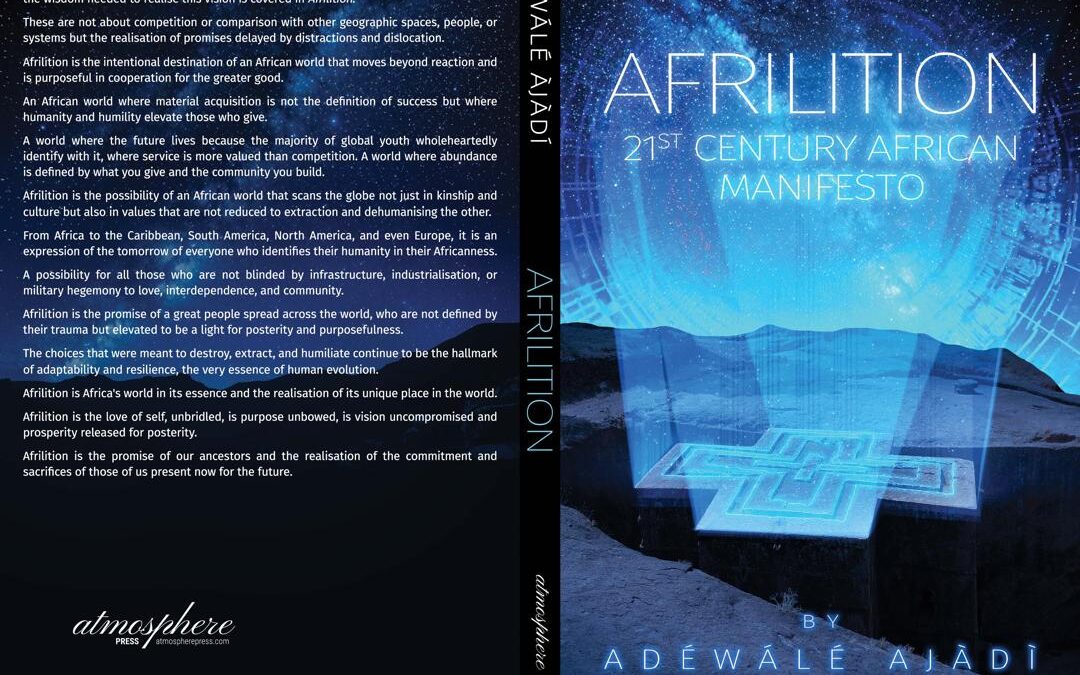
The title is a new word, and this new word is an argument. Afrilition combines Africa with ebullition, meaning the bubbling or the excitement, the state of a thing coming to a boil. It is not about restoring Africa. It is not about developing Africa. It is about Africa emerging, through its own energy, into a form it has not yet taken.
Ajadi also shows care in how he names the continent. He chooses to trace Africa back to an Egyptian root meaning ‘motherland’ or ‘birthplace’ and states clearly that this is his chosen source. The honesty in this framing is typical of the book. He is not claiming a settled meaning; he is claiming the right to choose which story he stands in. Naming in Afrilition is an act of self-creation, not just record keeping.
This perspective is clear from the start and remains consistent. He says there is nothing wrong with being called black, even if that description does not relate much to actual skin color. The issue he finds is different. It is that skin color, rather than culture or choice, has defined a people. We received a classification from oppressors and colonizers, he writes, and then accepted it as our identity. He talks about Malcolm X and others who struggled with the same legacy, and he does this respectfully, but he refuses to end where they did.
His alternative is captured in the sentence I would put on the cover: we must move beyond reaction to intention.
There is an easier version of this book that Ajadi did not write. It would list the crimes, name the villains, and create anger. He clearly states that Afrilition is not about heroes and villains, or good and bad, but about what must be done for the African world to play its part in renewing humanity towards a sustainable future. That choice is what makes the book meaningful, not just correct.
He does not hold back about the damage done. He describes what centuries of European control have cost: a continent defined by its worst, whether real or imagined; a Europe with a false sense of being the best at everything; and a world conditioned to see European choices as the standard for all civilization. He names the violent colonial experience and the heavy trauma of enslavement, without downplaying either.
And then he refuses to make these the end point. Afrilition, as he defines it, is a commitment to healing, to leave the wounds behind, and to move purposefully towards confidence and emergence. He points to the first two decades of this century as proof that something is changing, mentioning the shift in French influence across Mali, Burkina Faso, Niger, and Guinea as signs of a continent moving towards greater independence and self-realization.
What stops this from becoming overly optimistic is his insistence that the goal is not to win. He argues that the world does not need another fight for dominance or a struggle for one geography or people to be superior. It needs many different solutions to shared problems. Africa, in his view, is well placed to stand out, offering a unique contribution to humanity rather than competing for someone else’s space. Human development, he writes, needs variety, energy, and purpose.
The most beautiful line in the book captures this belief: there is enough space in the sky for all the birds to fly.
Ajadi’s name for African youth is a challenging one, warriors of posterity’s illumination. When you read this alongside his description of the warrior of light, seeking depth, staying away from false hopes, and revealing the light in others so that your own does not distract from their path, it becomes clear that he is not just complimenting the youth. He is giving them a job description.
Afrilition does not romanticize its optimism. Ajadi backs his case with demographics and data, and the figures are powerful.
Africa is expected to hold about a third of humanity, with the youngest population in the world at a median age of around 19.7 years, and to provide no less than a quarter of the global workforce by 2050. By 2030, young Africans are expected to make up 42 percent of the world’s youth. By 2035, more young Africans will join the workforce each year than the rest of the world combined. That last figure is not just a prediction about Africa. It is a prediction about the global job market, and Ajadi points this out. The way work is inspired, supported, and delivered in every industry will be shaped by this group.
The continent produces at least 90 percent of the world’s platinum, leads in gold production, and supplies over 70 percent of cobalt, mainly from Congo. In agriculture, Africa grows 94 percent of the world’s yams, 70 percent of global cocoa from West Africa, and 63 percent of global cassava, not counting the Caribbean and countries like Brazil with large African diaspora populations.
Here is where the book proves its worth. Ajadi does not present these facts as reasons to feel proud. He presents them as a warning about our position. A continent that provides the world’s minerals and food while importing the world’s definitions of value has set itself up as a supplier. His chapter on shifting from raw material producer to a value-adding society is the core of the manifesto, and it connects directly to his worry about the youth. He fears that the demographic dividend will be wasted if young Africans measure themselves against borrowed standards and seek approval from those who see them as inferior.
The section on women is among the strongest parts of the book, partly because it avoids the usual traps of pity and flattery and simply reports.


African women, despite the challenges they face, lead the world in business startups and entrepreneurship at around 26 percent, compared to about 5.7 percent for their European counterparts. They make up 58 percent of the self-employed population. Ajadi’s point is not that they are doing well under tough conditions. It is that they are already excelling, and the continent’s returns on educating girls and advancing women’s rights are huge, with as much as 10 percent more added to annual GDP on the line.
He highlights Namibia’s example of a woman president, Netumbo Nandi Ndaitwah, along with Vice President Lucia Witbooi and a cabinet that is half women. He asks that this be built upon rather than just admired. He also makes a historical point that deserves more attention, that women had much more agency in many pre-colonial African societies than they do now. This reframes gender equality as a recovery process rather than an import, and as enlightened self-interest instead of charity.
Ajadi’s name for African youth is a challenging one, warriors of posterity’s illumination. When you read this alongside his description of the warrior of light, seeking depth, standing away from false hopes, revealing the light in others so that your own does not distract from their direction, in service to those who follow, it becomes clear that he is not just praising the young. He is giving them a job to do.
He also adds the strongest warning in the book. Without a real change in values, he writes, what comes from a youth bulge may look like a swarm of locusts, consuming everything because everything looks like a threat to survival. Numbers alone do not create a future. Numbers without values create greed.
He is also clear that the current group ready for a multipolar, digital world where African choices matter is small. So the call is to design and build systems of engagement and inspiration that fit before the demographic shift comes, not after. His message to the youth is straightforward. Engage with these values, adapt them, and turn them into living African wisdom. Do not pass off old thinking as new.
His proof that this is possible comes from listening. He cites a survey of young people done across seven West African countries by King’s College London’s conflict and security research group in 2006, and notes what struck him. Young people expressing themselves with bold clarity, questioning their leaders openly, challenging the norms of their societies. They were, in other words, already doing it.
Three linked chapters form the core diagnosis, and they are the parts most likely to make an African reader uncomfortable.
On validation. Ajadi names the hunger for external approval as one of the most dangerous barriers to African excellence, born of colonialism, fed by the indoctrination of enslavement, and matured into a craving for the blessing of neocolonial powers. He is willing to follow this thought to its most uncomfortable conclusion, that Africans are among the most effective individual supporters of white supremacy, not just in politics but in daily self-neglect, toxicity towards one another, and conflict between kin. His answer is not to react to racism, which would keep the racist as the reference point, but to find validation within ourselves.
On education. He draws the line most of us avoid, that an education system which preserves colonial development and colonial thinking is not neutral; it is a system of white supremacy. He separates education from indoctrination and asks the reader to honestly figure out which one they received. He also points out the assumption hidden in the word ‘development,’ that to modernize you must Westernize, and that closeness to Western culture and methods is the measure of how civilised you have become.
On economics. Ajadi rejects the idea that the winner-takes-all is the natural order and calls his generation’s respect for it a nightmare mistaken for maturity. His critique is precise, not just disapproving. The system confuses money and similar symbols, which are either scarce by design or nature, with true value, and it creates hierarchy from false scarcity, making your worth depend on the diminishment of others. In one of the book’s most memorable images, he notes that we are only tall when standing on the kneeling of others.
The alternative he sketches is varied, not idealistic. Wealth already has many forms in African societies: money, property, titles, power, popularity, trade skills, and specialized or general knowledge. A society that counts all these currencies has more ways to uplift people than one that counts in only one. An economy based on a few thriving and many suffering, he argues, is doomed in the birthplace of humanity.
The last chapter turns the manifesto into action, and the three actions he names are worth remembering.
First, embrace diversity and connect our shared humanity, designing intentionally for our best qualities while managing the worst that will come up.
Second, create processes that keep commitment and discipline, developing practices that foster continuous progress across generations.
Third, build structures that adapt, because the context in Africa will keep changing, and rigidity is a slow form of failure.
Notice what these are not. They are not policies to be lobbied for, and they are not demands directed at others. They are abilities to be built by the reader, in the reader’s institution, family, business, school, church, and community. This is why Afrilition deserves study rather than just agreement, and practice rather than mere study.
Ajadi ends where he started, looking forward. Afrilition, he writes, is the light towards a twenty-first-century African civilization, a platform for awakening across generations. That the African world is ready to fully express itself and define tomorrow in its own image. That the wealth that future generations build will be measured by the values and practices they leave for those who come after. His final message is both hopeful and demanding, and he understands it. Struggles will come, but dignity, creativity, and solidarity are renewable resources, and they renew as much as we allow them to.




Drop your comment
No comments yet — be the first to drop the gist 👇