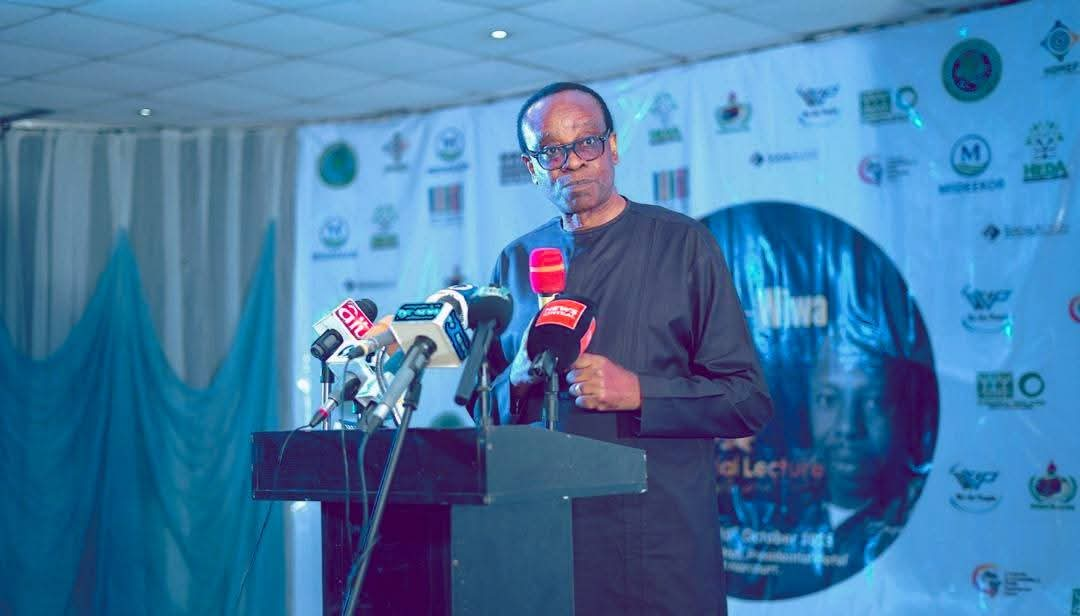
Environmental activist Nnimmo Bassey has called on Nigerians to refuse support for politicians who do not have clear plans to clean up polluted areas and restore damaged ecosystems. He warned that Nigeria's growing critical-minerals industry could lead to the same environmental damage seen from years of oil extraction.
Mr Bassey, who is the executive director of the Health of Mother Earth Foundation, said political candidates must explain how they will deal with issues like oil spills, gas flaring, and environmental damage before they ask for votes.
“Any candidate that does not have concrete plans for the remediation and restoration of the deeply damaged environment should not be given a single vote by the electorate,” he stated.
He made these comments on 17 October during the eighth graduation ceremony and annual leadership lecture at the Kebetkache Women Development and Resource Centre/Centre for Leadership, Strategy and Development Leadership School in Port Harcourt, Rivers State.
In his lecture titled Leadership for Environmental Justice in the Niger Delta, Mr Bassey challenged political leaders to take responsibility for the effects of resource extraction on communities that rely on their land and water.
He pointed out ongoing environmental issues, like the fire at the Ororo-1 oil well near the Awoye community in Ondo State. He also mentioned gas eruptions in Bille community in Rivers State and a crude oil fire at Oil Well 9 in the Ofiomina-Ama Alakiri community in Okrika, also in Rivers. These situations should guide voters' choices.
The Ororo-1 well fire has lasted for years, while residents in Bille have been threatened by toxic gas emissions, according to past media reports.
Mr Bassey’s comments come as Nigeria's mineral resources gain more attention. In September, Nigeria signed an agreement with the United States to attract American investment into the country’s estimated $700 billion mineral sector. This agreement aims to boost investment across the mining value chain.
The activist warned that moving from fossil fuels to minerals for renewable energy will not guarantee fairness if communities continue to lose their land, livelihoods, and access to natural resources.
“Changing the energy source without changing this underlying logic will not deliver justice,” he said. He cautioned that mineral extraction could create the same problems of dispossession seen in the oil industry.
He explained that the shift must focus on environmental protection, community consent, public accountability, and fair sharing of benefits.
Mr Bassey raised concerns about community safety and the environmental impact of mining in Nigeria, especially given the country’s history of pollution and weak accountability in resource extraction.
He recalled the lead-poisoning crisis from artisanal gold mining in Zamfara State, which killed hundreds of children in 2010. He also mentioned deadly mining-pit collapses in Plateau State.
He brought up the deaths of young mining suspects in custody in Niger State, saying that these incidents show a lack of leadership in managing the country’s natural resources.
Mr Bassey warned that without responsible leadership, the search for mineral wealth could put more communities at risk of environmental harm, unsafe mining practices, and loss of livelihoods.
He urged leaders to ask whether communities agreed to the extraction, if legal steps were followed, what benefits residents would gain, and how any potential environmental harm would be prevented or fixed.
He also called for stricter checks on the Petroleum Industry Act, especially its rules for Host Communities Development Trusts. Under this law, oil companies must contribute three percent of their actual annual operating costs from the previous year to develop host communities.
But Mr Bassey questioned the arrangement allowing oil companies to choose members of the trusts’ boards and the rule that lets funds be used to fix oil infrastructure damaged by others.
He insisted that policies should be judged by how they actually affect communities, not just by the promises made when they were introduced.
Mr Bassey stated that environmental justice needs leadership beyond political officeholders and formal leaders.
He pointed to women organizing to protect their water sources, young people documenting oil spills, fishers calling for investigations, and residents pushing back against pollution as examples of leadership in affected communities.
He noted that women often bear the brunt of environmental damage due to their roles in farming, fishing, collecting water, preparing food, and caring for families, yet they are often left out of decisions about land, energy, and natural resources.
He urged leadership institutions to empower women, young people, and marginalized communities to take part in decisions that affect their areas.
“True leadership listens before it speaks,” he said, adding that communities have knowledge and experience that should guide development decisions instead of being seen as passive recipients of government or corporate policies.
Mr Bassey also said development should be measured not by roads, buildings, public revenue, or economic growth, but by whether people can breathe clean air, drink safe water, feed themselves, and live without fear of environmental harm.
“The Niger Delta does not need leaders who merely manage the consequences of injustice. It needs leaders who will work with communities to dismantle the conditions that produce it,” he said.
He urged the graduating students to use their training in public offices and communities, emphasizing that leadership should be measured by the state of people, institutions, and ecosystems after their time in power.
He congratulated the graduates and welcomed the new students, urging them to focus on accountability and public service instead of just seeking positions.



Drop your comment
No comments yet — be the first to drop the gist 👇