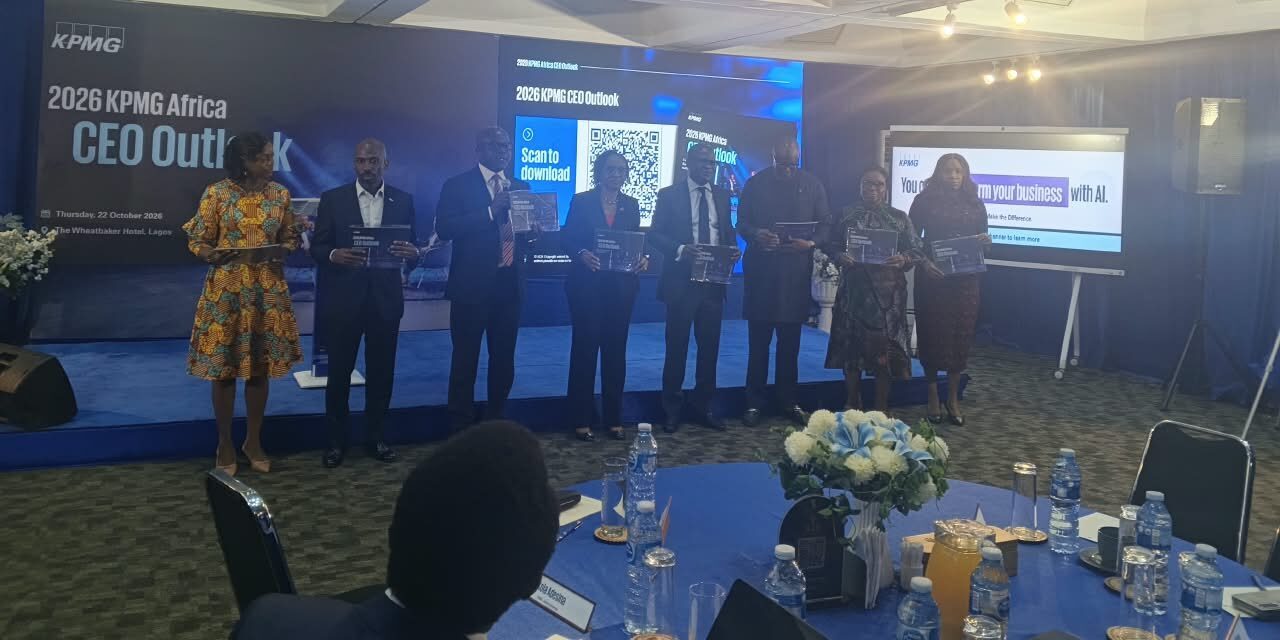
African business leaders are putting more emphasis on investing in artificial intelligence (AI). But just 14 percent think their companies are keeping up with AI changes.
In contrast, 66 percent of business leaders worldwide are ahead in AI developments, as shown in a recent KPMG survey.
The survey revealed that 72 percent of African chief executive officers (CEOs) see AI as a top investment priority. This shows a gap between the eagerness to use the technology and the readiness to implement it.
These findings come from the 2026 KPMG Africa CEO Outlook, which launched in Ikoyi, Lagos, on Thursday.
The report looks at what business leaders expect for growth, their investment focus, economic risks, workforce strategies, and readiness for sustainability across Africa.
According to the report, there is a clear gap between AI investment goals and the readiness of organizations. This highlights the challenges faced by African businesses wanting to turn their tech ambitions into real business results.
While 48 percent of African CEOs expect to see returns on their AI investments in one to three years, 71 percent of global CEOs feel the same. Meanwhile, 42 percent of African CEOs believe it will take more than three years to see returns, while only 12 percent of global CEOs think that way.
The report suggests that the longer wait for returns might be due to the need for better data systems, integrating AI into current operations, setting up proper governance, and developing skills to make the most of AI.
At the launch, Tola Adeyemi, senior partner and CEO of KPMG One Africa, said the survey aims to challenge the current views of business leaders, spark fresh ideas, and support the decisions they are making.
The firm spoke to 176 CEOs from all over Africa, covering north to south and east to west, as part of a larger global survey of 1,400 CEOs across various industries.
“One clear message from the survey about the economic outlook is that African CEOs are hopeful about the growth of their businesses, despite the challenges they face,” Mr. Adeyemi said.
He also pointed out that ambition alone won’t bring the expected results. Businesses need to execute their plans well and show resilience to achieve their growth goals.
Mr. Adeyemi also responded to fears that AI adoption would lead to job losses. He noted that African CEOs expect their workforces to grow as companies start using the technology.
“Instead, it is about reskilling the workforce and finding new types of talent that can work with technology to get better results,” he said. He stressed that changing the workforce is a key part of the AI discussion.
The survey found that 84 percent of African CEOs expect their teams to grow in the next three years, compared to 89 percent globally.
It also showed that 86 percent want to keep and retrain talented employees, while 82 percent are changing roles, career paths, and team structures to support better teamwork with AI.
Despite these intentions, there are still big skills shortages. About 59 percent of African CEOs see skills gaps as a challenge, 58 percent mention the need for AI training, and 52 percent have trouble attracting and keeping talent.
The results suggest that how well businesses can benefit from AI will depend not just on technology investment but also on their ability to develop their workforce and systems to use AI effectively.
The report identified cybersecurity and data security, along with supply-chain resilience, as the biggest threats to growth, each noted by 31 percent of African CEOs. The integration of AI into business operations follows at 27 percent.



In response, 45 percent of African CEOs said they are increasing spending on cybersecurity and digital risk management. Meanwhile, 36 percent are investing more in meeting regulations and reporting, and 31 percent in AI integration.
Mr. Adeyemi mentioned that the findings show how important resilience is as businesses prepare for the coming year.
“I expect that as we move from 2026 into 2027, we will keep seeing this focus on resilience as a driver of growth,” he said.
Despite the challenges, African CEOs generally feel positive about the economy.
The survey found that 66 percent of CEOs are confident in the global economy, close to the global average of 65 percent.
Confidence in local economies is at 72 percent, while 79 percent believe in their own companies’ growth.
This optimism comes after a year of solid business performance, with 86 percent of African CEOs reporting revenue growth in their latest financial year.
But only 58 percent expect annual earnings growth of at least 2.5 percent in the next three years, compared to 68 percent globally.
The findings suggest that turning revenue growth into steady profits is still tough for businesses facing economic uncertainty and increasing operational challenges.
“Africa’s growth chances will depend on how well businesses collaborate across markets, develop talent, and build the skills they need to compete in a changing global economy.
“The focus should be on taking action on these opportunities, with investment choices that boost resilience today while preparing for long-term growth,” Mr. Adeyemi added, outlining how African CEOs can turn their confidence into action.
The report highlighted Africa’s energy resources, critical minerals, growing consumer markets, and chances to develop local manufacturing as potential attractions for investment as global supply chains evolve.
However, making the most of these opportunities will rely on having dependable energy, solid infrastructure, skilled workers, good connectivity, and stable regulations, the report noted.
The survey also found improvements in sustainability reporting readiness. About 65 percent of African CEOs believe their organizations can meet new reporting needs, up from 55 percent last year.
Yet only 48 percent said they are embedding sustainability more deeply into their business strategies, compared to 63 percent globally.
KPMG pointed out that the bigger challenge is to integrate sustainability into business decisions in ways that boost resilience, efficiency, and long-term value.
Apart from technology, the survey highlighted economic uncertainty and geopolitical issues as major factors for African businesses.
The report linked these disruptions to changing energy prices, supply chain issues, and trade relationships that impact costs and investment choices.


Drop your comment
No comments yet — be the first to drop the gist 👇