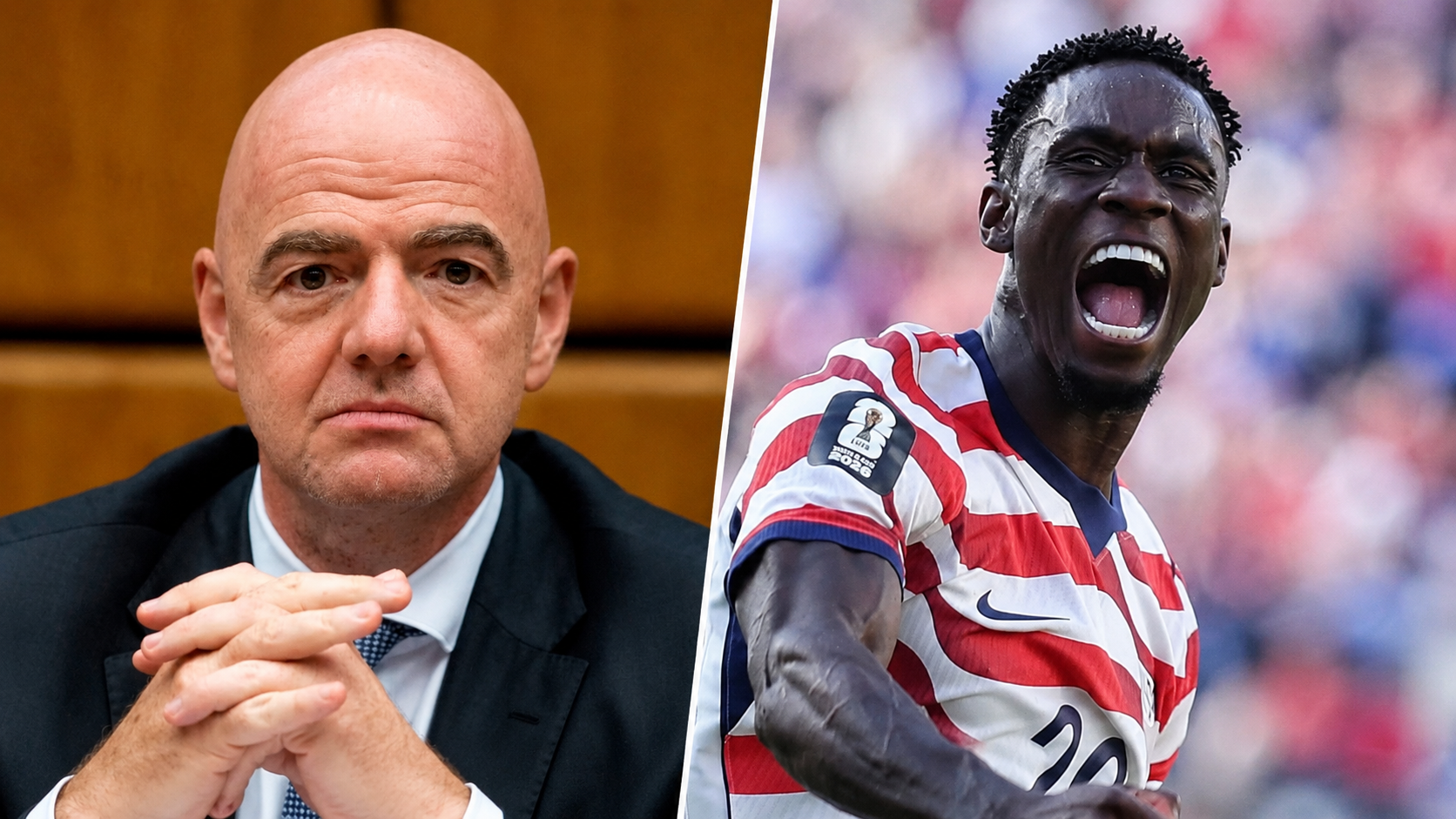
Until last week, Folarin Balogun was in the news for all the right reasons.
The United States striker, who has Nigerian roots, has been one of the best players at the 2026 FIFA World Cup. His three goals helped the co-hosts reach the knockout stage, earning him praise and boosting his reputation internationally.
Today, Balogun is making headlines for a different reason.
Instead of celebrating his goals, people are talking about FIFA’s decision to let him play in the Round of 16, even after he received a red card in the previous match.
This decision has started one of the biggest debates about discipline in World Cup history.
By pausing Balogun’s automatic one-match ban, FIFA has not only allowed one of the tournament's top stars to play against Belgium, but has also opened a broader discussion about fairness, consistency, and trust in football rules.
Criticism has come from many sides.
UEFA has accused FIFA of undermining the game’s rules, Belgium has questioned the legality of the decision, and former FIFA president Sepp Blatter has warned against any political influence in football.
International media outlets, including BBC Sport, Associated Press, and CBS News, have also increased scrutiny after revealing details about what led to FIFA’s ruling.
The controversy has gone beyond just Balogun himself.
It has become a test of whether football’s governing body can still convince players, coaches, and fans that the same rules apply to everyone.
An Unusual Decision
Balogun was red-carded during the United States’ win over Bosnia and Herzegovina in the Round of 32.
Usually, that would end the matter.
According to FIFA’s World Cup rules, any player who gets a straight red card automatically misses the next match. This is one of football’s clearest rules and has rarely been debated.
Instead, FIFA stated that while Balogun’s red card would stay on his record, the one-match suspension would not take effect right away.
The governing body used Article 27 of the FIFA Disciplinary Code, which allows suspending a disciplinary sanction under certain conditions.
FIFA referenced Article 27 in a brief statement but did not explain why Balogun’s case was treated differently or what factors influenced the decision.
This lack of explanation has become a major issue in the controversy.
Questions quickly followed.
Why was Article 27 used in this situation?
Why was Balogun allowed to play while every other player sent off at this World Cup served their suspension?
What made his case different?
Without clear answers from FIFA, the discussion has shifted from Balogun’s red card to how decisions are made.
According to BBC Sport, Article 27 has never been used before to pause an automatic red-card ban during a FIFA World Cup. This makes Balogun’s case unique in the tournament’s modern history.
A Rule Once Untouchable
For many years, players, coaches, and fans accepted one simple fact about the World Cup.
If a player gets a straight red card, he misses the next game.
There has never been room for negotiation or appeal in the tournament.
This certainty has helped protect the trust in the competition because every team expects the same rule to apply fairly.
According to BBC Sport, there have been 189 red cards in World Cup history, but only one player has managed to avoid the usual suspension.
That player was Brazil's Garrincha during the 1962 World Cup in Chile.
Garrincha was sent off in Brazil’s semi-final against Chile but was later allowed to play in the final against Czechoslovakia.
Even then, the decision faced claims of political pressure and remains one of the most contested rulings in World Cup history.
More than sixty years later, Balogun is now only the second player to benefit from such an extraordinary ruling.
This comparison has raised more questions about FIFA’s actions.
For many, FIFA’s decision has also highlighted another important issue.
If Article 27 can now be used to pause an automatic World Cup ban, national teams may start asking for similar treatment whenever one of their key players is sent off.
In trying to fix one disciplinary issue, FIFA may have created a bigger problem for future tournaments.
That is why many believe the debate is no longer just about Balogun.
It is about whether one of football’s oldest rules has quietly become open to exceptions.
UEFA Draws the Line
One of the strongest criticisms of FIFA’s decision has come from UEFA.
In a strong statement on its website, UEFA said FIFA has gone too far by suspending Balogun’s automatic ban.
UEFA called the decision one that had “crossed a red line.”
“Football, like every sport, depends on rules that ensure fair, honest, and transparent competition,” UEFA stated.
The organization argued that an automatic suspension after a red card is a fundamental rule of football and should not be up to any committee’s discretion once the dismissal is confirmed.
“A minimum automatic suspension of one match after a red card is not optional,” UEFA insisted. “It is a principle in the regulations, which cannot be made subject to exceptions, especially in the middle of a tournament where other players have faced similar situations and served their suspensions.”
UEFA warned that changing how such a rule is applied during the World Cup could harm the credibility of the competition and create issues for future disciplinary cases.
“When the certainty of rules is not guaranteed by those in charge, the integrity of the game is at risk, and the credibility of a competition is damaged,” the statement added.
The European body finished by expressing its “disbelief at such an unprecedented, incomprehensible, and unjustifiable decision.”
This language shows just how seriously UEFA views the issue.
It is rare for football’s two most powerful governing bodies to disagree so openly over a disciplinary matter.
Political Questions Remain
The controversy grew after reports surfaced that United States President Donald Trump had spoken with FIFA president Gianni Infantino before Balogun was allowed to play.
CBS News reported, citing sources familiar with the call, that Trump brought up Balogun’s suspension during a conversation with Infantino before FIFA made its decision.
Neither FIFA nor the White House has publicly said the conversation influenced the ruling.
Still, these reports have sparked debate over whether politics played a role in one of the World Cup’s most controversial decisions.
Former FIFA president Sepp Blatter added to those concerns.
Writing on X, Mr Blatter said: “Red cards are not overturned by political phone calls. They are overturned by rules, evidence, and independent bodies.”
He added: “Football must never become a playground for political power.”
Mr Blatter did not accuse anyone of interfering in the process.
Instead, he questioned the impression given by the sequence of events, saying that football’s disciplinary decisions must remain independent to keep public trust.
Whether politics influenced FIFA’s decision may never be known.
But in football, perception matters just as much as reality.
Without a full explanation from FIFA, questions that could have been cleared up with transparency continue to dominate the discussion.
Belgium Says Football Is the Real Loser
Belgium, the United States’ Round of 16 opponents, has made its frustration clear.
In a statement, the Belgian Football Association said it was “astonished” by FIFA’s decision, arguing that it goes against the rules discussed with participating nations before the tournament.
The federation insisted that the World Cup rules clearly state that a player sent off automatically misses the next match.
Belgium coach Rudi Garcia was even more direct.
“I didn’t know that at the FIFA World Cup, 5 July is now 1 April,” he told reporters, suggesting the decision felt like an April Fool’s joke.
“We are not defending the national team or the federation,” Garcia added. “We’re defending football.”
His comments echoed concerns shared beyond Belgium.
Other players sent off during this World Cup have served their suspensions without exception.
Some have even received longer bans.
The case of Qatar midfielder Assim Madibo comes to mind, as he was handed a five-match suspension for an incident with Canada’s Ismael Koné.
Given this context, Balogun’s reprieve has raised questions about equal treatment.
If one player can escape an automatic suspension, many are asking why others were not given the same chance.
A Decision That Could Shape Future World Cups
The impact of FIFA’s ruling may go beyond this tournament.
For years, national teams accepted that a World Cup red card meant missing the next match.
That certainty may now be gone.
Football lawyers and national associations could use the Balogun case whenever a key player faces suspension at future tournaments.
Every controversial dismissal could lead to appeals and demands for similar treatment.
That is why many believe this case is about much more than one player.
It is about the consistency of football’s disciplinary system.
If exceptions become more common, FIFA may find it harder to convince teams that every case is handled equally.
More Than a Balogun Story
Balogun’s return may help the United States in their quest to reach the quarterfinals for the first time since 2002. The U.S lost in the Round of 16 to Ghana in 2010, Belgium in 2014, and the Netherlands in 2022. They failed to advance from the group stage in 2006 and didn’t qualify for the 2018 tournament.
But the discussion around his eligibility has grown much larger than just football tactics or team choices.
It has highlighted the challenge FIFA faces in balancing flexibility with fairness.
Rules are meant to bring certainty.
When exceptions are made, especially in the biggest football tournament in the world, they must be explained clearly and convincingly.
So far, that explanation has not come.
Instead, FIFA’s silence has allowed questions to grow louder, while criticism spreads across football.
Whether FIFA will eventually share the full reasons behind its decision remains uncertain.
For now, the Balogun controversy has become one of the key talking points of the 2026 World Cup.

Drop your comment
No comments yet — be the first to drop the gist 👇