There has been a drop in Boko Haram violence in Nigeria since the first quarter of 2026, a report reveals.
This decline is especially notable in Borno State. It might add weight to claims of a ceasefire agreement between the Nigerian government and the militant group. But the decrease in violence could also result from military successes against Boko Haram. This is significant since the drop began before the supposed ceasefire.
Data from the Armed Conflict Location and Event Data (ACLED) project shows a steady decline in violent incidents involving Boko Haram, also called Jama’atu Ahl al-Sunna li-Da’wa wa-l-Jihad (JAS), in Nigeria over three straight quarters in 2026.
This trend aligns with reports of a ceasefire reached between the Nigerian government and a Boko Haram faction led by Bakura Doro in June. This deal followed talks that led to the release of 360 civilians kidnapped from the Ngoshe community in Borno State.
The alleged agreement, which the Nigerian military has denied, was first highlighted by The New Humanitarian in September. Three people with ties to Boko Haram, including some senior members, told the publication that the truce had been active since June and was likely to be extended.
About two months after this report, the Nigerian military challenged it. They stated troops are still engaging with all terror groups across various frontlines. Earlier, a Boko Haram judge dismissed the report, calling it "a lie" and a political tactic by the Nigerian government ahead of the 2027 elections.
The supposed ceasefire did not include the rival Islamic State West Africa Province (ISWAP), which is seen as more dangerous than JAS.
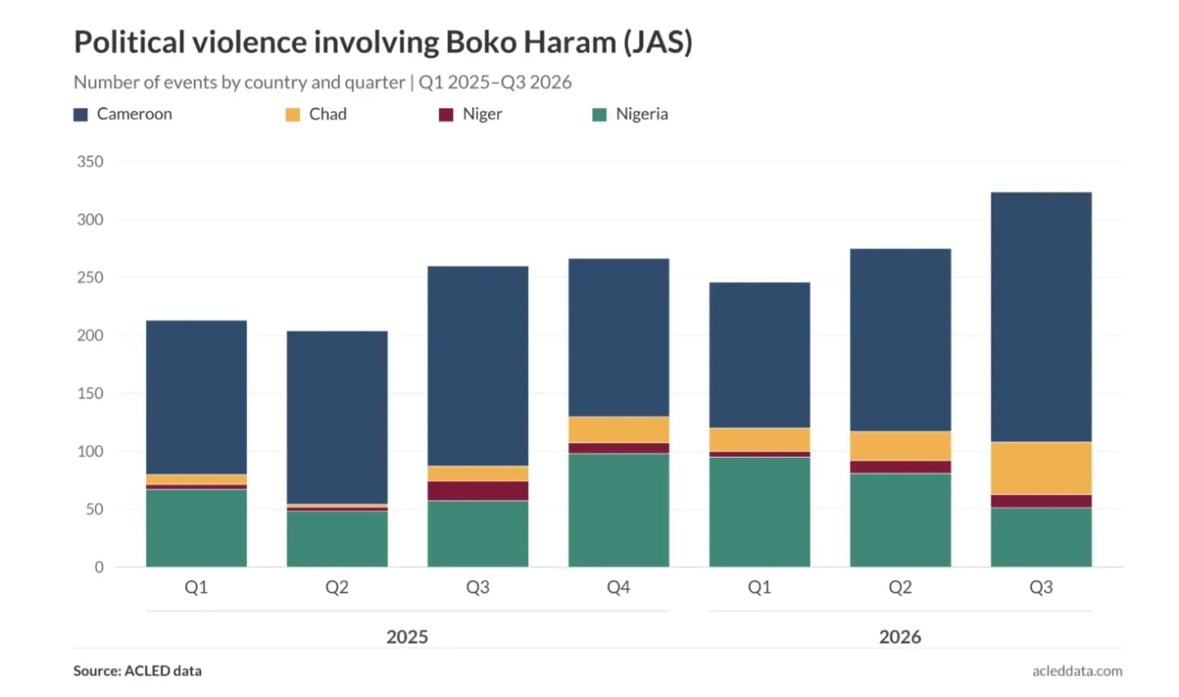
The ACLED data, shown in an infographic, tracks political violence involving Boko Haram across Nigeria, Cameroon, Chad, and Niger from the first quarter of 2025 to the third quarter of 2026. It shows a clear decline in recorded events in Nigeria during this time.
In the first quarter of 2026, Nigeria saw about 95 events involving the group. This number dropped to around 80 in the second quarter and about 50 in the third quarter. This shows a nearly 50 percent reduction between the first and third quarters.
This drop comes after a relatively high activity level in the last quarter of 2025, when Nigeria recorded close to 100 events with the group.
The numbers suggest the decline began before the reported ceasefire started. However, the chart does not provide a specific breakdown for Borno. ACLED’s separate analysis indicates that violence involving JAS decreased in parts of Borno following the reported agreement.
While Nigeria sees a drop in violence, the situation is different in neighboring countries. In Cameroon, recorded events increased significantly during the same period.
The infographic shows that Cameroon recorded about 125 events in the first quarter of 2026. This rose to around 155 in the second quarter and more than 210 in the third quarter.



Chad also saw an increase, especially in the third quarter. Niger had a smaller number of recorded events.
These figures suggest that while JAS-related violence is falling in Nigeria, the group's activities are growing across the border. This raises concerns about the wider regional effects of the reported ceasefire.
In a comment with the infographics, Ladd Serwat, ACLED’s Africa senior analyst, said the reported peace deal highlights the challenges of negotiating with an armed group that operates across borders without strong security coordination.
“Although ACLED data show that violence involving JAS in Borno State declined after the agreement, JAS has stepped up operations across the border in Chad’s Lac province and Cameroon’s Far North region,” Mr Serwat stated.
He noted that the group has increased targeting civilians, mainly through kidnappings for ransom.
“With this rise in Cameroon and Chad, overall violence involving JAS actually grew in the second and third quarters of 2026 compared to the average quarterly violence over the previous year,” he added.
Despite the apparent link between the violence drop and the reported ceasefire, ACLED warned against saying the decline is solely due to the agreement.
In a prior analysis from September, Mr Serwat mentioned that violence involving JAS peaked in April 2026 before dropping in May, a month before the alleged ceasefire began.
He pointed out that both clashes with military forces and attacks on civilians have decreased, along with reported deaths.
The analyst also stressed that the reduction was not uniform across affected areas. Some local government areas, like Hong in Adamawa State, recorded sporadic increases in violence during the reported truce.
“So, the reported ceasefire comes against the backdrop of an overall decline involving JAS that was already visible over several months, rather than marking a clear break from the previous violence pattern,” he said.
The ACLED assessment highlights the limits of any local ceasefire with an armed group that operates beyond Nigeria’s borders. While the drop in violence may bring some relief to communities in Borno and other areas, the simultaneous rise in JAS activities in Cameroon and Chad shows that the reported agreement has not led to better regional security.




Drop your comment
No comments yet — be the first to drop the gist 👇