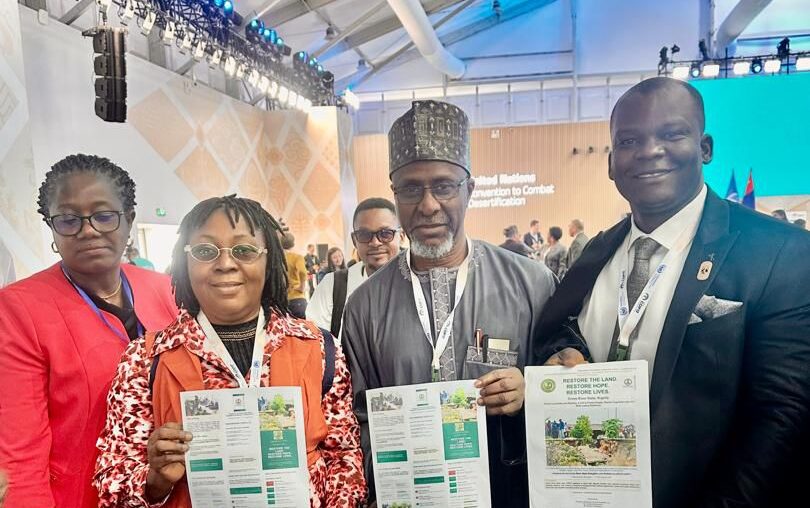
The Cross River State government team at the ongoing 17th session of the United Nations Convention to Combat Desertification Conference (COP17) in Mongolia is working to attract investors and partners. They want to tackle the state’s worsening environmental problems.
The team, which includes Martins Achadu, the Chairman of the Cross River State House of Assembly Committee on Education and Vice Chairman of the Committee on Environmental Matters, and Catherine Ubi, Clerk of the State House of Assembly, said they are using COP17 to bring global attention to issues like land degradation, erosion, and flooding in the state.
They shared this during an interview with PREMIUM TIMES at the conference in Ulaanbaatar on Thursday.
On Monday, PREMIUM TIMES reported that the Cross River State Government had presented its July-August 2026 landslide and flood disasters at COP17. They are asking for $25 million in international support for emergency response, ecological restoration, and long-term resilience.
The appeal is part of the proposed Cross River Restore Hope Initiative, which the state is presenting to potential investors and partners at COP17.
Seeking Investment and Partnerships
At the COP17 venue, PREMIUM TIMES noticed Cross River delegates handing out pamphlets and copies of their report on the state's ecological challenges. This report highlights disasters that have impacted lives and livelihoods.
The Cross River team, along with representatives from Yobe State, is also taking part in several side meetings and engaging with important delegations during the second week of the conference.
On Tuesday, the Cross River and Yobe teams met with Nigeria’s Minister of Environment, Balarabe Lawal, and the Director-General of the Nigeria Climate Change Council, Omotenioye Majekodunmi.
During the meeting, Mr Lawal expressed the Federal Government’s readiness to work with Cross River to tackle the environmental issues raised. He also pointed out worries about ongoing illegal logging in the state and urged the team to strengthen efforts to combat deforestation.
“The previous administration did not do much to address illegal logging in your state. Most of the trees are being cut down. You have to go back and enforce laws to address these. The federal government can step in to help with some of your issues,” Mr Lawal told the delegation.
PREMIUM TIMES learned that the federal government of Nigeria approved at least 65 delegates to attend the UNCCD COP17 from Nigeria. But it seems not all the delegates made it to Mongolia. Unlike the annual UNFCCC COP, Nigeria did not have a pavilion at the ongoing COP17 conference.
‘We Need Additional Intervention’
Speaking with PREMIUM TIMES on Thursday, Mr Achadu said attending COP17 has shown him the gaps in Nigeria’s environmental policies. He believes stronger laws could help with land restoration, biodiversity conservation, and environmental management.
He noted that the erosion crisis in Cross River has worsened. The damage now exceeds what current funding can handle.
“We need additional intervention. He agreed, and we assured him that even if our governor had to personally engage him, he would visit Calabar.
“We also met with the World Bank Country Director and many other stakeholders, and all of them were very positive,” he said.

He added, “No one hears the story of Cross River without feeling sympathy. But it all comes down to national interest.”
According to the lawmaker, if Nigeria treats the environmental challenges in Cross River as national priorities, many issues can be resolved.
He also mentioned that the delegation is looking for opportunities beyond emergency help, especially in agriculture and water management.
“It is all very promising. We have their contacts, and when we return home, we will sit down and start formal discussions with them. The engagement will build from there,” he said.
Biodiversity Under Pressure
Cross River is known as one of Nigeria’s key biodiversity hotspots. It has vast tropical rainforest and holds a significant portion of the country’s remaining forest biodiversity.
The state is home to the critically endangered Cross River gorilla, chimpanzees, drills, forest elephants, and many other plant and animal species found near the Nigeria-Cameroon border.
Its forests are part of the larger Guinea-Congolian rainforest and the Cameroon Highlands ecological area, making the state crucial for regional biodiversity conservation.
But illegal logging, agricultural land expansion, severe weather events like floods and landslides, and infrastructure development are putting pressure on these ecosystems.
COP17 Negotiations
The 17th UNCCD COP, which started in Ulaanbaatar on 17 August, is set to wrap up on 28 August, depending on the agreement among the parties.
The conference theme is “Restoring Land. Restoring Hope.” It is also happening during the UN-designated International Year of Rangelands and Pastoralists.
The discussions focus on fighting land degradation and drought, improving land restoration, and mobilizing financing to support vulnerable countries and communities.
As delegates enter the final hours of negotiations, they are still working to resolve differences on how to enhance global action on land degradation, drought, and sustainable financing.
For Cross River, the conference has become a chance to turn its environmental issues into a call for international investment and partnerships.

Drop your comment
No comments yet — be the first to drop the gist 👇