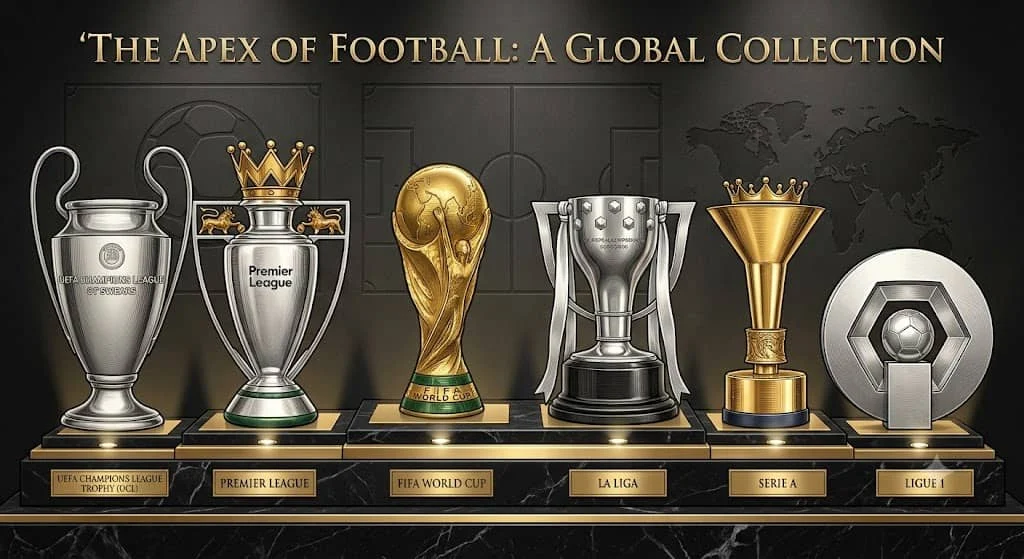
A debate has been ongoing in football circles about what winning a trophy really means.
Not the glory. Not the history. Not the feelings that come with lifting it.
The money.
How much is the FIFA World Cup really worth? Is winning the UEFA Champions League more valuable than winning the World Cup?
Is the Premier League title worth more than several championships in Spain, Italy, Germany, or France?
And why do some clubs seem to care more about one trophy than another?
These questions have become more relevant after claims that the financial value of the World Cup is less than that of the Champions League. There is also a popular belief that winning the Premier League is worth as much as winning several La Liga titles.
But the way football prize money is set up makes these comparisons tricky.
Some competitions have a clear winner’s prize.
Others share money through participation fees, performance bonuses, TV rights, commercial revenue, and historical factors.
So, to value a trophy properly, PUNCH Online looked into the direct prize money and other financial rewards related to some of football’s biggest international, European, and domestic trophies.
World Cup: $51 million for the winner
The 2026 FIFA World Cup has the biggest prize pool ever seen in the history of the event.
The total payout to the 48 teams was $871 million. Spain, who won the tournament, got $51 million as champions.
Argentina, the runners-up, got $34 million. England and France received $30 million and $28 million for finishing third and fourth.
The $51 million is the prize for winning, not the total financial impact of taking part in the tournament.
FIFA also pays teams based on how far they go and gives preparation money to all participating nations.
So, the total amount is much bigger than just the winner’s check alone, according to AP News.
The World Cup’s champion prize is significant, but its financial model is different from club football.
The tournament occurs every four years, and the cash goes to national associations instead of directly to clubs or players.
Champions League: The financial powerhouse
The UEFA Champions League shows a clear financial comparison.
For the 2025/26 season, UEFA expects €2.467 billion for clubs in the Champions League and Super Cup.
UEFA says the Champions League payout includes:
- €670 million in shared payments;
- €914 million in performance bonuses;
- €853 million through the value pillar.
This system allows a successful club to earn money throughout the competition instead of just getting one winner’s prize, according to UEFA’s website.
The difference can be huge.
A report by La Gazzetta dello Sport estimated that the Champions League winner could earn around €150 million in total income from the competition, depending on performance, coefficients, and market-related payments.
In the 2025/26 season, a separate report from The Athletic projected Paris Saint-Germain’s Champions League earnings to be about €146 million, including the final win.
This is why some argue that the Champions League can financially surpass the World Cup when looking at the total earnings of a successful club compared to the World Cup winner’s prize.
But it is not a direct comparison.
The World Cup is a national-team event every four years, while the Champions League is an annual club competition where teams can earn money at different stages.
Premier League: No winner’s prize
The Premier League is a clear example of why saying “prize money” can be misleading.
The league states there is no specific prize fund for being champions.
Instead, clubs receive central payments based on their final position.
The Premier League explains, “But in the Premier League there is no specific prize fund for being crowned champions.”
The club that finishes first gets the highest merit payment calculated on a sliding scale from first to 20th place, according to the Premier League.
For example, in the 2024/25 season, champions Liverpool received £53.1 million in merit payments.
This is just one part of the club’s total income from the Premier League.
The league also shares broadcast and central commercial revenue. The Premier League confirmed that clubs received central payments for the 2024/25 season and that more than £550 million was committed to the wider game during that time.
So, the value of winning the Premier League cannot just be described as £53.1 million.
The real financial gain includes the champion’s merit payment, central distributions, commercial income, sponsorship effects, and the value of qualifying for European competitions.
Is one EPL title worth five La Liga titles?
The common claim that winning the Premier League equals five La Liga titles needs careful checking.
The two leagues do not have the same prize-money systems.
La Liga clubs earn revenue mainly from the sale of broadcasting rights and other central income sources.
The reward for finishing first is not just a single cheque labeled “La Liga winner’s prize.”
Reports have estimated the payout for the champion at around €55 million to €60 million, but this depends on the distribution formula and other income sources available.
So, the idea that one Premier League title is worth five La Liga titles is not a simple comparison of winner’s prizes.
The difference between the two leagues is found in the size of their entire commercial environment.
The Premier League’s TV and commercial revenues are much higher, meaning that the financial gap between English clubs and those in other top European leagues can widen greatly when considering all payments, sponsorships, and European income.
In short, the “ten La Liga titles” claim is not about direct prize-money comparison. It looks at wider revenue, and even then, it varies based on the income included.
Bundesliga: The value linked to central distribution
The Bundesliga does not have a straightforward winner-takes-all prize either.
Germany’s DFL distributes centrally marketed media revenue based on a formula that considers equal distribution, performance, fan interest, and youth development.
From 2025/26 to 2028/29, the DFL approved a new distribution method while keeping the main focus on equal distribution, performance, interest, and youth development, according to DFL Deutsche Fußball Liga.


This means winning the Bundesliga does offer financial benefits through performance, but the overall value also relates to the club’s revenue profile.
So, a Bundesliga champion cannot be compared to a Premier League champion just by looking at a single official winner’s cheque.
Serie A: About €70 million for the champion
Serie A shows how a league title's value relates to TV rights distribution.
Reports say the financial reward for the Serie A champion is about €70 million, but this can change based on the distribution system and how revenue is shared among clubs.
The Italian model gives part of broadcasting revenue based on league position.
For the 2025/26 season, La Gazzetta dello Sport reported that the league-position component had a total of about €100 million. The second-placed club got €13.2 million, the third got €11.3 million, and the fourth received €9.4 million from that component.
This amount is separate from the financial impact of qualifying for the Champions League.
This distinction is key.
For many Serie A clubs, the financial benefit of finishing high in the table comes as much from Champions League qualification as from winning the Scudetto itself.
Ligue 1: The title is valuable, but the gap is wider
France's Ligue 1 also works through central TV and commercial payments instead of one big winner’s cheque like the Champions League.
The value of winning the title includes the champion’s share of league distributions, performance payments, commercial benefits, and importantly, qualification for the Champions League.
The difference between Ligue 1 and the Premier League is not only about the money tied to winning the trophy.
It also involves the size of the local broadcast market and the commercial value that comes with playing in England’s top league.
This is why the financial results of winning a league title can vary significantly, even if the sporting achievement is similar.
Domestic cups: prestige often matters more than prize money
The gap between sporting prestige and direct prize money is most clear in domestic cup competitions.
FA Cup, £2.12 million
The 2026/27 Emirates FA Cup prize fund states £2.12 million for the winner and £1.06 million for the runner-up.
The Football Association’s official prize document says: “Final winners … £2,120,000.”
So, the FA Cup champion gets a direct prize much smaller than the money available in the Champions League.
Still, the competition is one of the most historic trophies in English football.
DFB-Pokal, smaller direct prize, bigger domestic prestige
Germany’s DFB-Pokal also has a prize system that rewards clubs as they progress.
Bayern Munich won the 2026 final against VfB Stuttgart, getting their 21st DFB-Pokal title.
The direct prize money is modest compared to the Champions League, but the trophy is a major part of German football’s history.
Coppa Italia
The Coppa Italia also has a financial value smaller than the Champions League. Its importance lies in domestic prestige, European qualification, and the commercial value of winning a national cup.
Coupe de France
The Coupe de France shows that a trophy's direct prize money does not always define its importance.
For many clubs, especially those outside the elite, a strong cup run can lead to visibility, ticket sales, sponsorship interest, and chances to beat bigger teams.
Why clubs might not value every trophy equally
These financial details help explain why clubs sometimes focus on one trophy more than another.
A club targeting the Champions League might rest players in a domestic cup because the European competition can make tens of millions more.
A club fighting relegation may prioritize staying in the league over a cup run since being in the Premier League is worth much more financially than winning a domestic cup.
For clubs outside the European elite, a domestic cup can be their best chance for silverware and European football.
So, the same trophy can mean different financial things depending on the club.
For a global super-club, a domestic cup might not matter much.
For a smaller club, it could be their biggest achievement ever.
The conclusion: what is football’s most valuable trophy?
The answer depends on how you measure it.
By direct performance prize, the 2026 World Cup champion’s $51 million is huge but less than what a Champions League winner can make.
In terms of annual domestic league economics, the Premier League is the financial giant, but it does not have a single winner’s prize.
For championship-related payments, La Liga and Serie A can give tens of millions to their champions, making the claim that one Premier League title equals five or more La Liga titles not straightforward.
For knockout-cup prizes, the FA Cup’s £2.12 million is small compared to the Champions League.
But football trophies are not just about money.
The Champions League is a yearly competition.
The World Cup happens every four years.
A domestic league is decided over a whole season.
A cup can be won in one match.
The true value of a trophy combines prize money, broadcast income, commercial returns, qualification benefits, rarity, history, and sporting prestige.
That is why a trophy with a lower cash value can still mean a lot to a player.
And it is also why, in today’s football, the question is not just, “What is the trophy worth?”
The better question is:
“What financial opportunities does winning the trophy create?”




Drop your comment
No comments yet — be the first to drop the gist 👇