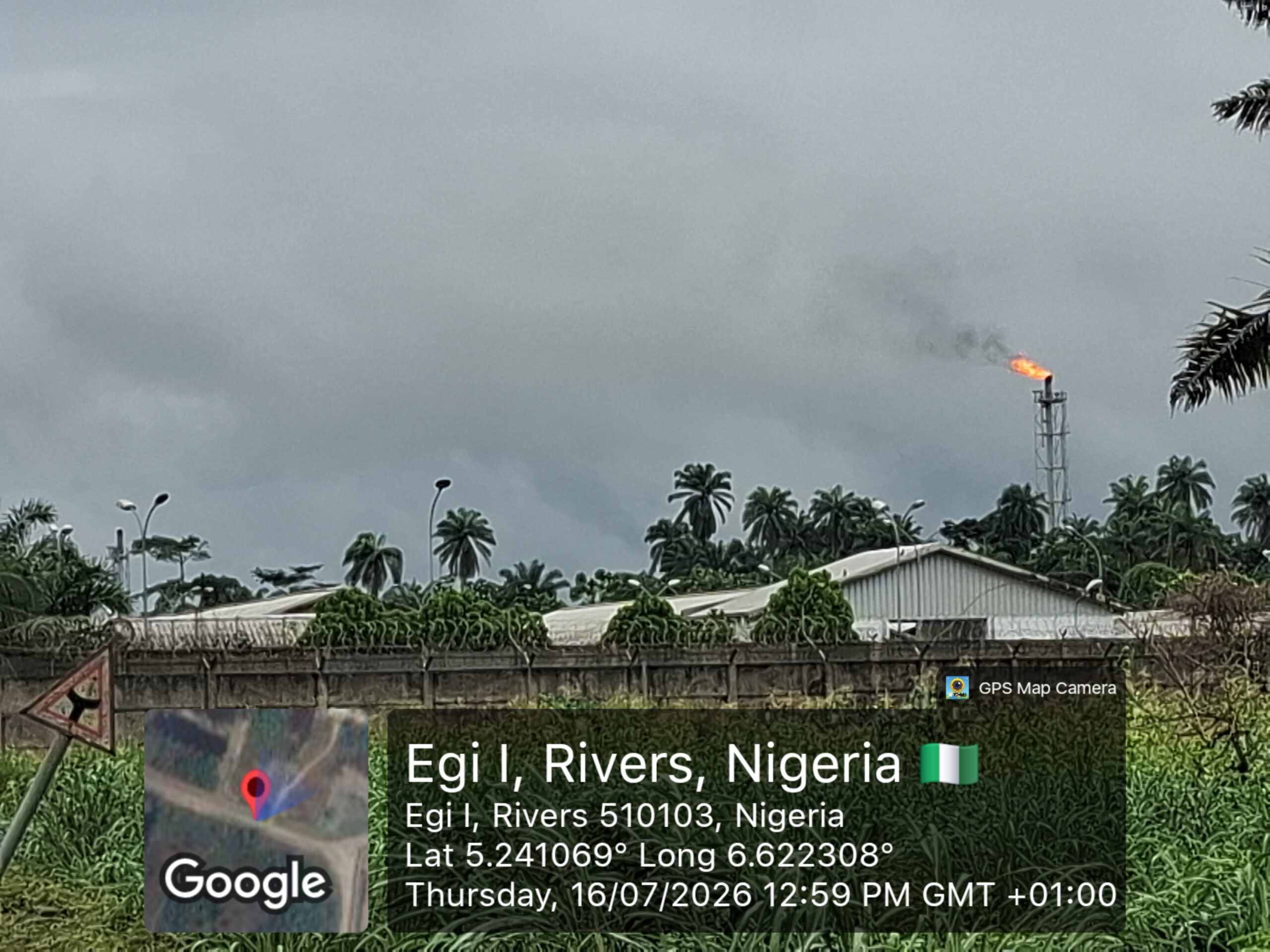
For years, people in Obite, Obagi, and nearby communities in Ogba-Egbema-Ndoni Local Government Area of Rivers State have watched flames erupt from TotalEnergies’ oil facilities. These flames light up the night and, according to the locals, change their lives.
Even after TotalEnergies said it reached a major environmental goal, the flames did not go away. Residents told PREMIUM TIMES that flaring continued.
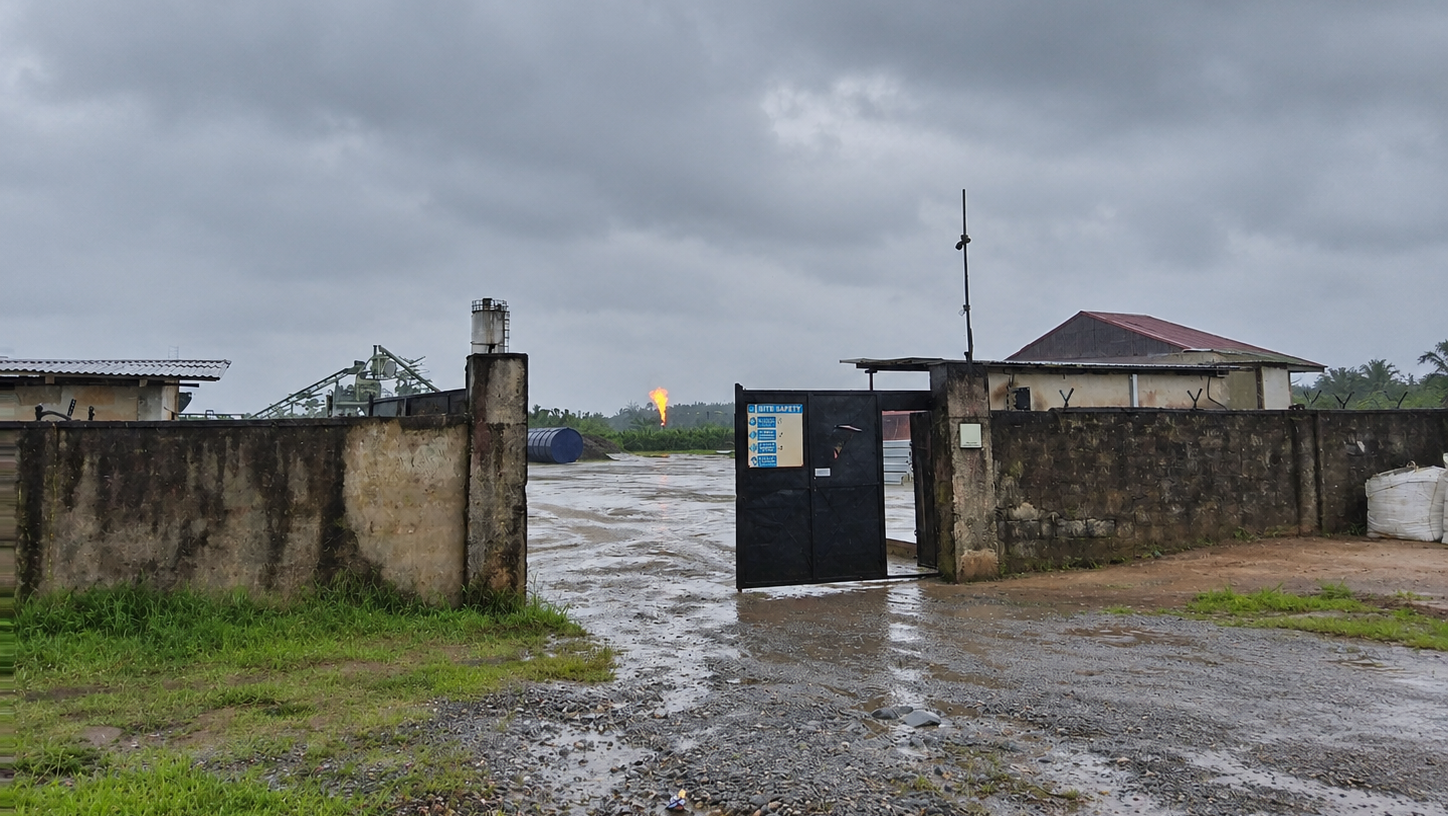
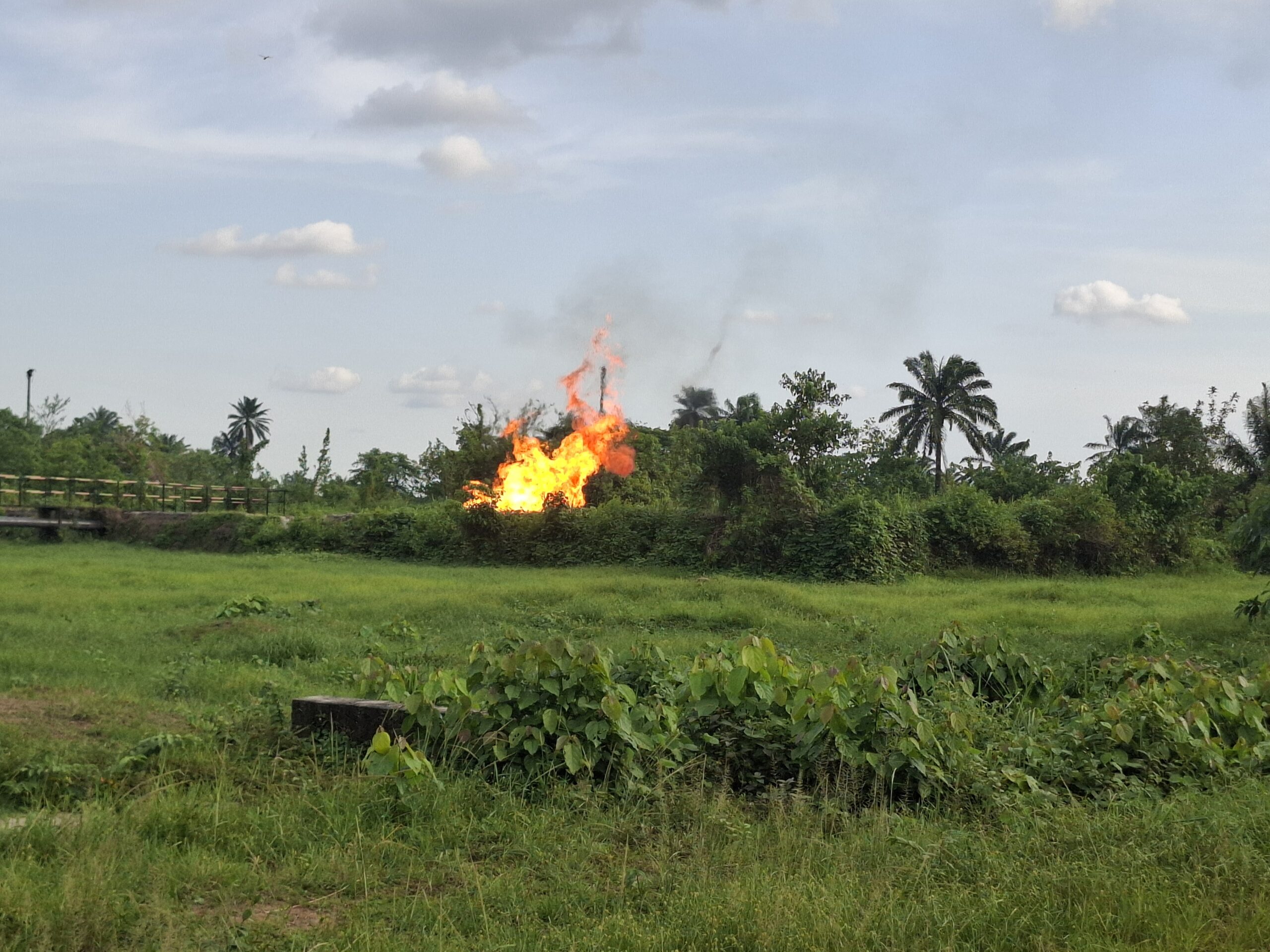
In July, PREMIUM TIMES visited areas around Oil Mining Lease 58, TotalEnergies’ main onshore property in Nigeria. Our reporter saw flare stacks burning continuously, day and night.
At TotalEnergies’ facility in Obite, two flare stacks were visible. One burned brightly while the other had a small flame. In Obagi, home to the Obagi Oil Field, we saw two more flare stacks burning without pause during our visit.
TotalEnergies claims it will end routine flaring at OML 100 by December 2023. This is said to be the last Nigerian asset still involved in routine flaring. However, information gathered by PREMIUM TIMES and reports from residents show that significant flaring is still happening around OML 58 since the announcement. Additional government data also reveals an increase in gas flaring at another TotalEnergies asset after this announcement.
The company has not clarified why PREMIUM TIMES observed ongoing flaring. Officials did not respond to our repeated requests for details, which leaves an important part of the company’s environmental claim unverified.
This observation alone does not prove that the company has continued routine flaring against its promise. TotalEnergies makes a distinction between routine flaring and non-routine flaring for safety purposes. Flaring can happen for reasons other than the regular disposal of associated gas.
However, the company has not shared the necessary data or regulatory documents to confirm what kind of flames were seen around OML 58. This lack of information is central to this investigation.
The ongoing flares raise questions about TotalEnergies’ environmental claims in Nigeria. If routine flaring ended in 2023, what are the flames that residents still see?
The Promise
On December 2, 2023, at COP28 in Dubai, TotalEnergies signed the Oil and Gas Decarbonization Charter along with 49 other oil and gas firms.
This charter commits members to aim for net-zero operational emissions by or before 2050, near-zero upstream methane emissions by 2030, and to eliminate routine flaring by 2030. It also calls for emissions monitoring and reporting.
TotalEnergies was quick to show off its progress in Nigeria, where it operates five assets: OML 58, 99, 100, 102, and 130.
On December 18, 2023, during a meeting in Abuja with President Bola Tinubu, TotalEnergies CEO Patrick Pouyanné announced that the company had stopped routine gas flaring in Nigeria.
Their definition of routine flaring matches the definition from the Nigerian Upstream Petroleum Regulatory Commission’s Gas Flaring, Venting and Methane Emissions Regulations 2023.
According to TotalEnergies, routine flaring happens during normal production when there are not enough facilities or geological conditions to reinject, use, or sell the gas produced. The NUPRC also distinguishes routine flaring from safety flaring, stating that routine flaring does not include safety flaring, even if it happens continuously.
But the Nigerian regulations also describe “Non-Routine Flaring.” This includes flaring that is not routine and is usually temporary and short-lived, whether planned or unplanned.
This category involves temporary equipment failures during normal operations, safety flaring, and maintenance activities. It also covers situations needing flaring to stabilize operations or during exploration activities.
So, the presence of flames at OML 58 does not automatically mean TotalEnergies’ declaration is false. Yet, it raises more questions.
If routine flaring has ended, what category does the remaining flaring fall under? How often does it happen? What causes it? How long does it last? How much gas is being burned? And has the NUPRC verified the operator’s claims?
These questions can only be answered through detailed operational and regulatory records.
If routine flaring has indeed ended, communities, regulators, and the public should be able to understand how ongoing flare events are classified. They should also know why the flaring in their area is not “intermittent and of short duration” as the regulations state. They need to find out how much gas is involved and if it meets regulatory standards.
But the main question remains: are the flames near OML 58 just occasional safety or non-routine flares, or do some of them indicate continued routine flaring under a different name?
Community Waiting for Changes
In Ogbogwu community, Ndenso Okwuikpo lives close to a TotalEnergies facility. He can see the flare from his home.
Okwuikpo said he has not noticed any real decrease in the flaring since the company announced the end of routine flaring.
His family donated over 150 hectares of land to TotalEnergies, hoping oil operations would bring jobs and economic growth.
Instead, he said, the community deals with pollution. “Our farmland isn’t producing well because of the heat in this area. That is what we get for the land we gave them,” he said.
Okwuikpo said he has developed serious sight problems over the last four years and spends money on medication that he could use to support his family.
He said residents expected relief after the company’s announcement in 2023.
“We heard they will stop flaring. We were very happy. But since then, nothing has changed. The gas burns day and night and has not stopped even for an hour.”
While his experience doesn’t prove his eye problems come from the flaring, it shows a worry from locals about living near oil production sites.
Another resident, Hannah Igila, is concerned about the heat from the flare, which she says burns all day and night. She said it makes it hard for families without fans to sleep at night.
In Obite, 84-year-old traditional leader Ebiere Ejah remembers when TotalEnergies’ operations did not affect the community.
He complained that the flaring harms agriculture.
Ejah said Obite used to be known for its cocoyam, locally called Indian cocoyam. He said the crop no longer thrives because of the heat. “Even our cassava isn’t fruitful due to the heat from the gas flared day and night,” he said.
He also complained about polluted rainwater and skin problems among residents.
At Obagi, Flames Are Common
In Obagi, residents say it is harder to reconcile the situation with the company’s environmental claims.
Oil production started in the field decades ago. Many locals were born into a community where flaring was already present.
Michael Kio, a high chief in the community, said his family has 32 oil wells on their land.
Yet, he said, they remain poor next to oil infrastructure.
“All we get from TotalEnergies is the continuous destruction of our environment from nonstop gas flare,” he said.
“We heard years ago that this gas burning would stop, but it hasn’t. They keep burning our lives,” Kio added.
At the Obagi Primary Health Centre, the official in charge, Osam Augustine, said residents often come with complaints of itchy eyes, skin irritation, and chest pain with cough.
“There is no month without at least 20 complaints about itchy eyes,” he said.
He also noted that itchy skin complaints are common, along with chest pain and cough.
At the Obite Primary Health Centre, officer Vatican Nwoke reported similar issues.
She said she often experiences itchy eyes and estimates the facility receives about 15 cases of itchy eyes and 17 itchy body complaints each month.
Nwoke said chest pain is also frequent, with around 20 cases monthly.
“These communities need proper health studies,” she said, noting that the complaints she sees differ from those in areas without gas flaring.
The health workers did not provide proof that gas flaring caused these issues. Their comments show a health burden they often see at their facilities.
Scientific evidence supports the concerns from local communities.
A study from the National Library of Medicine found eye irritation and chest pain were common in communities near gas flaring in the Niger Delta. Another study in the West African Journal of Medicine revealed higher rates of chest pain, breathing problems, skin irritation, and eye irritation among those living near flare sites compared to those farther away.
Data Reveals More
Regulatory and satellite data add to the picture.
Data from NUPRC shows that TotalEnergies flared 4,395.75 million MSCF of gas in 2024, ranking 13th among 46 companies in the report.
That same data shows TotalEnergies used 418,231.37 million MSCF of gas in 2024, putting it second among the listed companies.
However, the figures don’t show what happened at individual assets.
An analysis from NOSDRA’s Gas Flare Tracker, which uses satellite data, captured flaring from TotalEnergies’ assets, OML 58 and the deepwater asset OML 130. NOSDRA data reveals OML 58 flared 10.1 million MSCF in 2022. This increased to 10.6 million MSCF in 2023, then decreased to 7.9 million MSCF in 2024. In 2025, it rose again to 10 million MSCF.
Flaring volumes around OML 130 stayed below 6.2 million MSCF in 2022 and 2023, then increased to 7.9 million MSCF in 2025.
The pattern does not show a consistent end to flaring activity after TotalEnergies’ December 2023 announcement.
TotalEnergies Commitments vs Methane Concerns
Beyond the flames, there are worries about TotalEnergies’ methane disclosures.
Methane is a main component of natural gas and a powerful greenhouse gas.
TotalEnergies aims to cut methane emissions from its assets by 80 percent by 2030 based on 2020 levels.
In its 2026 Sustainability Climate progress report, the company claims a 65 percent reduction globally by 2025 and is targeting 70 percent by 2026.
But these figures are global and do not show the methane emissions from TotalEnergies’ Nigerian operations. This makes it hard for Nigeria to track its climate goals.
TotalEnergies has invested in technology to measure methane. The company introduced its AUSEA drone technology in Nigeria in 2022.
In December 2023, TotalEnergies and NNPC signed an agreement to use AUSEA technology for methane measurement on Nigerian oil and gas sites.
In its 2026 report, TotalEnergies noted a significant methane reduction from its Nigerian operations. It identified a source of venting in Nigeria as combustible cover gas used in storage tanks. By December 2024, the company replaced this gas with inert nitrogen.
This change cut emissions from 5.2 kilotonnes of methane per year to 0.35 kilotonnes, a reduction of 4.85 million kilograms of methane annually.
While this is a big reduction from that source, it does not reflect TotalEnergies’ total methane emissions in Nigeria.
A facility can stop routine flaring but still release methane due to leaks, venting, incomplete combustion, or other issues. So, measuring and reporting methane emissions is still necessary even when a company claims zero routine flaring.
Lack of Data on Methane Emissions
The Nigeria Extractive Industries Transparency Initiative’s 2022-2023 oil and gas audit found that only 15 out of 62 companies provided greenhouse gas emissions data, while 47 did not.
While big oil companies like Shell, Mobil, and Chevron submitted data, TotalEnergies’ two Nigerian entities did not provide the needed methane and greenhouse gas data in the audit. TotalEnergies is a global company that releases extensive climate data and is committed to measuring and reducing methane.
NEITI suggested strict enforcement, penalties for non-compliance, and third-party verification of emissions data. The audit also called for cooperation from NUPRC, the Federal Ministry of Environment, and NEITI to help firms understand and comply with reporting requirements.
The regulatory framework now requires more. The 2023 Gas Flaring, Venting, and Methane Emissions Regulations established measurement and reporting duties for upstream operators.
In April 2026, NUPRC issued a directive for operators to use standard templates for GHG emissions management plans and methane accounting.
Operators must use IPCC Tier 2 methods from the third quarter of 2026 and shift to Tier 3 systems by January 2027.
Need for Transparency
Tengi George-Ikoli, Nigeria Country Director of the Natural Resource Governance Institute (NRGI), welcomed TotalEnergies’ reported progress but said corporate commitments must be matched by transparent, asset-level disclosures.
“NRGI welcomes TotalEnergies’ reported end to routine gas flaring and its use of AUSEA technology for methane detection,” she said.
“But corporate commitments must be matched by transparent, asset-level disclosures.”
Ms George-Ikoli emphasized that stopping routine flaring does not mean methane emissions are gone.
Methane can still escape through leaks, venting, and other failures.
“A zero-routine-flaring claim does not remove the need to measure, report, and verify methane emissions,” she said.
She also said TotalEnergies could show leadership by publishing specific emissions results for Nigeria and clarifying what data it submitted to authorities. This would allow for independent evaluation of TotalEnergies’ claims.
“Voluntary corporate disclosure should complement strong regulatory reporting and public accountability,” she added.
Seeking Answers from TotalEnergies and Regulators
PREMIUM TIMES sought answers from TotalEnergies.
On July 22, we sent a detailed inquiry to the company’s Nigeria office and its headquarters in France. We asked them to confirm when routine flaring stopped at OML 58, explain the flaring activity seen during our visit, and clarify whether the company had looked into residents’ claims.
We also requested flare volume data from 2021 to 2025 and January to June 2026.
Earlier, on June 16, we asked for methane emissions data, including fugitive emissions and reports submitted to NUPRC.
We inquired if the company submitted methane data to NEITI and, if not, why. We also asked for its Flare Elimination and Monetisation Plan and details on investments made to stop routine flaring.
Despite reminders sent on August 26 and September 21, the company did not respond.
PREMIUM TIMES also contacted NUPRC through the Commission Chief Executive, Oritsemeyiwa Eyesan, and Head of Media and Strategic Communication, Eniola Akinkuotu on June 21 and again on September 21. We wanted to know if the regulator independently checked TotalEnergies’ claim that routine flaring ended in Nigeria, especially with ongoing flare activity at OML 58. We also asked what actions they took regarding TotalEnergies’ failure to report methane emissions in the NEITI audit. The regulator did not reply.
This lack of response is not new. In a previous investigation, PREMIUM TIMES found that oil companies break Nigerian laws and flare gas without facing penalties. We reached out to NUPRC on regulatory enforcement then too, but they did not reply. This pattern has continued in other investigations.
The regulator’s silence raises questions about accountability.
For a body responsible for enforcing rules on flaring and methane emissions, the public needs to know if investigations are happening, what they found, and what actions follow when companies do not comply with commitments.
Without this information, it is hard for communities and the public to know if companies are following through on their promises and rules.
Unanswered Questions
The silence leaves a bigger problem.
Visible flaring continues around OML 58 even after TotalEnergies claimed routine flaring stopped across its Nigerian operations.
Satellite data shows flare activity at OML 58 and 130 did not disappear or reduce much after the announcement.
Residents say the flames are a part of their daily life, while health workers report ongoing complaints from those living near the facilities. NUPRC’s data shows TotalEnergies reported significant gas volumes flared in 2024, but it lacks enough asset-level information to determine how much came from OML 58 or other assets.
TotalEnergies has not provided PREMIUM TIMES with the operational and emissions records needed to clarify this issue, leaving an important question unanswered: If routine flaring has ended, what are communities seeing day and night and who has verified the situation?
Without verifiable records and answers from both the company and the regulator, the public faces two conflicting realities: TotalEnergies’ claim of zero routine flaring versus a landscape where flames are visible all day and night.



Drop your comment
No comments yet — be the first to drop the gist 👇