
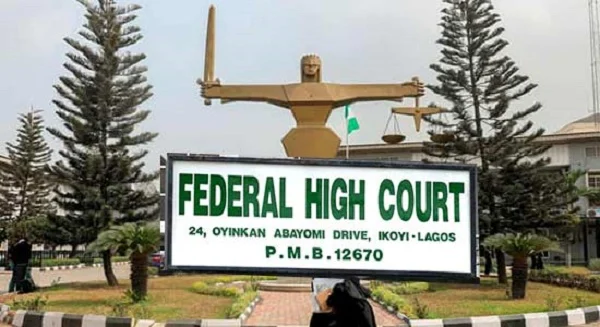
Justice Ayokunle Faji of the Federal High Court in Lagos has ordered that Uzoma Ilomuanya be sent back to the United Kingdom. He will serve a 66-month prison sentence there for drug-related crimes.
Ilomuanya, who is also known as Val, Valentine Ilomuanya, and Henry Ilomuanya, will be extradited after the court approved an application from the Attorney-General of the Federation. This follows Nigeria's Extradition Act.
In the ruling on July 6, 2026, Justice Faji stated that the Federal Government met all legal conditions needed for Ilomuanya’s extradition.
The request was made on March 6, 2026, following a formal appeal from the UK. Ilomuanya had been convicted and sentenced by the Isleworth Crown Court. He fled while on bail and was tried in his absence.
Justice Faji confirmed that the Attorney-General provided enough evidence to support the extradition. This included a valid conviction certificate, a warrant of arrest from the UK, and diplomatic requests for Ilomuanya’s return.
Using the Supreme Court ruling in Attorney-General of the Federation v. Princewill Ugonna Anuebunwa (2022), the judge said the crimes Ilomuanya was convicted of are extraditable. He also stated that the UK’s request followed Nigeria’s Extradition Act rules.
The court dismissed Ilomuanya’s claim that the application was not valid because it was not signed personally by the Attorney-General.
Justice Faji referenced Section 4 of the Law Officers Act. He mentioned that the Attorney-General can allow other officials to sign documents in the Federal Ministry of Justice.
He said, “The presence of the seal of a law officer in the chambers of the Attorney-General substantially complies with the law. Technical objections relating to signatures, seals, or the failure to tick the signatory’s name cannot invalidate these proceedings.”
The judge also turned down Ilomuanya’s challenge regarding the authenticity of the conviction documents from the UK.
According to him, the conviction certificate and other papers had original signatures. They were verified by a district judge in the UK, making them likely genuine.
He stated that original documents from another country do not need more verification unless there is evidence against their validity.
Justice Faji rejected the argument that the extradition request did not come from the right authorities.
He noted that messages from officials of the UK Central Authority and the British High Commission in Nigeria were valid diplomatic requests under the Extradition Act.
“The principles of international comity require Nigerian courts to accord due recognition to official communications issued by competent foreign authorities in extradition matters,” the judge said.
On Ilomuanya’s claim that ongoing criminal cases in Nigeria stopped his extradition, the court found this argument weak.


Justice Faji pointed out that the criminal case against Ilomuanya had been dropped by the prosecution before the extradition process started.
He stated that the Notice of Discontinuance filed on February 24, 2026, ended the case, leaving no pending criminal issues that could stop his extradition.
The court also dismissed Ilomuanya’s argument that the 13-year gap between his conviction and the extradition request made the process unfair.
Justice Faji stated that Ilomuanya fled the UK while on bail and cannot use the delay caused by his own actions to escape justice.
“I do not, however, see anything inordinate in sending a convict back to the place of conviction, even after 13 years, as in this case,” the judge said.
He added, “What it means is that a duly convicted person who jumped bail must not be allowed to escape the long arms of the law.”
The judge also dismissed Ilomuanya’s claim that he was too ill to travel to the UK.
Ilomuanya told the court he was receiving traditional treatment in Imo State and could not handle flights over two hours long.
However, Justice Faji said there was no solid medical proof presented to the court.
“There is no report from any orthodox medical practitioner, no meaningful description of the alleged ailment, and no particulars identifying the traditional medical practitioner said to be treating the respondent,” the judge said.
He questioned how Ilomuanya managed to fly from the UK to Nigeria if he truly could not handle long flights.
Justice Faji concluded that Ilomuanya’s health claim seemed more like an attempt to delay the enforcement of his sentence from the British court.
Emphasizing Nigeria’s international duties, the judge said, “The treaty obligations of Nigeria ought to be complied with and observed by all organs involved in law and order.”
After finding the Attorney-General’s request valid, the court approved it and ordered Ilomuanya to be extradited to the UK to complete his 66-month prison sentence from the Isleworth Crown Court.


Drop your comment
No comments yet — be the first to drop the gist 👇