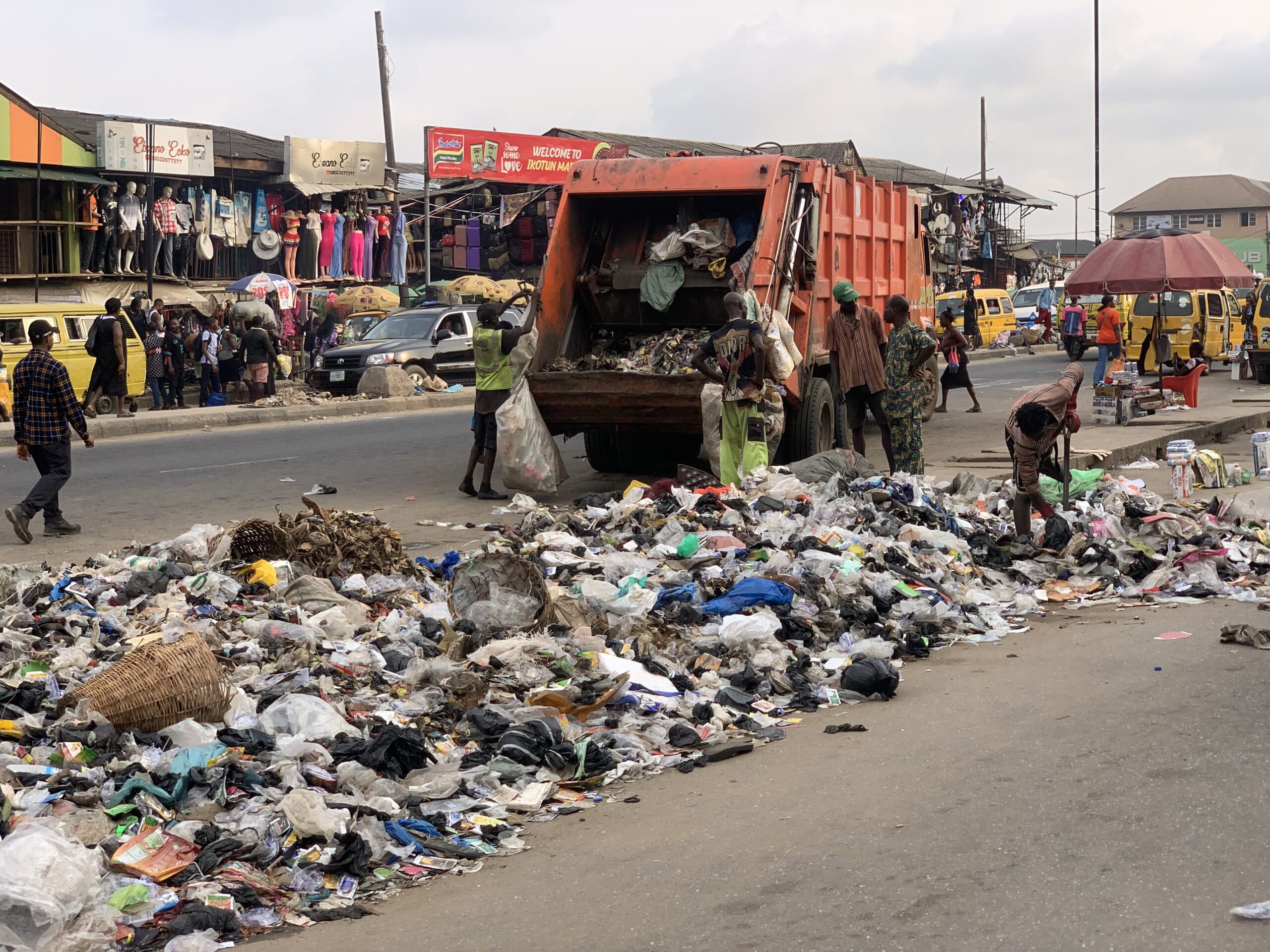
Flies buzz around piles of rotten waste near Christian Mbalisigwe’s point-of-sale stand at Jakande roundabout in Ejigbo, Oshodi-Isolo Local Government Area, Lagos State. As buses slow down to pick up passengers, commuters hold their noses. Some step around food waste, black nylon bags, and dirty water flowing from heaps of rubbish in the middle of the road.
For Mr Mbalisigwe, the smell has become normal. From morning till evening, he attends to customers while facing the rubbish dumped across from his kiosk. Sometimes, he said, the waste stays there for days before anyone comes to clear it.
“It wasn’t like this before,” the 43-year-old recalled when the road median was mostly clean. “Now, everywhere starts to smell when it is not cleared. We just have to manage it,” he added.
A city’s waste troubles
Lagos, home to over 22 million people, produces about 13,000 tonnes of waste daily. But only 54 percent gets disposed of properly through the city’s waste system. The rest ends up in open dumps, drainage channels, roadsides, and waterways. This situation worsens flooding risks and health issues during the rainy season, according to a 2024 World Bank assessment.
Poor waste management in Lagos has effects beyond just the rubbish piles. According to the World Health Organisation (WHO), bad waste collection leads to environmental and marine pollution. It often blocks drainage channels, causing floods and stagnant water that increase the risk of diseases like cholera and infections like malaria and dengue.
The World Bank also found that illegal dumping and open burning in areas without formal collection expose people to harmful pollutants. These can cause respiratory illnesses and other health issues.
In 1997, Lagos started using licensed operators called Private Sector Participants (PSPs) to collect waste citywide. The Lagos State Waste Management Authority (LAWMA) says there are currently 454 licensed PSP operators for the state’s 376 wards, averaging one operator per ward.
Under the Lagos State Environmental Protection Law 2017, residents must register with the assigned PSP and pay a monthly fee for waste collection. But a World Bank report found that only 67 percent of households in Lagos have access to any waste collection service.
Collection issues in communities
Our investigation shows the system is struggling. Operators face low payment compliance from residents, which weakens service delivery and leads to irregular collection schedules.
Residents and community leaders in Jakande Estate say waste collectors come only once a month instead of weekly, causing rubbish to pile up in their homes. Kayode Adeshina, a former vice president of the estate association, told PREMIUM TIMES that irregular collection has made residents lose faith in the system.
“They’re supposed to come to the estate at least three times a month, but they come once,” said Mr Adeshina. “When they collect the month’s money, about N1000, they will not come again. They will say the dumping site is full and that there is nowhere to dump the refuse. So you will see people dumping their refuse in every corner.”
Many residents now throw their waste on the streets or hire informal waste collectors with wheelbarrows who go from house to house. In many parts of Lagos, people say the system no longer works.
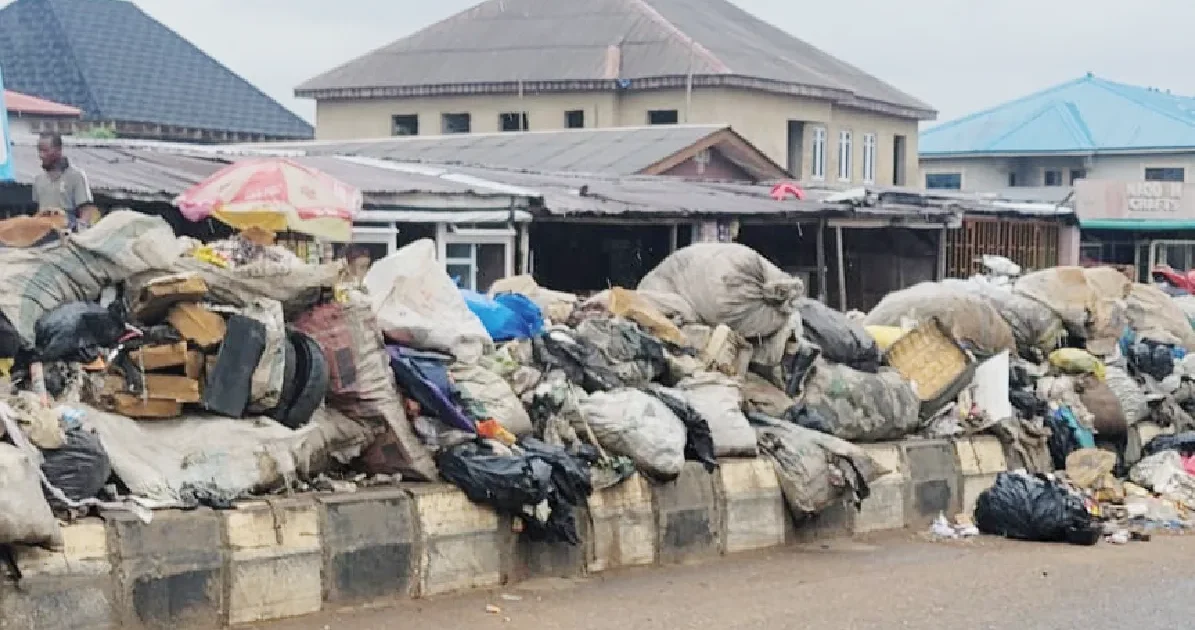
In areas like Ikeja, Mushin, Alimosho, LASU-Ojo road, Surulere, Ikorodu, Abule Ado, and Tinubu Square on Lagos Island, road sides and bus stops have turned into dumping grounds as rubbish piles up between collections.
In some areas, like Ijegun-Ijagemo Road in Alimosho Local Government Area, residents say waste collectors do not service them. Cart pushers have become the main way to get rid of waste. In 2018, the Lagos State Government banned cart pushers and wheelbarrow operators, saying they worsen illegal dumping and environmental damage.
Challenges from rising fuel prices
A 2025 report from the African Cities Research Consortium (ACRC) says poor logistics, weak infrastructure, and government inefficiency have created gaps filled by informal waste collectors. These informal workers don’t have the capacity to handle the amount of waste dumped all over the city.
Residents say wheelbarrow operators are often easier to reach and quicker to respond than formal waste collectors. “I rely on cart pushers several times a month and pay between N500 and N700 each time to dispose of my waste,” said a resident along Ijegun-Ijagemo Road, who wished to remain anonymous.
Waste collection contractors say they face rising fuel costs, making it hard to operate. The long trips to dumpsites like Olusosun in Ojota and Solous III in Igando have forced them to reduce collection trips.
According to them, maintaining the waste collection business in Lagos has become tough due to these high costs and poor payment compliance from residents. In Jakande estate, waste collectors like Golden Pond Limited and Veedic Nigeria Limited service the community’s 32 zones.
“The main problem is that most residents do not want to pay,” Bukola Olaigbe, a manager at Veedic Nigeria Limited, told PREMIUM TIMES. “The fee we give them is barely N1,500 per flat in a month, yet they find it hard to pay and still expect us to come often.”
She noted that only a few residents consistently pay for waste collection, making it tough for operators to maintain trucks, pay workers, and fuel daily operations. “Out of over 1,000 residents, we have about 15 people patronizing us. How are we going to come more often without money? For the few times we come, are they paying?”
Waste disposal struggles
The rise in diesel prices has added pressure on operators with diesel-powered trucks. Ms Olaigbe said drivers spend hours stuck in traffic, navigating flooded dumpsites and long distances to unload waste.
“Some operators have to bribe their way through. Sometimes the place is flooded, so we go all the way to Shagamu from Oke-Afa almost every day just to meet customer demand,” she said.
In May 2025, the Lagos State Government announced plans to shut down both facilities as part of a broader waste management reform program. Budget documents show that in 2025, N2.24 billion was set aside for building and fixing public facilities, including dumpsites.
Ms Olaigbe said they need subsidies and other support to improve waste disposal systems. Otherwise, more residents might resort to burning or illegal dumping, making environmental conditions worse. The supervisor at the Olusosun Landfill, Giwa Moshood, disputed claims that trucks wait too long to offload waste. He said the process usually takes about two hours during the rainy season.


“We have two seasons; in the dry season it takes about 45 minutes, but in the rainy season it can take about two hours,” he said. He also said he was not aware of any bribery issues.
Addressing collection failures
The Managing Director of LAWMA, Muyiwa Gbadegesin, blamed the growing roadside dumping on weak collection capacity, poor compliance, and failing equipment among PSP operators. “They’re supposed to collect waste from households once a week. When this doesn’t happen, some residents start dumping their waste by the roadside,” he said.
He added that residents’ non-payment also affects operators’ ability to function. To fix the problem, he said the state is supporting operators with leased equipment, introducing a centralized billing system, and expanding complaint channels to resolve missed pickups within 24 hours.
Mr Gbadegesin mentioned plans to improve logistics by adding transfer loading stations and using smaller tricycle compactors in areas where large trucks can’t go. He acknowledged that low payment compliance remains a big issue, even though the monthly fee is about N1,000. He added that illegal street trading and informal markets generate waste outside the formal collection system, making things worse.
“Illegal street trading and markets are problematic,” he said. To help improve collection in Jakande Estate, he said the agency plans to introduce communal bins. But these bins can’t help if pickups remain irregular. In some parts of Mushin visited by this reporter, many central bins were overflowing, with waste spilling onto nearby roads after delayed collections.
Mr Gbadegesin also recognized service gaps in areas like Ijegun, where residents rely on informal cart pushers because PSP operators are inactive or cannot access those roads. “I believe the PSP in that area has actually failed. It hasn’t been operational for a while,” he said.
Limited effectiveness of reforms
The failures in the PSP system have led to action from LAWMA. In December 2025, the agency fired 22 PSP operators for poor waste collection. Recently, they also withdrew licenses from five operators serving routes in Igando-Ikotun, Eti-Osa West, Ojo, and Ejigbo due to service failures and rising waste management pressure.
Yet in some parts of Lagos, the system works as it should. In Magodo, a wealthy residential area, waste collection follows a regular schedule. Licensed operators make consistent pickups, and residents mostly comply with payment. This creates a noticeably cleaner environment where roadside dumping is rare.
Exploring community solutions
Deji Akinpelu, co-founder of Rethinking City and an action researcher at ACRC, said Lagos waste reforms have mostly targeted symptoms instead of the root causes. He pointed out that actions like license revocations and route changes do not solve the problems of weak service delivery, poor payment compliance, and declining operator capacity.
A study by the consortium, based on 400 households in Ajegunle, Ikorodu, found that gaps in formal collection push residents to dump by the roadside, burn waste, or use informal recycling, creating a parallel system that fills gaps but strains existing infrastructure.
Mr Akinpelu suggested reducing waste at the source through community recycling hubs and composting. “Community recyclable collection hubs and food waste composting programs are the most underused tools for reducing the volume of waste reaching Lagos’ overwhelmed dumpsites,” he said.
But such solutions are lacking in places like Jakande Estate. In March, Lagos State Governor Babajide Sanwo-Olu launched a monthly cleaning exercise to tackle waste disposal and improve cleanliness statewide. This initiative is part of broader efforts to deal with ongoing waste management issues.
Although the government presents this exercise as a response to rising waste challenges, there is little evidence of lasting impact. In Jakande Estate, cleared areas quickly turn back into dumping sites.
LAWMA supervisor Opeoluwa Odunlami, who oversees refuse removal from road medians and highways around Jakande Roundabout, Isolo, and Cele Expressway, said traders near roads contribute to illegal dumping.
“These dumping locations are illegal. There are task forces to arrest and fine offenders,” he said. But even with the threat of arrest and fines, dumping continues. Just days after cleanup efforts, the medians are filled with fresh rubbish again.
Mr Mbalisigwe often sees residents arrive with bags of waste in cars, tricycles, or on foot, briefly stopping to dump them before leaving. “There is no proper place to take it. There used to be a collection point, but it stopped. The government did not provide a place to dump trash, and since there is no collection bin, people have no choice but to dump by the roadside,” he said.
Street sweepers in the area say their work has become a daily struggle. They mention that scavengers looking for recyclables often tear open bags, spreading waste across the road and undoing their efforts.
“We clear it, but it doesn’t stay clean. People come early in the morning or late at night to dump. Some even throw it from their vehicles,” Olamide Omotayo, one of the workers, told PREMIUM TIMES. She says the dumping comes from different sources, residents, traders, and cart pushers.
“We have argued with them, tried to stop them, but it continues,” another sweeper, Shakirat Babatunde, said.
Community efforts and limits
Community leaders say repeated attempts to stop roadside dumping in the area have not worked, despite meetings with waste authorities and collectors.
Rukayat Muritala, councillor for Oke-Afa Ward in Ejigbo LCDA, said several meetings with LAWMA and private waste collectors have not solved the growing waste issue. Mrs Muritala said the local council tried to handle the situation by sending compactor trucks to clear waste and forming a task force to discourage illegal dumping.
“The PSP operators are not working well. The dumping sites at Igando and Ojota are full. They say they have to go to Epe or Badagry, which is more expensive. They said they need to raise the fees for residents to be more effective,” she said.


Drop your comment
No comments yet — be the first to drop the gist 👇