---
They promised to crack down on vote buying. INEC, EFCC, and ICPC warned that buyers would be arrested. But when Osun voters showed up to vote on August 15, cash was ready and waiting. In some areas, votes went for N15,000, N30,000, N40,000, or even more, turning polling places into busy marketplaces, reports BOLA BAMIGBOLA.
Before the August 15 Osun governorship election, two issues loomed large in the state: rising violence and the growing problem of vote trading.
For weeks, killings linked to rival cult groups made residents uneasy. The violence, which increased about two months before the election, continued despite visits from Deputy Inspector-General of Police for the South-West, Adegoke Fayoade, and Inspector-General of Police, Olatunji Disu.
Bodies kept appearing in different parts of the state. Repeated promises from security agencies that they would catch the culprits did little to ease the fears of the residents.
With solutions hard to find, some residents seemed to adopt a simple survival strategy: just stay alive until Election Day.
Then another promise came.
During a week-long visit to Osun ahead of the election, the Chairman of the Independent National Electoral Commission, Prof Joash Amupitan, raised hopes that even if violence couldn't be completely stopped, vote buying would not ruin the election.
At a press conference at the Osun INEC headquarters in Osogbo on August 1, Amupitan said INEC would join forces with the Economic and Financial Crimes Commission and the Independent Corrupt Practices and Other Related Offences Commission to fight vote trading.
“We recognize that vote-buying has increasingly shifted from physical cash exchanges at polling units to digital financial transfers and pre-election account harvesting,” he said.
He also mentioned that INEC might work with the Nigerian Financial Intelligence Unit and the Office of the Attorney-General of the Federation. Plain-clothes anti-corruption officers would monitor polling areas and arrest suspected buyers and sellers.
The Commissioner of Police for the Osun election, Samuel Etaifo, made his first public appearance since his appointment at the event.
The message was clear: this time, vote buying would not be business as usual.
The ICPC took the campaign to the streets of Osogbo, visiting markets, motor parks, and other public places to warn people against selling their votes.
The commission said its officers would be in all 30 local government areas of the state on Election Day.
While speaking at a sensitization rally, the Resident Anti-Corruption Commissioner for Osun State, Yusuf Olatunji, warned that both voting buying and selling are punishable by Nigerian law.
“We will not tolerate vote buying or selling and anyone caught will be arrested and prosecuted,” he said.
With INEC, the ICPC, and security agencies declaring war on vote trading, many had high hopes.
But when it was time to vote, the promises seemed to vanish.
When the ballot became a marketplace
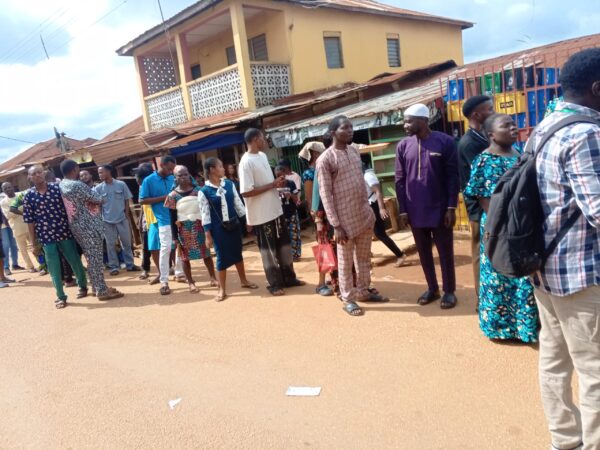
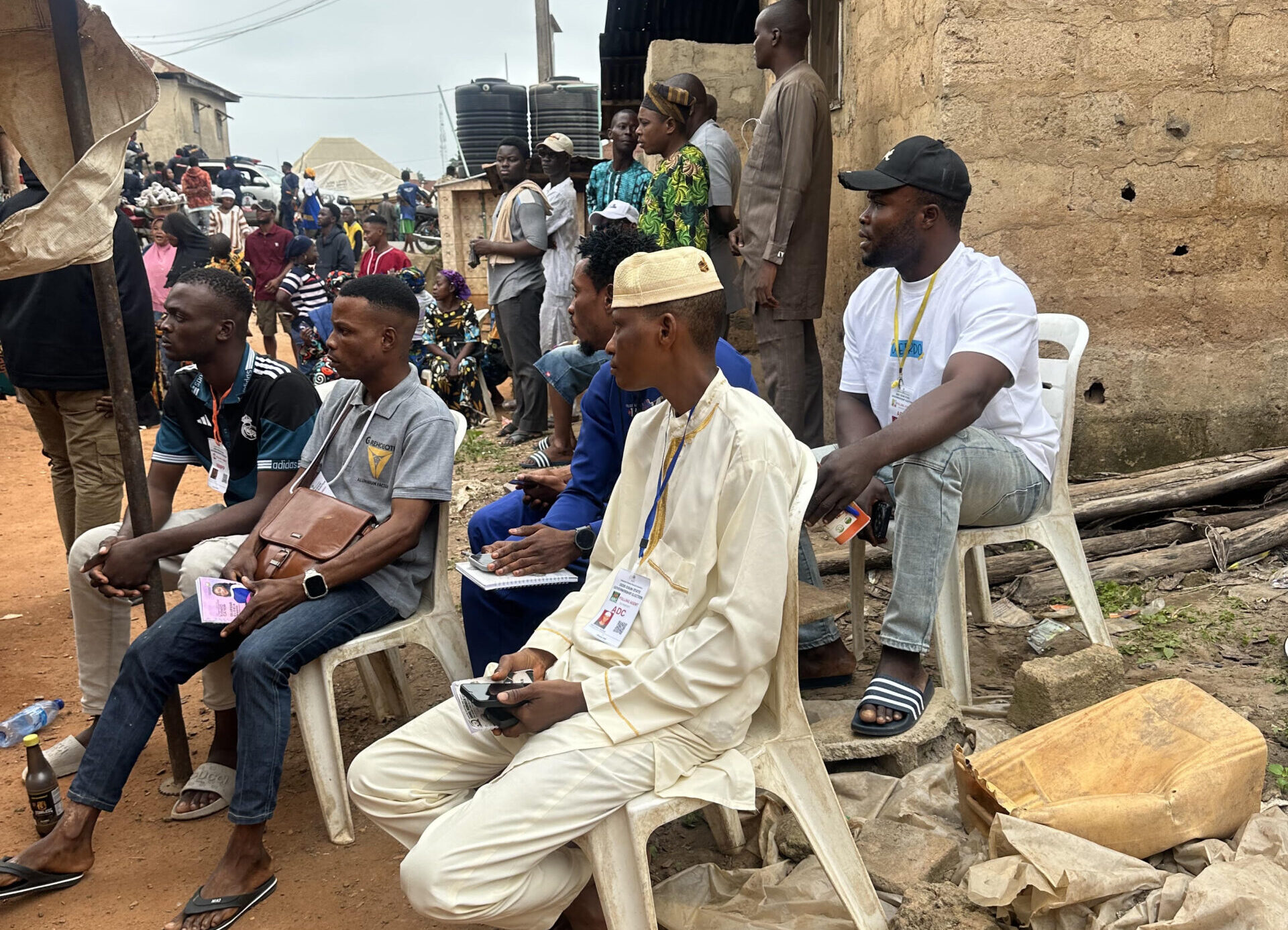
On Election Day, vote buying was reported at many polling locations. Voters were allegedly offered cash, food items, and promises of transfers in return for their votes.
In some areas, political agents handed out raw food items before voting began, which residents said was to “wet the ground.”
In other places, voters were asked for their bank account details, with promises that money would be sent after their votes were confirmed.
Some security personnel appeared to look the other way during these transactions.
Police officers stationed at some polling units reportedly saw the exchanges without taking action.
Despite the earlier announcement that ICPC operatives would be on the ground, the commission had not reported any arrests related to the alleged vote-buying activities at the time of this report.
For some voters, this situation revealed a troubling contradiction: the agencies meant to stop vote trading had promised a crackdown, but transactions continued openly when it really mattered.
‘A vote was N30,000, N40,000’
In Ward 05, Boripe Local Government Area, a voter who wanted to remain anonymous for safety reasons described how political agents approached voters with cash.
He said he was first offered N15,000 when he arrived at his polling unit around 10 am.
He turned it down.
But after he faced issues with the BVAS machine, he could not vote until around noon. By then, he said, the price had increased.
“That time, a vote was being bought for about N30,000,” he said.
He mentioned that a political party had set up a register near the polling unit for voters who agreed to support it.
More concerning was that four female police officers were present and allegedly watched the process without acting.
“Four women police were present and they saw what was going on. But they didn’t raise a finger to stop it,” he claimed.
The voter also said that the inducement began long before Election Day.
Three weeks before the election, he said, adults in his ward received N10,000 from a political party, although they called it an empowerment programme.
This situation showed how vote buying had developed beyond just what happens on Election Day.
For voters already facing rising living costs, accepting such money can be hard to refuse.
But what seems like a small amount for one voter carries a much bigger cost for the electoral system. It risks turning the ballot from a tool of choice into something for sale.
And in Osun, the question after Election Day was no longer whether vote buying happened.
It was how openly it could occur despite the many agencies that promised to stop it.
For Roseline, a voter in Israel Ward 8, Ilesa East Local Government Area, Election Day was not just about going to the polling unit, collecting a ballot paper, and making a choice.
It was also like visiting a marketplace where votes, according to her, had a price.
Speaking to The PUNCH by phone, Roseline alleged that agents of the Accord Party and the All Progressives Congress offered money to voters at her polling unit, with the price reaching N40,000.
But there was a twist.
Some people who took the money, she said, still voted for their preferred candidates.
“Many people that took money eventually voted for their chosen candidate. Police and NSCDC operatives saw how they were paying for votes, but they didn’t caution those involved,” she said.
Her story gives a glimpse into one of the challenges of vote buying in Nigeria: the money may change hands, but votes remain secret.
For the voter, taking the cash can be an economic choice; for the politician, it is a way to sway the outcome.
And for democracy, this raises a troubling question: what is really being bought when a voter accepts money but still votes according to their conscience?
Mudu of garri, then N20,000
In Ile-Ife, another voter said the inducement started even before voting began.
This voter, whose polling unit was in Oja Titun, said a political party agent gave out a mudu of garri to people in the market on Election Day morning.
He recognized the woman who distributed the food.
“She gave a mudu of garri to all of us in the market that Saturday morning before voting started. She didn’t ask us for anything, but it was clear she wanted us to vote for a specific candidate,” he said.
Later, after voting began, he said a political party agent paid him N20,000.
The two stories, one involving N40,000 and another involving food and N20,000, show how vote inducement can come in different forms, from cash payments to gifts handed out before voters go to the polling booth.
For voters grappling with rising food prices and living costs, such offers can be hard to ignore.
But former INEC National Commissioner, Prof Lai Olurode, believes the impact goes beyond the immediate financial gain for individual voters.
‘It was a bazaar’
Looking back at the election, Olurode described the atmosphere around some polling areas as “a bazaar.”
He said this trend was dangerous for democracy because it made it hard to tell if voters were choosing candidates freely or responding to money offers.
“You won’t know what the people are really voting for. Is it the highest bidder, or are they just voting their conscience or a mix of both?” he asked.
Olurode, however, cleared INEC of blame for the vote trading, saying it reflected a wider culture of monetizing elections.
He noted that political actors increasingly believe they cannot win elections without spending significant money.
He warned that this practice could harm not just electoral integrity but also Nigeria’s overall development.
“Corruption is everywhere, and you can’t separate your electoral practices from corruption,” he said.
For Olurode, the solution lies in ongoing voter education, not just campaigns that pop up right before elections.
“Maybe we should do more in terms of voter education, so that we don’t turn elections into a bazaar,” he said.
‘The grandfather of all vote-buying’
Osogbo-based lawyer, Chief Abimbola Ige, was even more direct in his take.
He called the scale of vote buying seen during the August 15 election “huge,” saying it was a bad sign for Nigerian democracy.
Ige claimed some voters were offered as much as N50,000 for their votes.
“What happened on the 15th of August 2026 was the grandfather of all vote buying,” he said.
For him, the real danger is not just that politicians spend money during elections.
It is that money is slowly taking the place of ideas, policies, and accountability in political campaigns.
He argued that candidates now focus on what they can give to voters rather than what they plan to do for them if elected.
Yet the outcome of the Osun election presented an interesting twist.
Despite reports of inducements, the sitting governor was re-elected for another four years. This led Ige to suggest that money may not be as powerful as politicians think.
“It is becoming clear that money is losing its magic in our electoral processes,” he said.
He urged political players to understand that there is a limit to what money can accomplish at the ballot box.
Parties reject allegations
The political parties involved denied the allegations of vote buying.
In separate interviews with The PUNCH, the spokesperson for the Ademola Adeleke Governorship Campaign Council, Pelumi Olajengbesi, and the Osun APC spokesperson, Kola Olabisi, said their parties did not buy votes.
Olajengbesi, however, claimed that about N110 billion was brought into Osun in two parts ahead of the election.
“Initially, there was N60 billion and then another N50 billion, totaling about N110 billion in a country where people are suffering, where the economy is struggling,” he alleged.
This claim could not be independently verified.
Olabisi rejected this claim, insisting that the APC had no need to buy votes because its candidate was popular enough to win.
He challenged anyone making the allegation to provide proof.
“Anyone can make an allegation, but any claim not backed by facts is as good as torn paper,” he said.
For voters standing inside the polling units, the debate over who spent what might be less important than what they saw.
In one place, a voter said N40,000 was offered.
In another, a mudu of garri came before a N20,000 payment.
And in the middle of it all stood the ballot, supposedly secret, supposedly sacred, but increasingly caught up in cash transactions.
Now, the question is whether Nigeria’s elections can stay truly competitive when the cost of participation keeps being set in naira.

Drop your comment
No comments yet — be the first to drop the gist 👇