Grace* never saw any state budget document. She never read a federal appropriation law or looked at a budget implementation report.
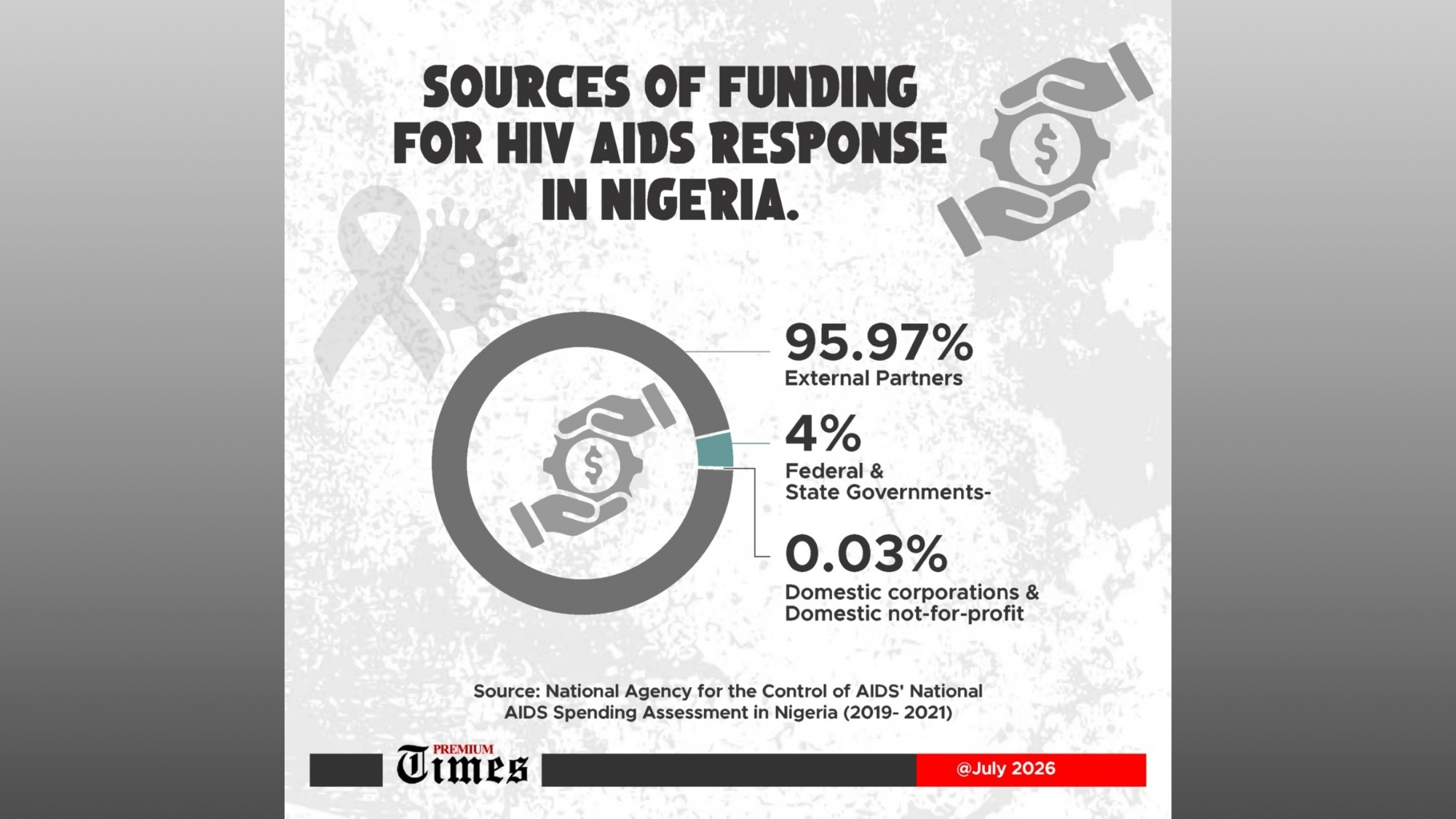
She probably did not know that Nigeria’s HIV response relied heavily on international donors. For years, both federal and state governments promised to take more responsibility for the programs that helped keep people like her alive.
What she did know was simple: the community health worker who used to deliver her antiretroviral medicines stopped coming. The counselling sessions ended. The support that helped her deal with stigma disappeared.
Now, she had to collect her medication at a public treatment centre. There, she felt exposed and eventually withdrew from care.
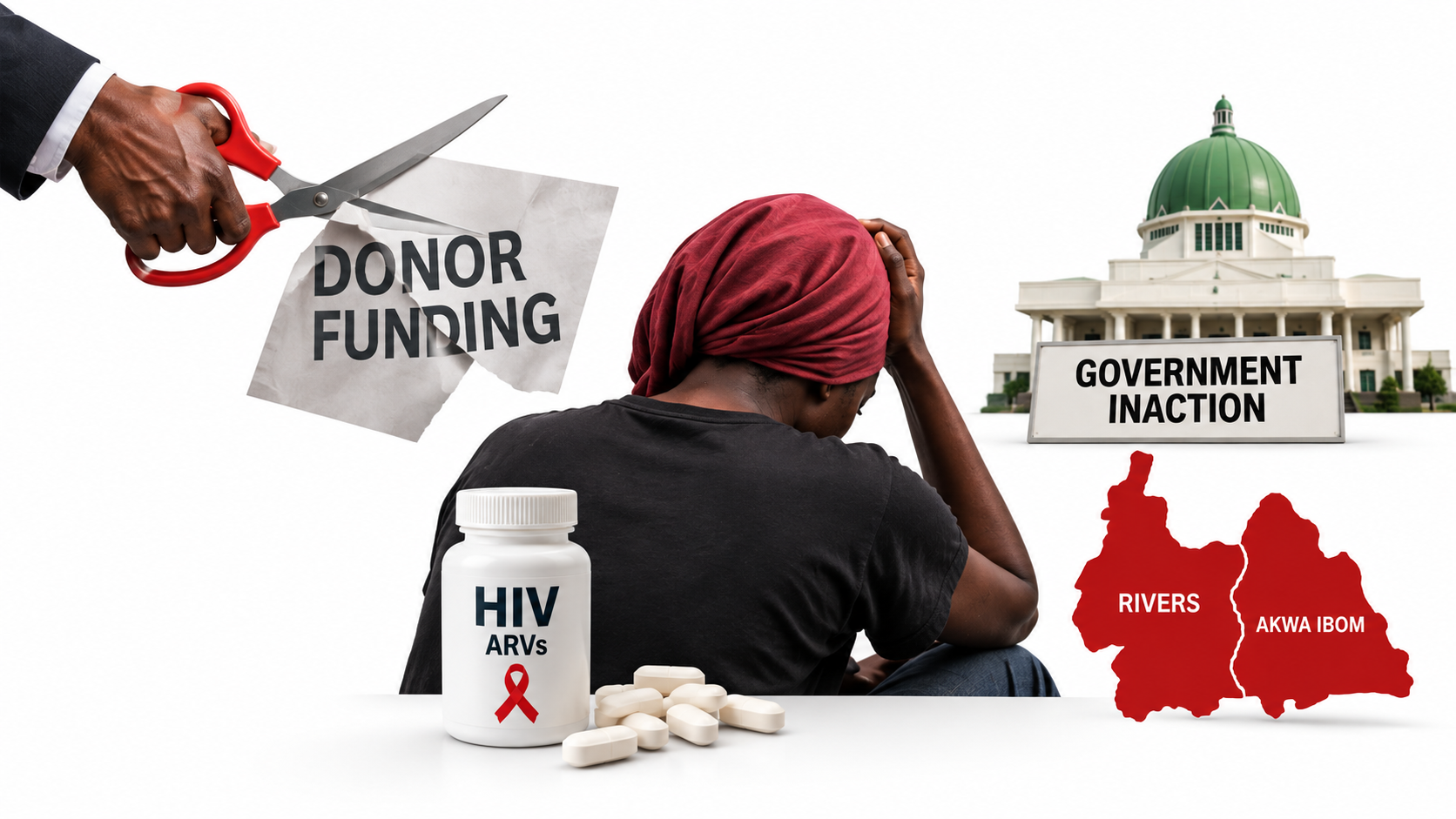
Her story raises a key question. As international donors cut back on community HIV programs, were the governments in Rivers and Akwa Ibom ready to fill the gap?
A PREMIUM TIMES investigation looked at official budget documents, budget implementation reports, government spending records, and interviews with officials, program managers, health advocates, and people living with HIV. It found little evidence that they were ready.
Instead, the investigation revealed a troubling pattern of responsibility and accountability.
Every year, federal and state governments approved budgets for HIV response. Yet, much of that money was never released.
This led to weakened health systems, interrupted community services, and patients who fell off care without anyone noticing.
As donor support decreased, it was expected that governments would take charge of the response. But PREMIUM TIMES found that did not happen in Rivers and Akwa Ibom. Both states continued to make budget provisions for HIV response while implementation remained poor.
Budgets Approved, Funds Withheld
Documents reviewed by PREMIUM TIMES show a concerning trend in both Akwa Ibom and Rivers states. Governments budgeted for HIV programs, but the funds rarely reached the agencies meant to implement them.
In Akwa Ibom, the State Agency for the Control of AIDS received capital allocations in every budget cycle looked at by PREMIUM TIMES. The agency was given N24.05 million in 2023, N10 million in 2024, N33 million in 2025, and N150 million for the 2026 budget.
These funds were meant for important HIV response activities like buying antiretroviral medicines, HIV rapid test kits, condoms, and screening supplies. On paper, this looked like a government ready to strengthen HIV services. But the approved funds were less than one percent of the health sector's total capital budget in those years.
Budget performance reports showed that despite these allocations, the agency received no capital releases between 2023 and 2024. The state also has not published the capital budget implementation report for 2025 or the first half of 2026. This makes it hard for the public to know if any money was released or how it was spent.
When PREMIUM TIMES contacted the Commissioner for Health, Ekem Emmanuel, he said the agency received some support towards the end of 2025. But neither he nor the State Agency for the Control of AIDS provided proof of the amount released, the source of the funds, or the programs funded.
The National Agency for the Control of AIDS (NACA) told PREMIUM TIMES that Akwa Ibom only released one percent of its total HIV funds for 2024 and 2025. If the commissioner’s claim of funding in 2025 is true, then the state spent no more than N330,000 out of its N33 million capital budget.
In Rivers State, PREMIUM TIMES found a similar situation. Official documents showed that the state allocated N180 million for HIV interventions in 2023 and N230.66 million in 2024. These funds were meant for HIV rapid test kits, community counselling, condom distribution, and even a state HIV anti-stigma law.
Yet, budget reports revealed that none of these funds were released. The Rivers State government has not published the approved fiscal documents for 2025 and 2026 either. PREMIUM TIMES also did not receive any clarifications from the State Agency for the Control of AIDS on whether any funds had been released.
NACA informed PREMIUM TIMES that Rivers State had zero releases for HIV/AIDS during the period examined. This shows that while both states budgeted for HIV response, they did not release the funds when international support was becoming less reliable.
Accountability Beyond the Budget Books
The effects go beyond just money. Every unreleased allocation means programs that could not be implemented and patients who missed appointments without follow-ups. Uduak Nyaetok, the executive director of Milestone Initiative for Human Rights and Empowerment, an NGO active in the Niger Delta, said HIV treatment starts with prevention. It is about finding people who do not know they are infected.
She explained, “After testing, a good HIV response relies on counsellors who encourage scared patients to start treatment. It depends on community workers who visit homes after missed appointments and support groups that help people overcome stigma.”
According to her, the loss of donor-funded community services disrupted this care chain. Some donor-supported HIV prevention activities have resumed since June. But she noted that the disruption showed the consequences of governments not taking more ownership of the HIV response.
“When support was cut, those who followed up on treatment were gone. Patients’ viral suppression dropped. When they engage in risky behaviour, new infections will surely rise, and data shows this,” she said.
NACA agrees with her. In response to a PREMIUM TIMES inquiry, they stated, “Program data shows that U.S. government-funded interventions, especially at the community level, faced setbacks.”
Nyaetok stressed that state governments must invest more in community-based HIV services, especially in rural areas where many people live far from health facilities. For people like Grace*, losing that community support was not just about losing a donor-funded program. It meant losing the very services that allowed them to keep up with their treatment and live with dignity.
Federal Spending Tells a Similar Story
The issue of accountability is not limited to state governments. A PREMIUM TIMES review of federal financing trends from 2021 to 2026 also shows a growing gap between budget approvals and actual spending. In 2025, as worries about international HIV funding grew, the federal government approved N18.27 billion for NACA, more than double what was approved in 2024.
This increase seemed to show a recognition that domestic funding needed to grow as donor support decreased. However, government spending records showed that only 31.2 percent of the approved capital allocation was funded.
In 2026, domestic investment fell even more. Although the budget approved N13.97 billion for NACA, records indicate that only N36.68 million (0.3 percent) of the approved amount was spent from January to May.
NACA told PREMIUM TIMES that capital release improved by June, stating that by midyear, the agency had received 3.8 percent of the approved allocation. But concerningly, of the amount spent in those months, only N16.13 million went directly to HIV programs, and only in Lagos State.
By June, NACA reported that total expenditure on HIV response in Lagos rose to N210 million. But they clarified that this covered two different constituency projects. The rest of the spending went to other expenses, like cleaning services and staff welfare. This raises serious questions about Nigeria’s ability to sustain HIV services as international partners reduce their involvement.
The disconnect threatens the goals of global HIV control. The UNAIDS 95-95-95 targets aim for 95 percent of people living with HIV to know their status, 95 percent of those diagnosed to receive treatment, and 95 percent of those receiving treatment to achieve viral suppression. Achieving these targets needs more than just buying medicines.
“It requires ongoing investment in community testing, patient follow-up, lab systems, counselling, and community support,” Nyaetok said. She added that these crucial interventions have suffered the most as donor help shrinks.
For Grace’s* family, the gaps left by domestic funding led to a painful experience. They feel the loss of their support system and how it was not quickly replaced.
NACA told PREMIUM TIMES they are working on the response effort by improving the National Domestic Resource Mobilisation and Sustainability Strategy (2021-2025). This strategy aims to close the domestic funding gap for HIV prevention and treatment.
They also mentioned the launch of the HIV Trust Fund of Nigeria under the Nigeria Business Coalition Against AIDS, with N10.7 million raised in 2024. NACA said, “The Government of Nigeria knows that integrating HIV treatment into State Health Insurance Schemes will make funding for HIV treatment more sustainable. To support this, NACA, the National Health Insurance Authority, and partners created the National Blueprint for Integration of HIV into State Health Insurance Schemes in 2020.”
“Nigeria is moving toward sustainable domestic financing by using financial protection schemes like the Basic Health Care Provision Fund, State Health Insurance Schemes, and Private Health Insurance to avoid out-of-pocket payments for people living with HIV at the point of care.”
They added that HIV testing is now part of the benefit packages at national and state levels, paving the way for including ARV treatment soon. The benefits also cover baseline and treatment monitoring investigations and managing opportunistic infections. Efforts are ongoing to enroll people living with HIV into financial protection schemes at the state level.
NACA mentioned that to address the funding gap, the federal government put $200 million (about N260 billion) into the federal budget in 2025. But as noted earlier, PREMIUM TIMES found that only N5.7 billion was actually spent by NACA.
Smaller Epidemics, Stronger Investments
One of the most striking findings from PREMIUM TIMES’ investigation is the difference between Nigeria’s highest HIV-burden states and some of the lowest. Rivers has the biggest number of people living with HIV in Nigeria, while Akwa Ibom is consistently among the states with the highest burden. Public health planning would suggest that both should be among the top investors in HIV programs.
But financial records tell a different story. While Rivers and Akwa Ibom struggled to turn budget promises into real spending, states with much lower HIV burdens continued to make significant domestic investments.
In Kwara State, where about 20,259 people live with HIV, about one-eighth of Akwa Ibom’s burden, the government spent N608.63 million on HIV interventions in 2024, according to a budget report reviewed by PREMIUM TIMES.
From January to September 2025, the state released another N132.16 million as counterpart funding for Global Fund-supported HIV and malaria programs. The 2026 budget goes even further, setting aside N8.29 billion for Global Fund-supported health interventions, including HIV, to boost domestic funding.
The contrast goes beyond Kwara. Zamfara, one of Nigeria’s lowest HIV-burden states, spent N3.42 million directly on HIV programs in 2025, even though it has an estimated 13,253 people living with HIV. Yobe, which has the least HIV burden in the country, also recorded direct spending of N500,000 on HIV interventions in 2025.
This comparison does not mean those states have solved their HIV financing issues. It shows that domestic investment is possible even when the epidemic is much smaller. This reality makes the situations in Rivers and Akwa Ibom harder to explain. Both states are among Nigeria’s most economically important, receiving substantial oil revenues and historically getting some of the largest allocations from the Federation Account.
Akwa Ibom ranks as the fourth-largest recipient of the Federation Account Allocation Committee (FAAC). As PREMIUM TIMES reported earlier this year, Governor Umo Eno’s administration generated N2.53 trillion in revenue within its first 32 months. Rivers State, though it has not published fiscal documents since 2025, ranks second among FAAC revenue earners in the country.
Still, interviews with health workers, advocates, and people living with HIV show that as donor-funded programs reduced, domestic funding failed to grow fast enough to protect the progress made over two decades.
For those living with HIV, the difference between an approved budget and actual funds released into the health system can be life-changing. It impacts whether a counsellor notices when a patient misses an appointment or if a community worker delivers medicines to someone afraid to go to an HIV clinic. It affects whether a support group stays open for a young person struggling with stigma or if someone newly infected is diagnosed before unknowingly spreading the virus.
These are the investments that kept Nigeria’s HIV response strong. They are also the investments that many patients and advocates told PREMIUM TIMES have gradually disappeared just when governments were expected to take charge.
As the global target to end AIDS as a public health threat by 2030 approaches, NACA insists Nigeria is in a good position to achieve these targets. But they warn, “The risks that could hinder reaching these goals are linked to funding instability from government and donor partners.”
Drop your comment
No comments yet — be the first to drop the gist 👇