Grace* spent years keeping two things safe: her health and a secret she never wanted to share.
Every few months, a community health worker brought her antiretroviral medicines to her home in Uyo, Akwa Ibom State. This setup helped Grace stay healthy without facing questions from her neighbours, customers, colleagues, or fellow church members who might see her at an HIV clinic.
But that routine ended in February 2025.
Due to cuts in international funding, community drug delivery programmes were shut down. Grace had to collect her medication herself from the treatment facility.
Someone saw her enter the HIV clinic, and soon, whispers spread through her church and neighbourhood.
Her family says the stigma that followed was unbearable. Ashamed and scared of more humiliation, Grace stopped going to the clinic for treatment.
By April this year, she was dead.
Her relatives believe her death was not just from HIV, but from the breakdown of the support system that had quietly kept her alive for years.
“If that support had remained,” her sister, Mary*, told PREMIUM TIMES, “she would still have been taking her drugs.”
Grace’s story reflects what many others living with HIV in Akwa Ibom and Rivers states are facing. Their lives became uncertain after international donor-funded community HIV programmes were cut back in early 2025.
In January 2025, PREMIUM TIMES reported that the President of the United States, Donald Trump, stopped HIV funding for Nigeria and other developing nations.
Patients, peer counsellors, and community advocates across both states described a system that suddenly lost many workers. These workers had ensured patients stuck to their treatment, received support, and dealt with the stigma around HIV.
Mercy*, another person living with HIV in Akwa Ibom, said the removal of donor-supported workers disrupted services and created fear.
“The first thing that came to my mind was uncertainty,” she said. “Everything happened suddenly. Nobody prepared us.”
When she got to her treatment facility after the cuts, many of the familiar faces who provided counselling, documentation, and treatment were gone.
“You asked questions, and they told you, Your people are not here.”
Those ‘people,’ she explained, were the adherence counsellors, laboratory workers, peer supporters, and others funded by donor programmes who helped patients with documentation, counselling, and treatment.
Without them, many patients felt lost in the clinics. “They knew us, followed up when we missed appointments and treated us with compassion,” Mercy said.
She worries that just replacing donor funding with government support won't be enough. Authorities need to invest in trained staff and patient-focused services.
“Medication alone is not enough. People also need encouragement. They need someone who genuinely cares whether they survive,” she said.
The cuts also ended vital programs that many patients said were key to HIV care outside hospitals.
Home-based care stopped, community HIV testing fell, support groups that helped people deal with stigma vanished, and routine follow-ups for patients who missed appointments stopped.
For Johnson*, a former community referral officer in Rivers State and a person living with HIV, the loss of home-based drug delivery is a significant blow to HIV care.
Every day after work, he travelled around delivering antiretroviral medicines to patients who could not visit clinics due to work, transport issues, or fear of being seen.
This program ensured they never missed treatment. Now, that support is gone. “Many of those people are no longer coming to the facilities, and we don’t know where some of them are anymore,” Johnson said.
Patients who miss appointments repeatedly are eventually labeled as “lost to follow-up.” This worries health workers and those living with HIV because missed treatment can lead to illness and preventable deaths.
Elizabeth Udo, Akwa Ibom State Coordinator of the Network of People Living with HIV/AIDS in Nigeria (NEPWHAN), said they have seen similar situations across the state since community HIV programs started shrinking.
“We have lost people,” she told PREMIUM TIMES.
“They did not die because HIV treatment stopped completely. Many died because the support systems that helped them stay healthy disappeared.”
Ms Udo explained that community-based HIV care went beyond just delivering medicines.
Donor-funded programs also provided home visits, appointment reminders, adherence counselling, support groups, education for adolescents, stigma-reduction campaigns, and help for survivors of gender-based violence. They also assisted patients in managing side effects and other health issues.
“We used to receive support for care and support programs, adolescent education, stigma reduction, home visits, and community meetings,” she said. “Today, all of those activities have stopped.”
She warned that the effects of this may take years to fully show.
“When people stop coming for treatment, which keeps their viral load low, they don’t simply disappear from the epidemic. They actually vanish from the health system and may continue spreading the virus, thus increasing the number of infections,” she said.
For Victoria*, a youth advocate living with HIV in Rivers State, the biggest loss was not medicine but hope. She remembered how support groups used to bring together many young people living with HIV each month.
They talked about treatment, relationships, stigma, careers, and mental health.
Peer mentors, also living with HIV, reassured newly diagnosed patients that the virus was no longer a death sentence.
“If I can live with HIV and still work in this hospital, you can also live your life,” Victoria said they often told scared adolescents.
Those meetings stopped after donor funding was cut. Members tried to contribute money to keep the meetings going, but it did not last. “Many of those who contributed had also lost the stipends they earned as peer mentors,” she said.
Attendance dropped. “So did the hope those meetings gave many young people,” she added.
Peter*, another person living with HIV in Rivers State, said the uncertainty about HIV funding has increased stigma.
He recalled hearing people mock those living with HIV after news about the US reviewing parts of its health assistance came out. “Now that your drugs have been stopped, let’s see how all of you will survive.”
Even though years of advocacy made him stronger, he worries about newly diagnosed patients who are still accepting their status.
“I have outgrown stigma, but many people haven’t,” he said.
Peter remembered going with another patient to a treatment facility where someone from his area, unaware that he was also living with HIV, warned him not to sit in the waiting area for HIV patients.
Such experiences, he said, reinforce the fear that stops people from testing for HIV or staying in treatment.
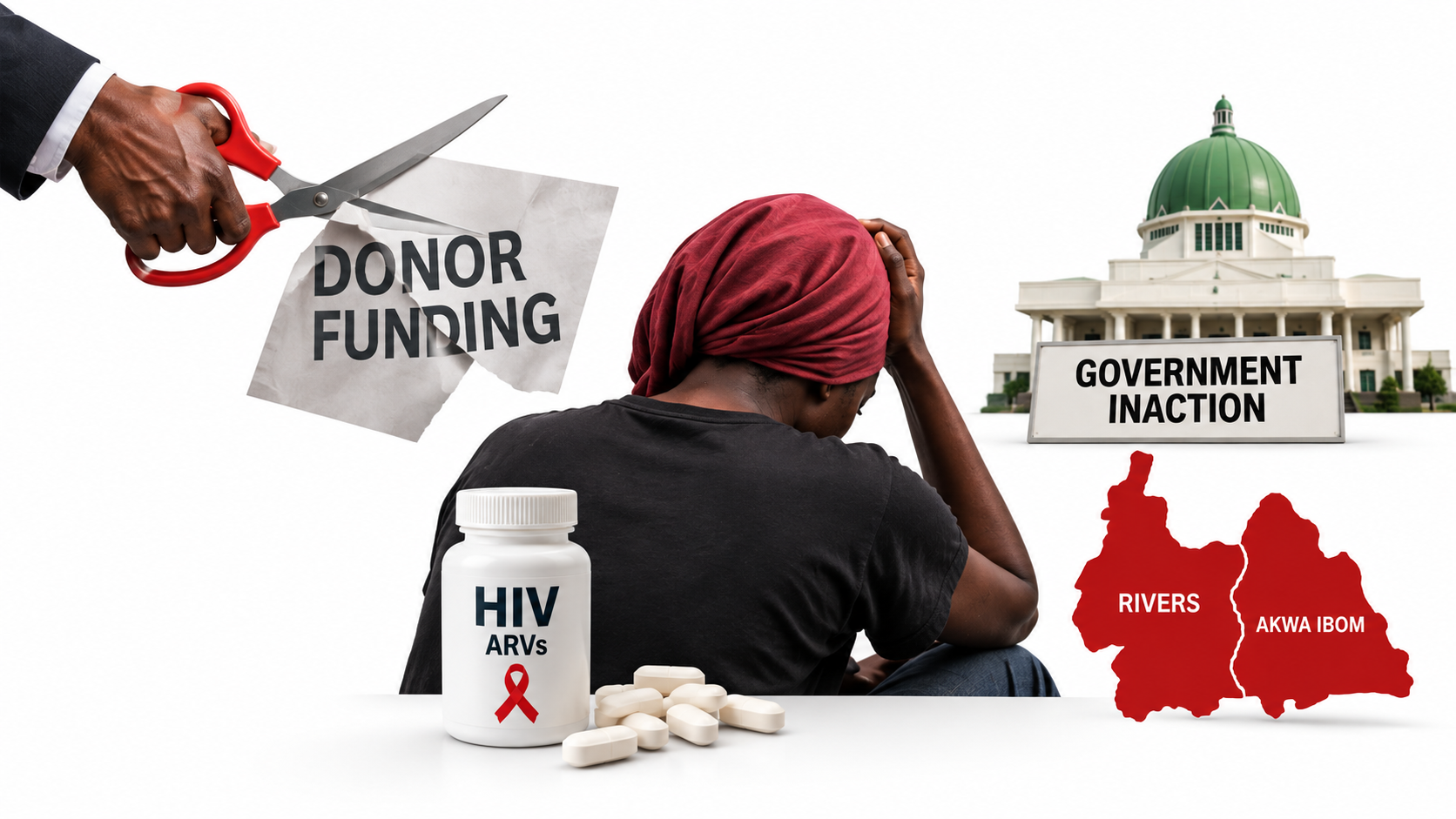
While patients and advocates tried to deal with the fallout from reduced donor support, community groups say they warned the Rivers State Government that transitioning from donor funding needed urgent planning.
A coordinator from NEPWHAN in Rivers, who asked not to be named for fear of retaliation, told PREMIUM TIMES that the network and other community organizations repeatedly asked the state government to act quickly after international donor support began to decline, but received little response.
“My collaboration with the government has not been very strong,” she said. “We have written letters. We have sought meetings. We have continued to ask: now that donor partners are leaving, what is the state’s plan? Unfortunately, we have not seen the urgency this situation requires.”
According to her, donor-supported groups like the Institute of Human Virology Nigeria had funded many workers in treatment facilities in Rivers State for years.
She said many of those workers were not doctors or nurses but adherence counsellors, peer mentors, case managers, community trackers, and lab staff who were key to HIV care.
“They were the people following up patients, counselling them, ensuring they collected their medicines and giving them hope,” the NEPWHAN coordinator said.
When donor support was cut, many of those workers lost their jobs.
She said over 300 workers funded through donor programs were affected, including 185 field personnel who worked directly with people living with HIV in communities.
Their loss has left government health workers overwhelmed.
“People now go to facilities and spend the whole day waiting. Sometimes there is nobody to attend to them immediately. Even taking viral load samples has become difficult,” she said.
She emphasized that the issue is not about the commitment of government-employed health workers but about the lack of personnel.
Beyond clinical care, she said the funding cuts have pushed many people living with HIV further into poverty.
Many of the peer counsellors and community workers who lost their stipends depended on that income to support their families and maintain their health.
“There are many people in our network who struggle even to pay transport fares to the clinic. The government needs to step in now because this is no longer just a donor issue. It is about protecting the health of Rivers people.”
She warned that if state governments do not replace the services once funded by international partners, years of progress in HIV treatment and prevention could be lost.
Beyond lives lost, the neglect keeps causing new infections. The Federal Ministry of Health and Social Welfare’s State of the Health of the Nation report 2025 shows Nigeria had 102,025 new HIV infections last year across all 36 states and the Federal Capital Territory.
Rivers State had 6,287 new infections, the second highest, while Akwa Ibom came fourth with 5,413.
These numbers are very concerning given the already high HIV rates in both states.
A recent report from the National Agency for the Control of AIDS (NACA) showed that Rivers has the highest number of people living with HIV in Nigeria, followed by Benue, while Akwa Ibom ranks third.
The experiences of Grace, Mercy, Johnson, and Victoria, along with many others interviewed by PREMIUM TIMES, highlight a crisis that goes beyond individual suffering.
Interviews with people living with HIV, peer counsellors, community advocates, health workers, and officials in Rivers and Akwa Ibom, backed by budget documents and financial records, reveal that the drop in international donor support has shown long-standing weaknesses in HIV response in both states.
For years, Nigeria’s HIV programme has depended heavily on international partners, mainly the US President’s Emergency Plan for AIDS Relief (PEPFAR) and the Global Fund, to fund essential services from HIV testing to counselling and community drug distribution.
This dependence became clearer in early 2025 when the US reviewed and ended many foreign assistance contracts funded by the US Agency for International Development (USAID) and the State Department.
Although funding for life-saving antiretroviral medicines was later restored, many community-based HIV interventions that kept patients connected to treatment did not return immediately.
Health experts say those services were never meant to replace government responsibility. They were meant to work alongside state health systems while governments slowly took more control of the HIV response.
For over 20 years, Nigeria’s HIV response has been one of Africa’s biggest public health successes.
Millions of people who would have died now live healthy lives because they have access to life-saving antiretroviral therapy. Mother-to-child transmission has reduced, viral suppression has improved, and HIV-related deaths have decreased.
But behind these achievements is a less talked about truth: Nigeria’s HIV programme has relied heavily on international donors.
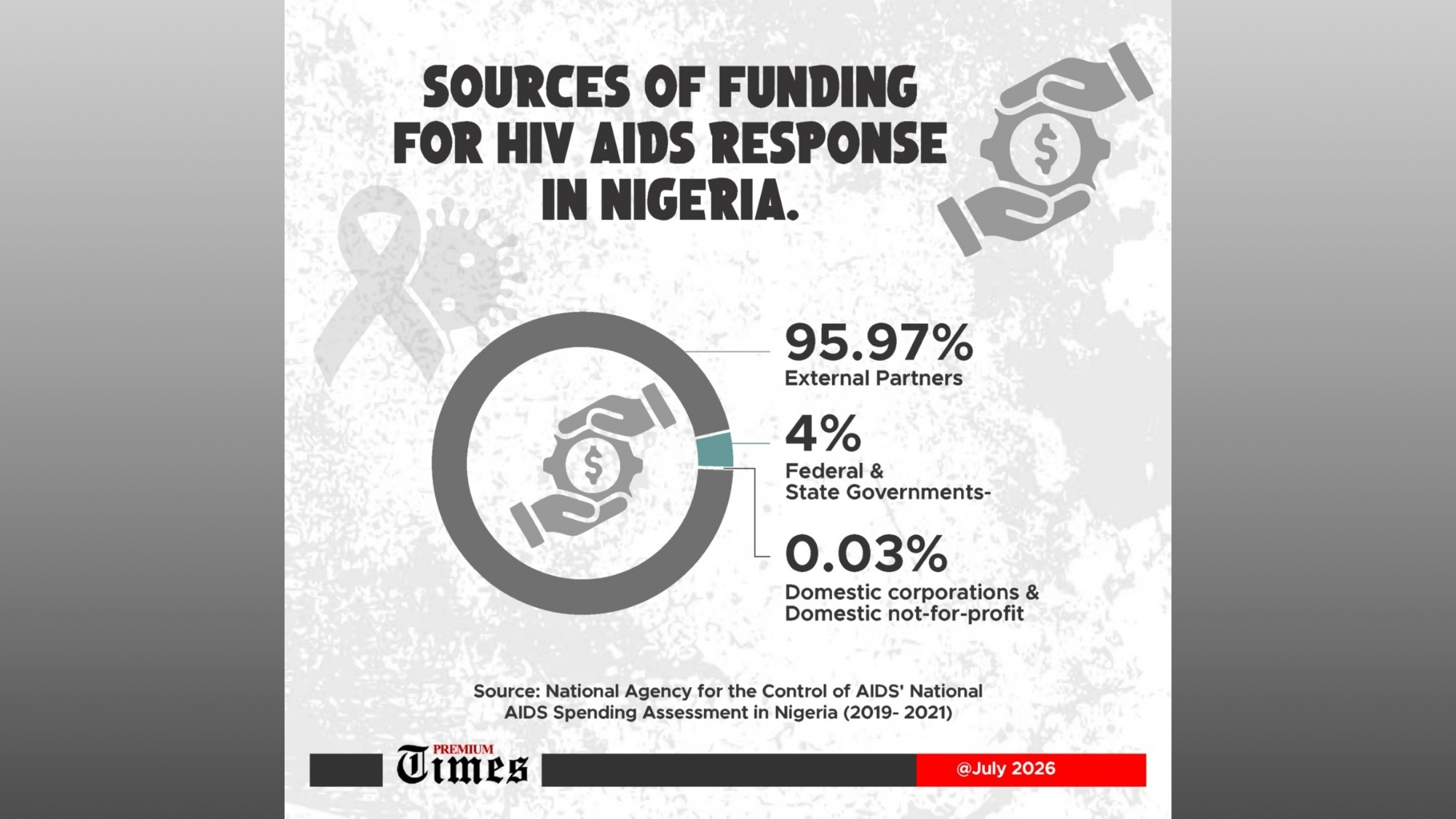
An analysis by NACA, titled ‘National AIDS Spending Assessment in Nigeria (2019-2021)’, shows that external partners funded 95.97 percent of the country’s HIV response in 2021. In comparison, public funding from federal and state governments accounted for just four percent, while private corporations and non-profits contributed 0.03 percent.
According to NACA, since 2005, Nigeria has attracted over $6 billion for HIV programmes, with four out of every $5 coming from international partners, especially PEPFAR and the Global Fund.
Private sector contribution has been minor, making up less than two percent of total funding. This funding structure has changed Nigeria’s HIV response.
PEPFAR became the largest funder of HIV care and treatment in Nigeria, spending $181 million on treatment services alone in 2021. Meanwhile, the Global Fund supported various aspects of HIV care, laboratory services, and health system improvements.
Donor funding covered much more than just medicine. It paid for adherence counsellors who motivated patients to stay on treatment, peer mentors who helped newly diagnosed clients, community workers who traced people missing from clinics, lab personnel, data officers, home-based delivery teams, community testing campaigns, and psychosocial support groups.
These were the same services that Grace relied on to receive her medication quietly, and the same support that Joy, Johnson, Victoria, and Peter told PREMIUM TIMES had vanished after donor programmes were cut back.
Recognizing the dangers of this dependence, the federal government, through NACA, has recently worked on what it calls an HIV Sustainability Agenda. This strategy aims to shift the ownership of HIV programmes from international partners to Nigerian governments.
The plan envisions state and federal governments gradually taking control of financing and managing HIV programmes while development partners provide technical support instead of directly delivering services.
NACA says the goal is a ‘new business model’ where the government takes the lead in managing and financing the national HIV response.
PREMIUM TIMES also reported that in June, the Nigerian government announced a new HIV plan to transition from donor-supported interventions to a government-led and locally funded response to HIV/AIDS.
This transition is becoming more urgent, especially as the World Health Organization aims to end AIDS as a public health threat by 2030. UNAIDS estimates that funding needed to reach global HIV targets is still lacking.
For Nigeria, the challenge grew more pressing in early 2025 when the US restructured its foreign assistance, leading to the end of thousands of USAID and State Department contracts globally.
PREMIUM TIMES reported in March last year that the US government terminated 83 percent of USAID programmes and cancelled 5,200 contracts, including those for HIV interventions.
Though waivers later ensured the continuation of life-saving antiretroviral medicines through PEPFAR, many community-based services, including outreach testing, peer support, community drug distribution, adherence counselling, and patient follow-up, were disrupted.
The funding uncertainty raised a question Nigeria has postponed for years: what happens when donors step back before governments are ready to take over?
Editor’s Note: * The names marked with asterisks have been changed to protect the privacy and identities of vulnerable individuals featured in this report.

Drop your comment
No comments yet — be the first to drop the gist 👇