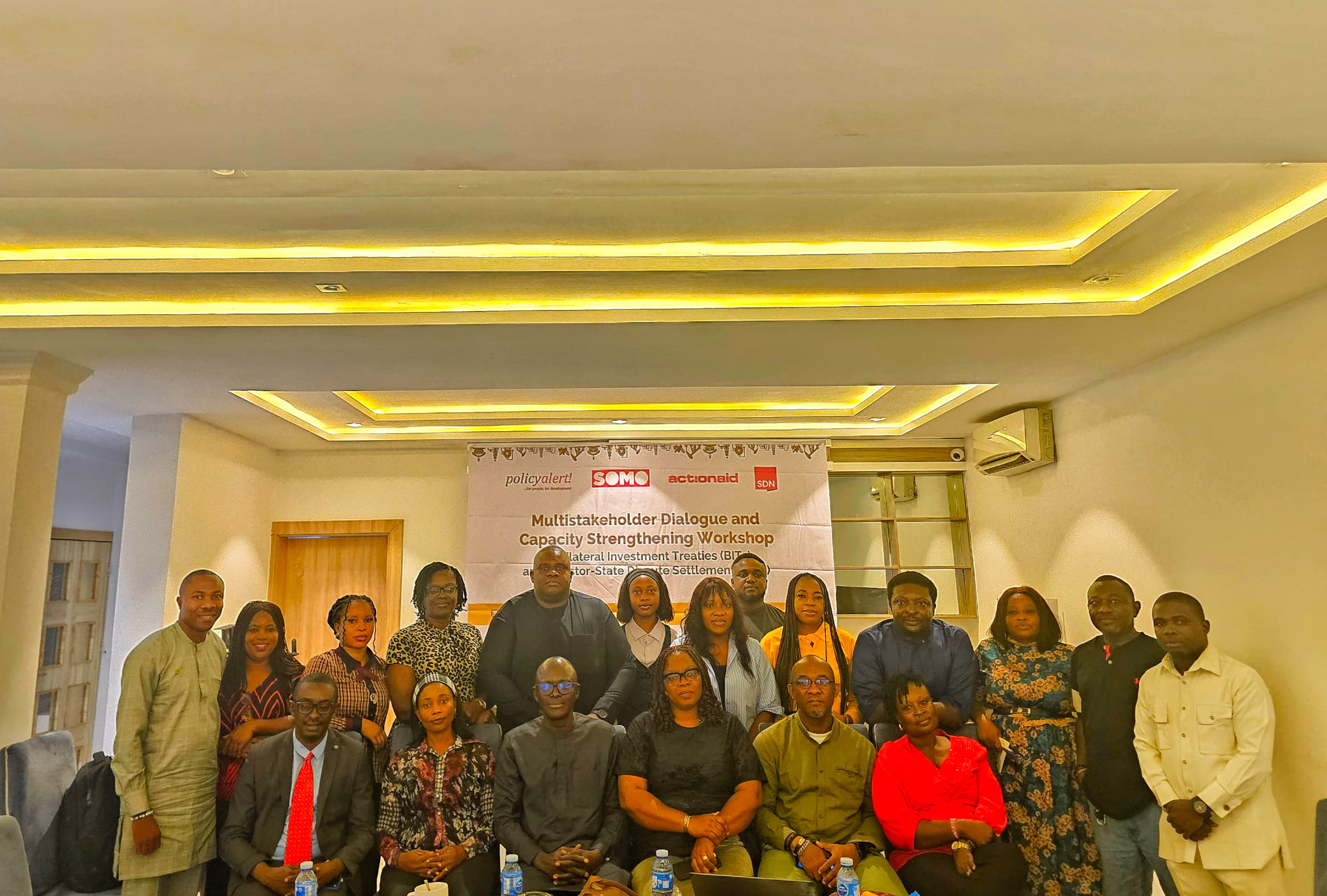
Civil society groups, community representatives, researchers and others have asked the federal government to review Nigeria’s investment treaties. They warned that protections for investors might limit the country’s ability to enforce environmental rules and pursue energy transition plans.
This call came in a statement released after a roundtable meeting on Investor-State Dispute Settlement (ISDS), energy transition, and investment management in Nigeria. The meeting took place in Port Harcourt, Rivers State, on September 16.
The roundtable was organized by Policy Alert with help from the Social Development Integrated Network and ActionAid, along with the Centre for Research on Multinational Corporations.
Participants looked at ISDS provisions in Nigeria’s investment treaties, including the 1992 Nigeria-Netherlands Bilateral Investment Treaty (BIT).
ISDS is a system that allows foreign investors to challenge government actions through international arbitration if they believe their investment rights have been violated.
The statement said participants worried these provisions might create a “chilling effect” on the government’s readiness to introduce or enforce environmental laws. This concern arises from the risk of investors making arbitration claims.
They noted that this issue is increasingly important as Nigeria seeks to balance ongoing investment in oil and gas with its goals for an energy transition.
The participants pointed to Shell’s offshore investments in the Bonga field, the federal government’s Decade of Gas initiative, and the ongoing sale of oil assets in the Niger Delta as developments that could lead to more investment-related disputes.
They specifically mentioned that the Bonga investment shows the need for Nigeria to consider the legal impacts of its treaty obligations.
This call for review comes after Shell renewed its investment in Nigeria’s deepwater sector. In December 2024, Shell and its partners announced a final investment decision on the $5 billion Bonga North deepwater project, which is expected to boost Nigeria’s oil production by about 110,000 barrels daily.
Shell also announced a $2 billion offshore gas project with Sunlink Energies and Resources Limited, which is expected to supply gas to Nigeria LNG when completed.
The participants said these investments could lead to disputes if future government actions affect investor rights protected under investment treaties.
The statement questioned the legal and financial impacts of Nigeria’s Decade of Gas initiative. They argued that expanding gas infrastructure could lead to more foreign investments that might be protected by these treaties.
They warned that this could increase the risk of arbitration claims and potentially lock the country into fossil fuel projects for many years.
The federal government sees gas as a key part of Nigeria’s energy transition and security strategy.
In July, it was reported that the government launched the National Grassroots LPG Penetration Programme as part of the Decade of Gas initiative. The goal is to expand access to cooking gas nationwide.
Officials have also stated that domestic gas is central to Nigeria’s plans for increased energy access, power generation, and industrial growth.
However, the roundtable participants said the government should review the implications of investment treaties related to expanding gas infrastructure before committing to more investments.
They suggested that the federal government carry out a thorough assessment of the potential ISDS risks linked to the Decade of Gas initiative.
The stakeholders also connected ISDS concerns to the recent trend of oil companies selling off their assets in the Niger Delta.
They said that when multinational companies leave onshore operations but keep offshore interests, it raises tough questions about who is responsible for past pollution and environmental clean-up.
These worries come amid increased scrutiny of oil company divestments in Nigeria.
In March 2025, the Nigeria Extractive Industries Transparency Initiative said it would review 26 oil blocks valued at $6.03 billion involved in divestments by five international oil companies due to environmental issues and unresolved matters.
Recently, four groups filed a lawsuit against TotalEnergies’ planned divestment, raising concerns about environmental responsibilities and the lack of public information about financial guarantees for clean-up and compensation.
A separate report in July highlighted internal Shell documents that, according to Amnesty International, suggest the company’s estimated cost for onshore decommissioning could reach $10.9 billion, not including environmental clean-up. The report also raised questions about how to handle past environmental responsibilities after Shell exits onshore operations.
The stakeholders from Port Harcourt said ISDS provisions could make it harder for the Nigerian government to impose environmental obligations on foreign investors after divestments.
They urged the Nigerian Upstream Petroleum Regulatory Commission to set clear requirements for companies to settle or secure legacy environmental liabilities before they finalize divestments.
The 1992 Nigeria-Netherlands BIT was a major focus in the discussions.
Participants said Nigeria should review and, if needed, renegotiate existing investment treaties to make sure they do not limit the government’s ability to regulate in the public interest.
The issue of Nigeria’s risk of international investment arbitration is real.
In the ongoing OPL 245 dispute, Italian energy firms linked to Eni have taken Nigeria to arbitration at the International Centre for Settlement of Investment Disputes. They claim that delays in processing the license breach obligations under the Nigeria-Netherlands BIT.
The Attorney-General of the Federation, Lateef Fagbemi, stated in March that Nigeria could face over $2 billion in damages and costs connected to this dispute. The federal government is now working on an arrangement to resolve the arbitration issues.
This case shows how disputes in Nigeria’s oil sector can go beyond local courts and become international matters.
The stakeholders recommended that future investment treaties should include clear protections for Nigeria’s right to regulate environmental protection, clean-up, and climate action without facing arbitration claims.
They called for relevant parts of the Petroleum Industry Act to be reviewed and strengthened, especially those about environmental clean-up, obligations to host communities, and enforcement of regulations.
The participants also suggested that Nigeria’s investment agreements should align with national laws and not override environmental, fiscal, or regulatory standards.
They called for more transparency around investment disputes, including public access to information on pending and resolved ISDS cases involving Nigeria.
The stakeholders urged government agencies that negotiate or renew investment treaties to engage in meaningful discussions with civil society and affected communities before finalizing agreements.
They further asked the National Assembly to play a formal role in negotiating and approving investment agreements and treaties.
Another major recommendation was that Nigeria should aim to remove ISDS clauses from its investment treaties moving forward.
The statement said that reforming Nigeria’s investment treaty rules should focus on protecting communities affected by oil and gas projects.
The participants insisted that Niger Delta communities should not have to bear the environmental damage costs from investments that profit corporations and the government.
They also called for continuous training for civil society groups, community members, and journalists to help them investigate and report on ISDS, investment governance, and energy transition issues.
They concluded that Nigeria’s climate and energy transition goals will depend not just on government policies or new energy projects but also on whether investment treaties allow the country to regulate in the public interest.


Drop your comment
No comments yet — be the first to drop the gist 👇