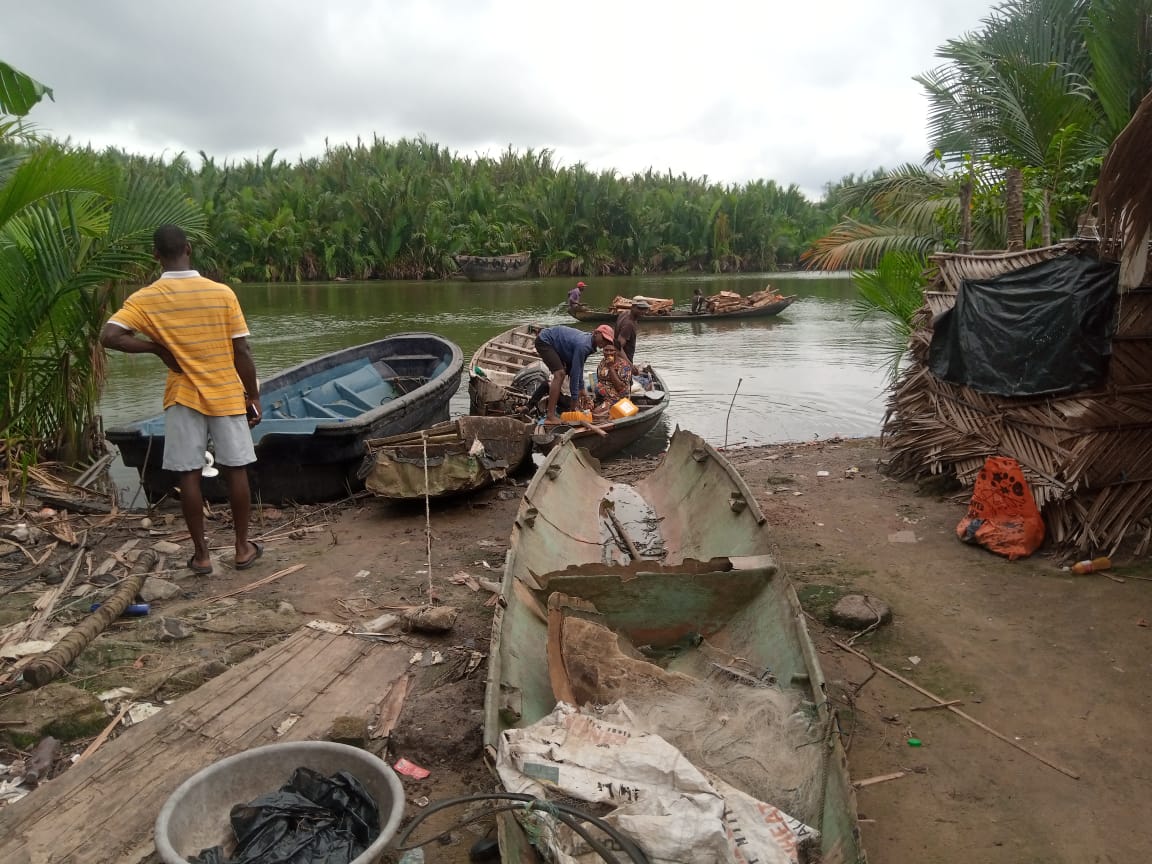
Dark clouds loomed over the Atlantic coast, a common sight during Nigeria’s rainy season in the Niger Delta. On this June day, rain poured since morning, turning the sandy paths of Ikot Inua Eyet, a fishing community in Ibeno Local Government Area of Akwa Ibom State, into muddy trails.
At home, 52-year-old fisherman Christian Inyang helped his wife serve customers at her small roadside food stall.
As the rain fell harder, Mr Inyang gazed at the river that had supported his family for years.
He should have been fishing today. Instead, like many fishermen along Nigeria’s southern coast, he was stuck on land.
"A lot has changed," he said quietly.
"Our catch is no longer like before. If you don’t have a big boat with a powerful engine to go far into the sea, you won’t catch anything," Mr Inyang explained.
For years, the shallow creeks around his community provided enough fish to feed families and support local markets. Fishermen used wooden canoes to paddle into nearby waters and returned with nets full of croaker, catfish, and bonga.
Now, those waters are mostly empty. Fishermen say the fish have moved farther offshore.
For Mr Inyang, some say it is "climate change," but he understands the changes affecting his livelihood.
"Some people came here and explained that it is climate change," he said.
"I don’t know much about it, but what I know is that the fish have gone deeper into the ocean," he added.
The situation has hit many fishermen hard, forcing some to find other sources of income. They often cannot afford engines strong enough to take them out to sea for a good catch.
Climate Change Hurts Nigeria’s Coastal Fisheries
Fishing has been a way of life in coastal communities across Akwa Ibom, Bayelsa, Delta, Rivers, and Cross River states for generations. Long before oil companies came, fishing was the main source of income for many families. Children learned to paddle canoes before they could ride bicycles.
Nigeria’s over 200 million people depend on the fishing industry for much of their protein, making this sector important for the economy.
But this sector faces many challenges, including climate change.
The Intergovernmental Panel on Climate Change (IPCC) says rising ocean temperatures, changes in rainfall, ocean acidification, and rising sea levels are changing marine ecosystems worldwide. Many fish species are moving into deeper or cooler waters as sea temperatures rise, making it harder for small-scale fishers to catch them.
The Food and Agriculture Organisation (FAO) has also warned that climate change affects fish distribution, breeding, and the productivity of coastal fisheries, especially in developing countries that rely on traditional fishing methods.
Nigeria is among the countries most affected by climate change. Rising temperatures, erratic rainfall, coastal erosion, and flooding threaten livelihoods across the country. Millions, especially in farming and fishing communities, face increasing food insecurity because of these changes.
On paper, the government has made some moves. Nigeria submitted its third Nationally Determined Contribution (NDC 3.0) in September 2025, promising a 32 percent reduction in emissions by 2035 compared to 2018 levels. It aims to increase renewable energy in electricity generation from 22 percent to 52 percent and achieve net-zero emissions by 2060, backed by Nigeria’s 2023 Climate Change Act.
But the government struggles to implement these policies. Financing is a big problem. Nigeria estimates it will need $337 billion between 2026 and 2035 to meet its NDC 3.0 goals, a sum far beyond what is currently available.
For fishing communities in Akwa Ibom and the Niger Delta, this gap between policy and action means the crisis remains largely unaddressed, leaving residents to fend for themselves, often without help.
In the Niger Delta, where artisanal fishers use small wooden boats powered by paddles or low-horsepower engines, going farther out to sea often requires equipment they cannot buy.
"If you don’t have a big boat with a powerful engine to go far into the sea, you won’t catch anything," Christian said.
For fishermen like Mr Inyang, the changing climate is no longer just a theory. It shows in longer hours at sea, higher fuel costs, smaller catches, and uncertainty about whether each trip will provide enough for their families.
"Before, a fishing trip could bring me fish worth between N700,000 and N800,000. Now, we make about N150,000 or even less. When you remove the cost of fuel, paying workers, and feeding the crew, what is left is very small."
Fish Production in Nigeria
According to WorldFish data, Nigeria produces around 1.2 million metric tonnes of fish every year, with 90 percent consumed domestically. In 2025, the sector produced about 1.4 metric tonnes. While this shows growth, the federal government says production still falls short of Nigeria’s yearly consumption, estimated at 3.6 million metric tonnes.
In February, the federal government raised the alarm over post-harvest losses of up to 30 percent in Nigeria’s fish sector.
"Despite fish being one of the cheapest and most accessible sources of animal protein for Nigerian families, post-harvest losses of up to 30 percent continue to undermine supply and affordability," said the Minister of Marine and Blue Economy, Adegboyega Oyetola.
For decades, poor government investment and regulation have hurt the industry. Small-scale fishers, who are the backbone of the industry, struggle with old equipment, inadequate storage, and limited access to credit and training in sustainable fishing practices.
Eyo Ambrose, a professor in the Department of Fisheries at the University of Uyo, says climate change is worsening the problems facing Nigeria’s fisheries. He believes local fishermen cannot fish in deep waters, which allows foreign vessels to exploit Nigeria’s fish resources without checks.
"Climate change is affecting our fisheries. Our local fishermen do not have the capacity to fish in the deep sea, so foreign vessels come with large trawlers, harvest the fish, and leave. There is little or no monitoring of their activities," Mr Ambrose said.
Forced to Change Careers
In Okorotip, another fishing community nearby, Aniedi Uwem said he has switched to crab harvesting.
"I have changed to crab catching," Mr Uwem said. "The fish we used to catch in shallow waters have moved deep into the ocean. Only a few are left. If I go fishing now with my normal canoe, I usually come back with very little or sometimes nothing at all," he added.
Another fisherman, Aniefiok Edet, sees a deeper meaning in the situation.
"In this area, we hardly see fish anymore. Instead, we hear that those who go farther into the deep sea are the ones making catches now. I don’t really know the cause, but I believe it is the will of God," Mr Edet said.
These changes are one reason fish prices keep rising. Fish catches are no longer enough like they used to be," he said.
Market checks show that fish that used to sell for N10,000 now costs N22,000. Quantity that used to go for N15,000 now sells for N25,000, and a stick of small tilapia fish that cost N3,000 has more than doubled to N7,000.
The Sea Moves Closer
While fish swim further away, residents say the sea itself is getting closer to their homes. Many areas are now regularly flooded or eroded by the advancing shoreline.
Affiong Benjamin, a resident of Oborotip, pointed to homes damaged by water.
"The water now comes into our houses and carries away our fishing equipment," she said.
Many families have piled sand and other materials around their homes to keep floodwaters out.
Costly Adjustments
For those determined to remain fishermen, like Mr Inyang, survival depends on larger boats and stronger engines, but those costs are too high for many.
The sharp increase in fuel prices in recent years has made longer fishing trips much more expensive. Each journey into deeper waters needs more petrol, more labor, and greater financial risk. For small-scale fishermen, it no longer makes sense.
Despite the many challenges, the fishermen interviewed said they have not received government support specifically to deal with climate change. They acknowledged that the government has provided some assistance, such as road infrastructure, electricity, and improved security.
Some hope for subsidized fishing equipment and targeted help, but many just want the authorities to recognize the problem before their way of life disappears.
Effiong Akpan, a community leader, said climate change threatens their existence. He warned that parts of the settlement could vanish if the impacts continue.
"Some parts of this community are at risk of disappearing because of climate change," Mr Akpan said.
"Fishing is our main source of livelihood because the land we would have used for farming has been taken over by water. If nothing is done, our community and our way of life will continue to be threatened," Mr Akpan added.
Mr Inyang believes things can return to normal if the nearby water is dredged to deepen it. "There is too much sand now," he explained.
"There used to be people dredging this river, but they stopped around 2018 or 2019. Since then, the river has not been deep enough for fish to survive here. If the dredging is carried out, things will be better, and fish will return to the nearby water where we can continue our work," he added.
Expert Opinion
Brave Imiete, a marine policy analyst and director of Ocean Stewardship International in Port Harcourt, confirmed that climate change is hurting the ocean, affecting how species relate to their habitats.
Mr Imiete said there is a need for sustainable adaptation measures and more investment in marine research to understand these changes and support Nigeria’s marine ecosystem.
"In the face of these challenges, we must work together to make informed decisions and adapt to these changes to protect fish stocks," he said.
"We must also focus on research, innovations, and adaptive management to secure our oceans and vital fish populations while supporting the livelihoods of coastal communities," Mr Imiete added.
Drop your comment
No comments yet — be the first to drop the gist 👇