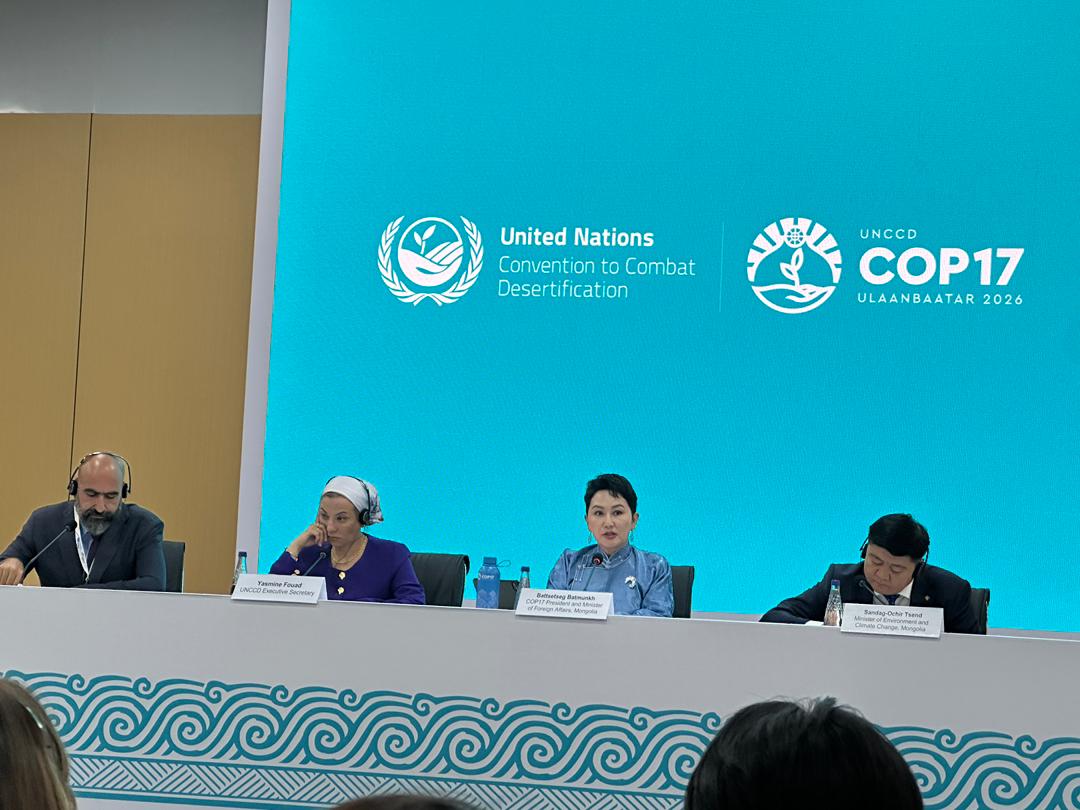
The 17th session of the Conference of the Parties to the United Nations Convention to Combat Desertification (UNCCD COP17) ended on Friday. Governments, banks, funds, and companies announced a $1.3 billion plan to support land restoration and drought resilience in 23 countries.
The deal was announced on Friday by the COP17 presidency during a closing press conference in Mongolia.
Delegates approved this during the closing meeting, led by the conference committees.
"Governments, development banks, funds and companies announced a US$1.3 billion portfolio of finance for land restoration and drought resilience across 23 countries on five continents, at different stages of development," the UNCCD stated.
The UNCCD did not list the 23 countries involved in this big project. They noted that $644.5 million is new finance, while $216.4 million is already confirmed and set to start soon.
The plan includes rangeland and landscape restoration, drought resilience, and local adaptation efforts.
The two-week conference brought together representatives from the 197 Parties of the UNCCD. Over 25,000 people attended in both the Blue and Green zones of the venue in Mongolia.
During the conference, the COP17 presidency focused on implementation to tackle land degradation, desertification, and drought.
The summit highlighted the importance of rangelands in the global land agenda. Rangelands cover about 54 percent of the Earth's land and support around two billion people, managed by about 500 million pastoralists.
A key outcome was the launch of the Rangelands Flagship Initiative. This brings together $1.2 billion across 45 projects aimed at managing rangelands sustainably and supporting pastoralist livelihoods.
UNCCD Executive Secretary Yasmine Fouad spoke to journalists at the closing press conference. She said the summit must be judged by what happens after delegates leave Mongolia.
"We came to Ulaanbaatar saying that COP17 must be a COP of implementation," Ms Fouad said.
She mentioned the conference improved the framework needed to turn promises into actions through political decisions, science, financing, investment pathways, and partnerships.



"But Ulaanbaatar will not be judged by what was announced inside this conference," she said. "Its legacy will be measured by what happens next."
The conference also pushed for better global drought resilience.
Parties agreed to keep discussing plans for proactive drought management at COP18. Drought will be a separate agenda item at future meetings.
Additionally, COP17 launched the Drought Resilience Investment Facility. This is a global financing platform aiming to gather up to $400 million for water security, sustainable agriculture, nature-based solutions, and land restoration.
The summit took place amid rising worries about land degradation. Up to 40 percent of the world's land is thought to be degraded, and countries are committed to restoring over one billion hectares by 2030.
But the funding gap is still large. Around $355 billion is needed each year until 2030 to meet global land restoration goals, while only about $77 billion is currently invested.
Mongolia, which hosted the conference during the UN International Year of Rangelands and Pastoralists, also launched three initiatives under its Steppe Plan. These include the Rangelands Flagship Initiative, Water, Land Nexus Initiative, and Nature-based Solutions for Sustainable Infrastructure Initiative.
Mongolia’s Foreign Minister and COP17 President, Battsetseg Batmunkh, said the country aimed for an open, inclusive, and agreement-driven process.
Environment and Climate Change Minister Sandag-Ochir Tsend stated that the priority after COP17 will be to turn decisions, partnerships, and investment pledges into real results.
"Although COP17 concludes today, our work does not end here," he said.
The next UNCCD Conference of the Parties (COP18) is set to take place in Egypt in 2028.



Drop your comment
No comments yet — be the first to drop the gist 👇