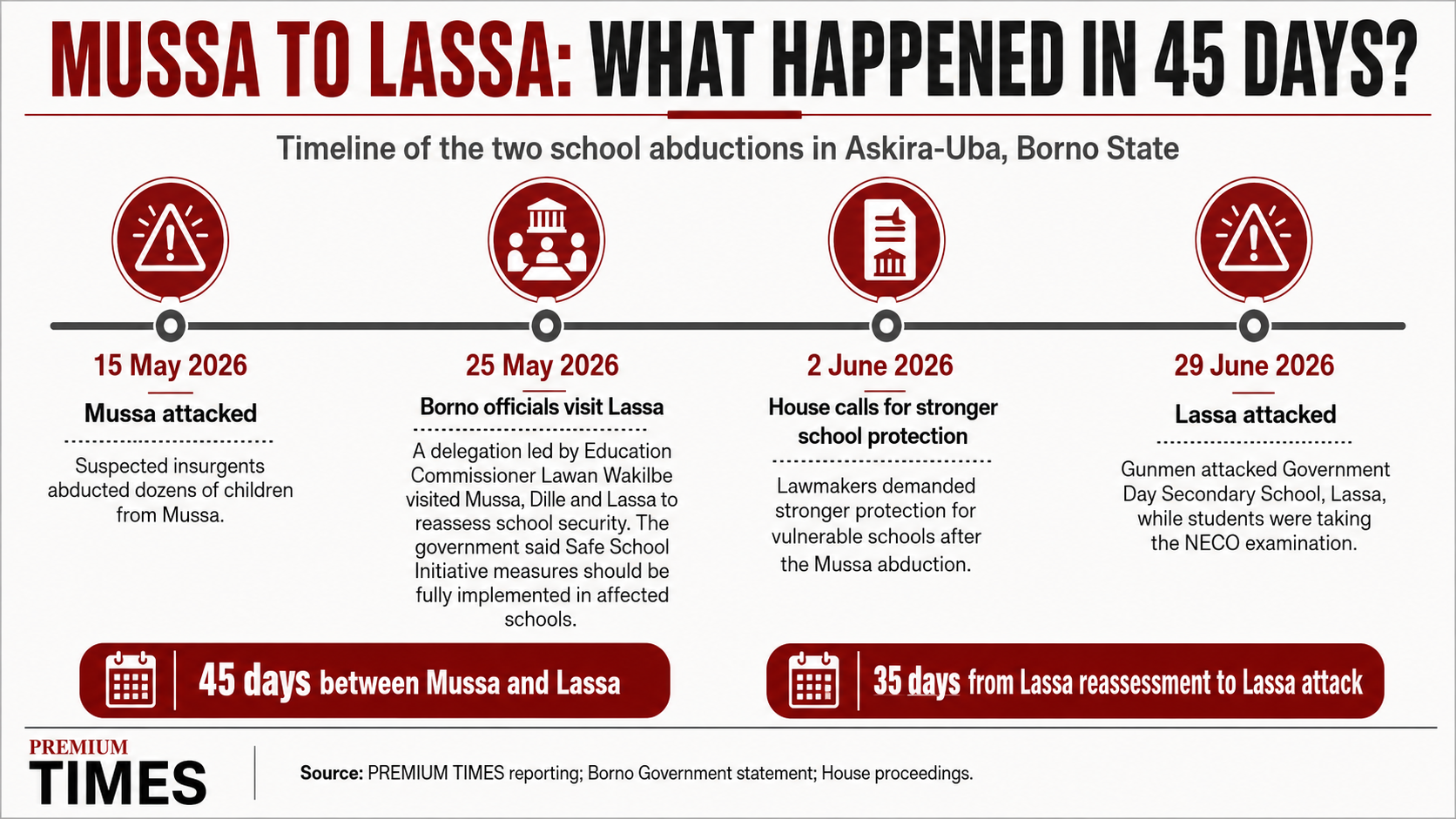
Ten days after suspected insurgents took many children in Mussa, Borno State officials went to nearby Lassa to check the security and safety of public schools.
The team, headed by the state’s Commissioner for Education, Science, Technology and Innovation, Lawan Wakilbe, visited Mussa, Dille, and Lassa on 25 May as part of the government’s response to the 15 May abduction.
After their visit, the government said Mr Wakilbe ordered that “all Safe School Initiative measures be fully implemented in the affected schools pending further government directives.”
Fasuma Askira, education secretary of Askira-Uba Local Government Area, was part of the delegation.
The government also said they temporarily closed and relocated Government Day Secondary School, Mussa, as an immediate safety step under the Safe Schools Initiative.
But just 35 days later, Lassa was attacked.
On 29 June, suspected insurgents attacked Government Day Secondary School, Lassa, while students were taking their exams with the National Examinations Council.
Some abducted students were rescued shortly after the attack, but checks by PREMIUM TIMES found that 36 students and a teacher remained missing.
The Lassa attack happened 45 days after Mussa.
The government had announced Safe Schools measures between the two attacks.
What happened to those measures?
Interviews with parents, community leaders, and local education officials, along with reviewed parliamentary and government records by PREMIUM TIMES, did not show what measures were put in place at Government Day Secondary School, Lassa, after the May assessment.
Mrs Askira, who was part of the government team that visited Lassa, told PREMIUM TIMES on 19 August that the Safe Schools programme was not active in schools in the affected area.
The federal body in charge of the country’s Safe Schools response also did not clarify, despite repeated requests, whether Mussa or Lassa had been registered, verified, or formally assessed under the national programme, what help reached the area, or how the Borno government’s measures related to the federal Safe Schools structure.
The effects of the insecurity have spread throughout the local education system.
Mrs Askira confirmed that only 56 of Askira-Uba’s 113 primary schools were operating after security-related closures, compared to 76 before the Mussa crisis.
Security issues existed before the abductions
Concerns about security in Mussa and Lassa did not start with the May attack.
More than a year before the Mussa abduction, worries over safety in the communities reached the House of Representatives.
On 20 February 2024, Midala Balami, representing Askira-Uba/Hawul Federal Constituency, sponsored a motion titled “Need to Prevent Killings and Deploy Urgent Security Measures in Saban Gari, Kelle, Dille, Lassa and Mussa Towns in Askira-Uba and Hawul Local Government Areas in Borno State.”
The House noted that attacks, killings, and destruction in these areas were becoming common and said there was an urgent need for “strong and effective security measures” to stop further attacks.
It urged the Nigerian Army and other security agencies to increase their presence and efforts in Mussa, Lassa, Dille, and nearby areas.
Eight months later, the House discussed security again, this time focusing on education issues.
On 15 October 2024, Mr Balami sponsored another motion about the challenges students faced while taking JAMB, WAEC, and SSCE exams in Mussa, Dille, and Lassa.
The House noted that insecurity was affecting students and called on the Federal Ministry of Education to work with security agencies to ensure the safety of students, teachers, and examination materials.
It also mandated relevant committees to monitor compliance.
Records show that security concerns in Mussa and Lassa were formally raised in the National Assembly more than a year before the two school abductions.
Mussa attacked
On 15 May 2026, suspected insurgents attacked Mussa.
PREMIUM TIMES got a register from Mussa Ward councillor Peter Wabba, identifying 40 missing children by name, age, and family background.
Further checks in the community at the time suggested the number might be higher, with families and local officials giving different counts.
Mr Wabba later told PREMIUM TIMES that little reliable information about the children’s whereabouts reached grassroots leaders.
“At our level, there is no information apart from hearsay,” he said.
The abduction led to visits and actions by the state government.
Governor Babagana Zulum visited the area on 19 May.
Six days later, a team led by Mr Wakilbe visited Mussa, Dille, and Lassa.
In Mussa, the government announced a temporary closure and relocation of Government Day Secondary School to Government Secondary School, Uba, calling it an immediate measure under the Safe Schools Initiative.
The delegation also assessed the situation in Dille and Lassa.
The government said officials visited to “reassess the security situation and evaluate safety conditions in public schools in the affected areas.”
Parliament demands better school protection
Eight days after the Borno assessment, on 2 June, the House of Representatives debated school security again after the Mussa abduction.
Lawmakers called for more efforts to rescue the children and urged stronger security around vulnerable schools in Borno and other areas.
The House also requested better intelligence, quick response systems, surveillance, early warning systems, and community security arrangements.
Twenty-seven days later, Government Day Secondary School, Lassa, was attacked.
What was really done at Lassa?
The Borno Government’s May statement says Lassa was visited and its security situation reassessed.
It also says the education commissioner ordered Safe Schools measures in affected schools.
But the statement does not say what happened next at Lassa.
When PREMIUM TIMES asked Mrs Askira what education authorities did after Mussa to protect other schools, she said the local authority wrote to the ministry and suggested temporary closures in Mussa and Lassa areas.
Schools on the outskirts and in vulnerable rural areas were closed temporarily, she said, while junior secondary students from Mussa were moved to a government boarding school in Uba.
She mentioned discussions with the local government chairman about having community vigilantes around schools when classes reopened.
Under this plan, vigilantes would stay around the school from morning until closing time.
She added that Mussa and Lassa had some military presence along with local vigilantes.
But when PREMIUM TIMES asked if Mussa was part of the Safe Schools Initiative before the attack, Mrs Askira replied: “No.”
After a pause in the interview, PREMIUM TIMES came back to this topic.
Mrs Askira first asked which program the reporter meant.
When the reporter explained that he meant the Safe Schools program for vulnerable schools, she said:
“We don’t have this program of school initiatives in our schools in that area.”
She later said she could not speak for schools in Maiduguri but doubted that the program operated in rural local government areas outside the city.
At her request, PREMIUM TIMES later sent her the main statements for her to check for any errors or misquotes.
She corrected the number of working primary schools and the spelling of some schools and communities, but kept her account of the Safe Schools situation.
Her story and the government’s statement raise a point that needs clarification.
The state government said Mrs Askira was part of a team that visited Lassa and that the education commissioner ordered the implementation of Safe Schools measures.
Mrs Askira later said the Safe Schools program was not active in the area’s schools.
These statements do not necessarily conflict. Measures called Safe Schools could have been ordered even if a formal Safe Schools setup was not active.
But neither the Borno State Government nor the federal Safe Schools coordinating center has explained what was happening in Askira-Uba.
The Borno government’s statement did not clarify whether “Safe School Initiative measures” meant actions coordinated through the National Safe Schools Response Coordination Centre or security measures the state adopted under the broader Safe Schools framework.
PREMIUM TIMES asked the federal coordinating center for clarification on this relationship.
What Nigeria’s Safe Schools program includes
The federal government’s Standard Operating Procedure for the National Safe Schools Response Coordination Centre describes the National Plan on Safe Schools as a framework for protecting at-risk schools, students, teachers, non-teaching staff, and communities from attacks.
This framework encourages cooperation between the Federal Ministry of Education, the Nigeria Security and Civil Defence Corps, the police, the Department of State Services, the Defence Headquarters, and other government bodies.
Its goals include coordinating measures to prevent and respond to attacks on schools.
PREMIUM TIMES asked the federal coordinating center if Mussa Central Primary School and Government Day Secondary School, Lassa, were registered, mapped, verified, or captured under the National Safe Schools program.
The newspaper also asked if either school had a formal vulnerability assessment, if Lassa was reassessed under the federal plan after Mussa, and how the Borno Government’s assessment on 25 May related to the NSSRCC.
Other questions included what measures were in place before the 29 June attack and how many schools in Askira-Uba were registered, verified, or formally assessed under the program.
NSSRCC questions still unanswered
PREMIUM TIMES started reaching out to the National Safe Schools Response Coordination Centre on 23 August, using the contact numbers published in the federal government’s Early Warning Handbook.
The newspaper finally made contact with the Centre on 26 August, when one of its published lines returned an earlier call. PREMIUM TIMES spoke with Mohammed Yabagi, an official at the Centre.
Mr Yabagi asked the newspaper to send its questions to a phone number and the Centre’s official email. PREMIUM TIMES did so.
The newspaper spoke with him again after sending the questions and made several follow-ups.
On Friday, PREMIUM TIMES sent a final reminder to Mr Yabagi and followed up by email, letting the Centre know the report was being finished and asking for a response before 6 p.m. to include their position.
No substantial response had been received by the deadline.
This does not mean Mussa and Lassa were not part of the Safe Schools system.
It just means PREMIUM TIMES could not find out from the federal coordinating body what status the schools had under the program, what assessments were done, or what help, if any, occurred between the two attacks.
Only 56 of 113 primary schools operational
Insecurity has also impacted education across Askira-Uba.
Mrs Askira confirmed that the local government has 113 primary schools.
Before the Mussa crisis, 76 were operational.
After the attacks and security-related closures, this number fell to 56, according to figures she later reviewed and corrected for PREMIUM TIMES.
Not all 57 non-operational schools stopped because of the two attacks.
Thirty-seven were already closed before the Mussa crisis.
So, the drop from 76 to 56 means 20 fewer primary schools were functioning after the security-related closures than before.
Mrs Askira listed affected schools around Mussa as Mussa Central, Mussa B, Mussa Burda, Chul, Kindindila, Lagunasara, and Mungum.
Around Lassa, she mentioned Lassa A, Lassa B, Hamman-Nomadic, and Samuwa, among others.

She said insecurity made it hard to keep schools in some rural areas and favored boarding primary schools in safer urban areas like Uba.
Families wait, children stay out of school
Between 19 and 21 August, nearly two months after the Lassa abduction, PREMIUM TIMES spoke with parents and family representatives whose children are still missing.
Milnda Lassa is the spokesperson for the families of the students taken from Government Day Secondary School, Lassa. He is also one of the affected parents.
His son, Bitrus Milnda, an SS1 student, is among those still missing.
Mr Lassa told PREMIUM TIMES that shortly after the 29 June attack, residents chased the abductors and returned with seven people, six students, and one teacher.
Since then, he said, no other abductee has escaped, been rescued, or returned.
According to Mr Lassa, 36 students and one teacher, 37 people in total, remain missing. This matches PREMIUM TIMES’ verification after the attack.
He said families still had no recent information to know their children’s condition.
“We don’t know whether they are well, whether they are alive,” he said.
Mr Lassa stated that families had not received recent evidence to identify their children and confirm their condition.
He said he occasionally spoke with Education Commissioner Mr Wakilbe, who told him to be patient, keep praying, and that efforts were ongoing.
But those talks, he said, have not provided substantial information about where the children are, their condition, or when they might return.
Mr Lassa added that families had not received any material assistance since the attack.
Some parents have fallen ill, while others have stopped working or farming due to the distress from the abduction, he said. He also mentioned visiting some affected parents in the hospital.
Mr Lassa said schools were no longer functioning in Lassa and Mussa, while fear has affected farming and movement.
Although he heard that more security personnel were sent to the area, he said residents feel little improvement in safety.
“Nothing has changed,” he said.
It was through Mr Lassa that PREMIUM TIMES reached other affected parents. The children mentioned in those interviews are part of the 36-name register reviewed by the newspaper.
Partsi Simon: ‘We have no information’
One of them is Partsi Simon, an SS2 student, whose father, Reverend Simon Waindu, has been waiting for her since the attack.
Mr Waindu also said 36 students and one teacher remain missing.
When asked if families had received recent information about their condition, he said:
“We have had nothing about it since they carried the children away.”
Mr Waindu said his family has not received any financial or emotional support from the government since the abduction.
“No support, no encouragement,” he said.
His other children are also not in school.
When PREMIUM TIMES asked if any of them were currently attending school, Mr Waindu replied:
“Nobody.”
He noted that schools in Lassa, Mussa, and Dille had closed.
The abduction changed their daily lives, he said.
“We are not free because at any moment, we are thinking about this.”
Mr Waindu said that activities around the home remind the family of Partsi, and farming has become difficult because they cannot do it “with a free mind.”
He urged the authorities to bring the children home.
Two children taken from one family
Another mother interviewed by PREMIUM TIMES has two children among the 36 still missing: Ibrahim Ijai and Margret Ijai, both SS1 students.
They are her two oldest children.
She identified Ibrahim as her son and Margret as her daughter.
When asked what information she had received since the abduction, she answered:
“No news.”
She said entering the room where her children slept and seeing their things made her cry.
The mother recalled going to the farm with them the Saturday before they were taken the following Monday. She said she has not returned to the farm since.
Her two younger children are also not attending school.
She said some children who saw their siblings leave for school and not come back are now afraid to go to school themselves.
Martha Wajau wanted to be a nurse
Another name on the register is Martha Wajau, an SS1 student.
Her mother told PREMIUM TIMES that Martha was 15 when she was abducted.
She said she has received no information about her daughter’s condition since the attack, apart from visits by family representatives to comfort affected parents.
The mother had seen a short video presented by the Borno State Government as proof of life for the abducted Lassa students.
She said she could not identify Martha in it.
Martha’s siblings are also not attending school, her mother said, because schools in their area are closed.
Her mother mentioned that Martha’s absence is felt in household chores she used to do.
Martha, the eldest child, helped with cooking, fetching water, washing, and other tasks at home.
“Everything she used to do, she is not around to do it,” her mother said.
Martha wanted to become a nurse.
Partsi Simon, Bitrus Milnda, Ibrahim Ijai, Margret Ijai, and Martha Wajau are among the children whose families are still waiting for their return.
Their siblings and other children in those communities are also losing school time as many schools remain closed and parents are worried about safety.
Government claims it has proof of life
In July, Education Commissioner Mr Wakilbe showed a 15-second video at an education summit in Maiduguri, which the Borno State Government claimed showed the abducted Lassa students alive.
The government stated that 36 students, including 25 girls and 11 boys, were still missing.
Some parents later told PREMIUM TIMES the footage did not help them identify their own children.
Mrs Askira separately mentioned she was told that the children taken from Mussa and Lassa were alive.
She said she had no direct communication with the abductors and did not know who, if anyone, was negotiating with them.
Government says rescue efforts are ongoing
Mrs Askira said government officials have kept in touch with the families of the abducted Mussa children.
She said officials have visited Mussa several times, and the Education Commissioner asked parents to choose a representative to convey information.
When PREMIUM TIMES asked about families’ complaints about receiving little information about the children, Mrs Askira described the message being given to them:
“Exercise patience. This is the only thing now.”
Officials have had contact with affected families, but parents and community representatives told PREMIUM TIMES they have received little concrete information about the children’s condition or when they might return.
Borno Information Commissioner Professor Usma A. Tar also gave PREMIUM TIMES a government statement after Governor Zulum met parents of the Mussa children at Government House in Maiduguri.
Mr Zulum said the state and federal governments are working together to rescue the children, and President Bola Tinubu has directed security agencies to ensure their release.
The government described the Mussa victims as “about 44 primary school pupils.”
When PREMIUM TIMES later asked Mr Tar about Lassa, proof of life, differing Mussa figures, school protection, and Safe Schools coverage, he said the statement was “all we can provide for now.”
Even the Mussa number is still unclear
Public accounts still differ on how many children are missing from Mussa.
PREMIUM TIMES’ initial named register listed 40 children; community checks suggested the number might be higher. The House of Representatives later referred to 42 children in its June discussions. More recent Borno Government statements have mentioned “about 44” pupils. No public named register reviewed by PREMIUM TIMES has reconciled these numbers.
Mr Wabba initially told PREMIUM TIMES he understood the number to be 42; he later accepted the government’s figure after the parents’ meeting with Mr Zulum. PREMIUM TIMES also sought an interview with the spokesperson chosen by the Mussa parents to clarify the latest figure and what families were told at the meeting. He did not agree to the interview.
Lawmakers do not answer questions about implementation
PREMIUM TIMES asked Senator Ali Ndume, who represents Borno South, about what Safe Schools intervention or security reassessment followed the Mussa attack. Mr Ndume referred the newspaper to earlier comments he made about the abductions but did not answer further questions about Safe Schools actions before this report was completed.
Mr Balami forwarded to PREMIUM TIMES his earlier parliamentary interventions on insecurity in Mussa, Dille, and Lassa, including the motions discussed earlier in this report. But they do not show what security agencies or education authorities actually did. Mr Balami also did not answer later questions about whether Safe Schools covered the affected schools or what action followed the House’s earlier resolutions.
What happened between Mussa and Lassa?
The timeline is clear.
On 20 February 2024, the House of Representatives raised concerns about the repeated attacks in Mussa, Lassa, and surrounding communities. On 15 October 2024, lawmakers discussed insecurity affecting students in Mussa, Dille, and Lassa and called for cooperation between education authorities and security agencies.
Mussa was attacked on 15 May 2026. Ten days later, Borno officials said they visited Mussa to check school security and ordered Safe Schools measures in affected schools. On 2 June, the House called for better protection for vulnerable schools after Mussa. On 29 June, Lassa was attacked.
The Borno Government says the security situation in Lassa was reviewed after Mussa. What it has not shared is what the review found and what actions followed.
What risks were found at Government Day Secondary School, Lassa?
What Safe Schools measures applied to the school?
Which of those were put in place before 29 June?
Who was responsible for putting them in place?
Neither the Borno State Government nor the federal Safe Schools coordinating center has answered PREMIUM TIMES’ questions about the status of the two schools or any actions in Askira-Uba.
At the time local education authorities provided their latest figures, only 56 of the LGA’s 113 primary schools were functional. Many children taken from Mussa and Lassa remain missing. Their families want them back.
The events between the two attacks raise another question for the authorities: after a school’s security is checked and protective measures are ordered, who ensures those measures are actually carried out?

Drop your comment
No comments yet — be the first to drop the gist 👇