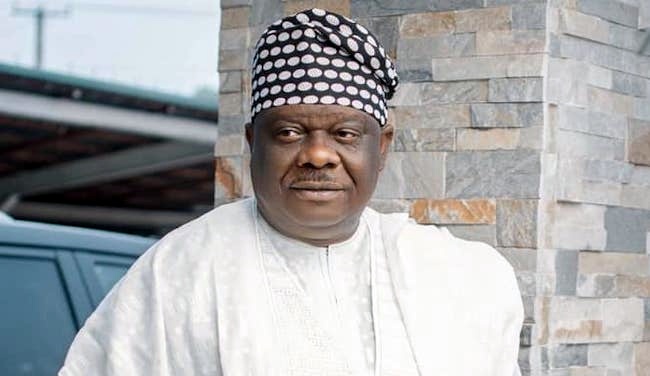
Four people from Benue State have gone to the Federal High Court in Abuja. They want to stop former Attorney-General of the Federation, Michael Aondoakaa, from running in the 2027 governorship election in the state.
The plaintiffs, through their lawyer Fredricks Itula, a Senior Advocate of Nigeria, asked Judge Joyce Abdulmalik to grant their request. They pointed to a past Supreme Court ruling that prevents Mr Aondoakaa from holding public office.
Mr Aondoakaa is planning to run for the governorship election in Benue under the Peoples Democratic Party (PDP). The applicants, who say they are registered voters in Benue State, are David Ejembi, Aondoaver Teryila, Joseph Okpanachi, and Benedict Orkume. The case is marked FHC/ABJ/CS/2152/2026.
The plaintiffs have sued the Independent National Electoral Commission (INEC), the PDP, and Mr Aondoakaa. They want the court to declare that INEC must follow the Supreme Court's ruling in the case of Michael Kaase Aondoakaa v. Obot (2022) 5 NWLR (Pt. 1824) 523, by stopping the PDP from backing Aondoakaa in the 2027 election.
They argue that this is in line with the laws in sections 235 and 287(1), along with the definition of “public office of a state” in Section 318(1) of the Nigerian constitution. They also asked the court to declare that INEC and the PDP are legally required to follow the Supreme Court’s ruling.
They want a court order to prevent INEC from allowing the PDP to support Aondoakaa for the 2027 governorship election. They also want a court order to stop Aondoakaa from running in the election.
During the hearing on Monday, Mr Itula told Judge Abdulmalik that he could not serve the court documents on Mr Aondoakaa. Because of this, he said he filed a motion for substituted service.
He asked for permission to serve Mr Aondoakaa through the PDP’s office. The judge approved this request. She ordered that a copy of the service must be sent to the court as proof. She also instructed that hearing notices be sent to all defendants. The case was then adjourned until 29 September for further mention.
Background on Aondoakaa's Disqualification
On 10 December 2021, the Supreme Court confirmed Mr Aondoakaa's lifetime ban from public office. This was for using his position as AGF to block the enforcement of a court ruling. A five-member panel of the Supreme Court, led by Mary Peter-Odili, agreed with the earlier decisions of the Federal High Court and Court of Appeal.
The lead judgment was given by Kudirat Kekere-Ekun, who is set to become the Chief Justice of Nigeria. She stated, “The appellant (Aondoakaa), as the Chief Law Officer of the Federation and a Senior Advocate of Nigeria was reckless and acted in a manner most unbecoming of the occupant of such an exalted office.”
This case started from the PDP's primary election ahead of the 2007 election for the Uyo Federal Constituency of Akwa Ibom State. Emmanuel Obot, who started the suit at the Federal High Court, won the primary election. He claimed his name was sent to INEC, but later it was unlawfully replaced with another name.
On 12 December 2007, the Court of Appeal ordered the President of the Court of Appeal to set up a new tribunal to address Mr Obot’s petition regarding Uyo. Mr Aondoakaa, as AGF, wrote to the President of the Court of Appeal, asking not to follow the Court of Appeal's decision.
Despite this, the then President of the Court of Appeal, Ayo Salami, ignored Mr Aondoakaa’s letter and created a new panel for the tribunal. On 18 April 2008, the new election tribunal ruled that Mr Obot should be sworn into the House of Representatives for Uyo Federal Constituency.
The Court of Appeal confirmed this ruling on 2 December 2009, and ordered INEC to give Mr Obot a certificate of return. According to Section 246(2) of the Nigerian constitution, the Court of Appeal’s decision on legislative elections is final.
Yet, Mr Aondoakaa wrote to the then INEC chairman, Maurice Iwu, telling him to ignore the Court of Appeal's ruling, which he called “obvious desecration of the institution of the judiciary.” He also wrote to Dimeji Bankole, the Speaker of the House of Representatives, asking him to disregard the ruling and to keep the situation as it was until the Supreme Court had its say.
Because of his letters to INEC and the House of Representatives, Mr Aondoakaa stopped Mr Obot from being sworn in. Upset by this, Mr Obot filed a suit on 9 May 2009, asking the Federal High Court in Calabar to declare Aondoakaa unfit for public office.
Mr Aondoakaa, who was still in office then, was sued both personally and in his official capacity. Mr Obot claimed Aondoakaa used his role as AGF to obstruct the ruling that ordered him to be sworn in.
He described Aondoakaa’s actions as driven by a shared interest with Bassey Etim, from whom the Court of Appeal’s ruling took back the House of Representatives seat. On 1 June 2010, the Federal High Court ruled that Mr Aondoakaa was “not a competent, fit and proper person to hold office.” He was also ordered to pay N50 million in damages to Mr Obot.
At that time, Mr Aondoakaa had already left office.
Appeal Court's Ruling
Mr Aondoakaa appealed to the Court of Appeal in Calabar. On 3 September 2015, the court dismissed his appeal and upheld the Federal High Court’s ruling. The Court of Appeal stated that Mr Aondoakaa “undermined and subverted the rule of law, the due administration of justice and the independence, authority and integrity of the judiciary.”
Justice Joseph Oyewole, part of the three-man panel, said, “It is unthinkable that the occupier of the exalted office of Attorney General would subvert the ends of justice, as was crudely done in this case by the appellant.”
He added that someone in the AGF position should represent the best of the legal profession. “That office should never again be occupied by individuals of such poor quality as the appellant,” he said.
Looking at Mr Aondoakaa’s actions compared to his appeal for justice, Justice Oyewole said, “It is ironic that the appellant should approach the same temple he so brazenly desecrated for succor against the consequences of his appalling conduct.” Mr Aondoakaa tried to get the Supreme Court to overturn the Court of Appeal’s decision but was unsuccessful.
Drop your comment
No comments yet — be the first to drop the gist 👇