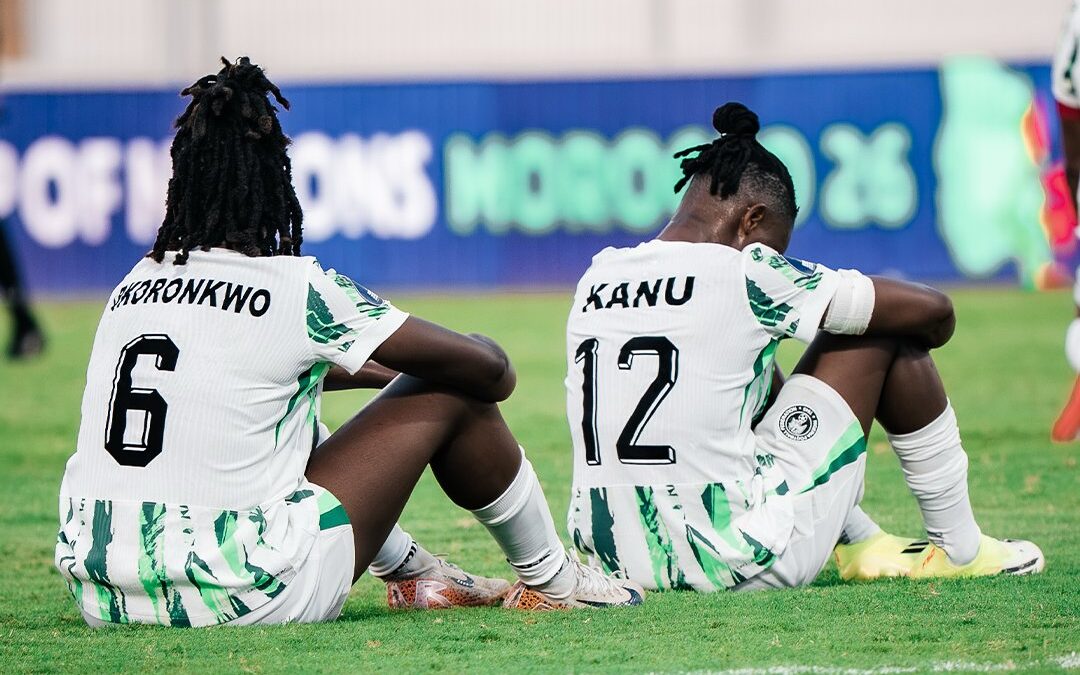
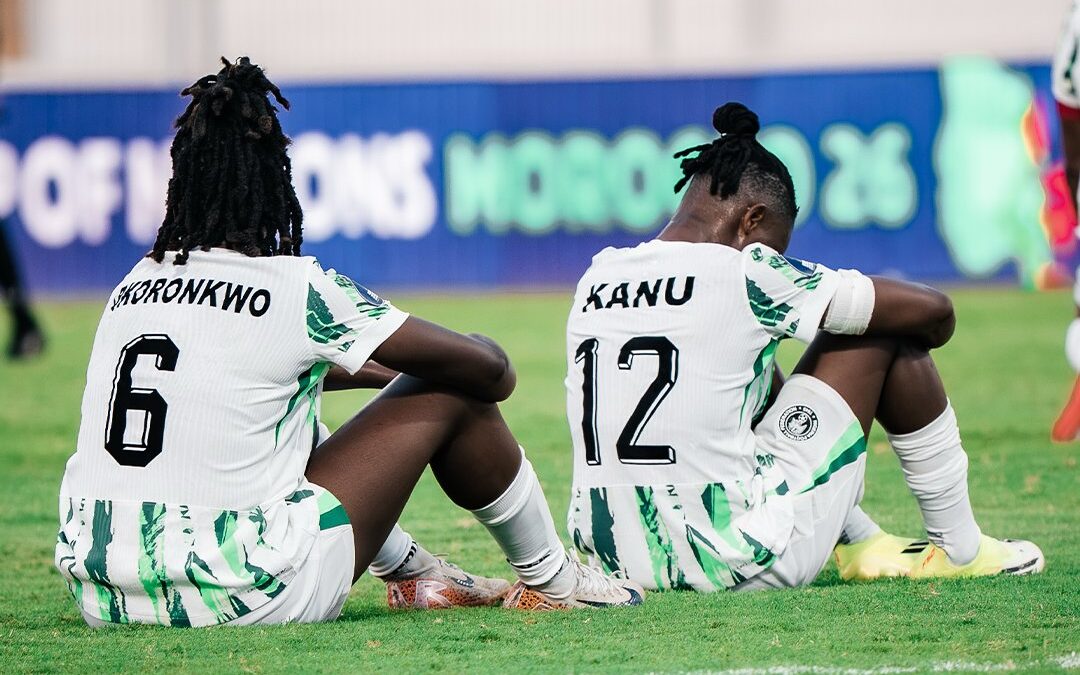
The signs have been clear since last year. The players' strength, not any plan from the Nigeria Football Federation (NFF), helped the team win a 10th WAFCON title in Rabat.
With a year to rethink and rebuild a squad ready for tough competition in women’s football, the Falcons, under coach Justin Madugu, and the NFF did not take action. So, it was no shock on Sunday when a 19th-minute free-kick from Cameroon’s Myriam Nyadjou ended Nigeria’s title defence at the quarter-final stage in Casablanca. This is the Falcons' earliest exit in recent memory, and it also means they lost their automatic spot for the 2027 FIFA Women’s World Cup in Brazil.
Just like Samson from the Bible, who didn’t realize his strength was gone, the Falcons entered Morocco thinking their ten stars on the badge and rich history would help them win. It didn’t. Nigeria struggled through the group stage. They lost to WAFCON newcomers Malawi, barely beat Zambia 1-0, and needed a lucky 6-2 win against Egypt to stay in the tournament on goal difference.
In Nigerian terms, they stumbled and fumbled their way to the quarter-finals, where Cameroon shut them out completely. Only the four WAFCON semi-finalists get automatic spots for the World Cup. Under Gusau’s NFF, both the Super Eagles and the Super Falcons have now missed out on qualifying for their World Cups. This is not just bad luck. It shows the results of two decades of neglect.
What should have happened
Twenty years ago, Nigeria was way ahead in African women’s football. A serious, well-funded, long-term plan could have made Nigeria a World Cup semi-finalist by now. Three things were needed, but none were maintained.
First, there should have been a real domestic league, treated as vital rather than a side project. The Nigeria Women’s Football League has depended on state governments’ support and occasional sponsorship, not a clear commercial and broadcast plan. In contrast, Morocco launched a national women’s football strategy five years ago. They focused on youth academies, a professional league, better coaching, and they are now seeing results, including continental finals and automatic World Cup qualification. Nigeria had a decade’s head start but wasted it on poor management.
Second, there needed to be a clear path from the Flamingos and Falconets to the senior team. Nigeria’s youth teams have made it far in global finals, showing talent is not the issue. What’s missing is a bridge from youth to senior teams, including coaching, sports science, and fitness standards to prepare young players for senior-level play, instead of starting over with each new coach.
A proper diaspora and welfare strategy
Nigeria's biggest asset is the number of Falcons playing in Europe and the United States. But scouting, integration, and player welfare have often been reactive. Players get called up close to tournaments, bonus arguments come back at bad times, and preparation is rushed instead of planned well ahead. A federation serious about reaching semi-finals and beyond would have gathered year-round data on every eligible player abroad and fixed welfare issues long before they became problems during big tournaments.
None of this needed massive money. It needed stable leadership and a plan that lasted beyond any single NFF administration, which Nigerian football has rarely had.
How the damage can be reversed
The damage isn’t beyond repair, but it won’t fix itself with the talk that Amaju Pinnick’s time was known for or with another four years of haphazard tournament planning.
First, whoever wins the NFF election in September must present a clear women’s football plan, not just a manifesto promise, but a document with specific goals, like Morocco’s federation did.
Second, the domestic league needs a broadcast and sponsorship revamp to make playing in Nigeria financially viable again, so talent isn’t lost before being scouted. Third, a full-time technical department should track every Nigerian-eligible player abroad from the youth level. This way, building teams for major tournaments starts years ahead, not just months.
Fourth, players’ welfare and bonus arrangements should be clear and made permanent. This would remove the off-field issues that have troubled the team during major tournaments.
Let me be clear. For the Super Falcons, the playoff route to Brazil isn’t just a chance; it’s the only door left open. If they miss it, this generation will watch the World Cup from home for the first time. That should be unthinkable.
But here’s the hard truth: even if they qualify, it won’t erase two decades of stagnation. It will just push the reckoning further away. If the Falcons fail to get to Brazil at all? That absence would make the call for reform in September impossible to ignore, not by choice, but by the heavy shame.
And maybe, sadly, that might be the only good thing left: a loud crisis that even the deaf can hear, calling for change. It’s also painful that, instead of resigning, the administrators are looking for another team in office, for what?
Nigeria has always had players who could reach a World Cup semi-final. What it has lacked for two decades is a federation ready to build a system around them. September’s election is the best chance in years to change that.

Drop your comment
No comments yet — be the first to drop the gist 👇