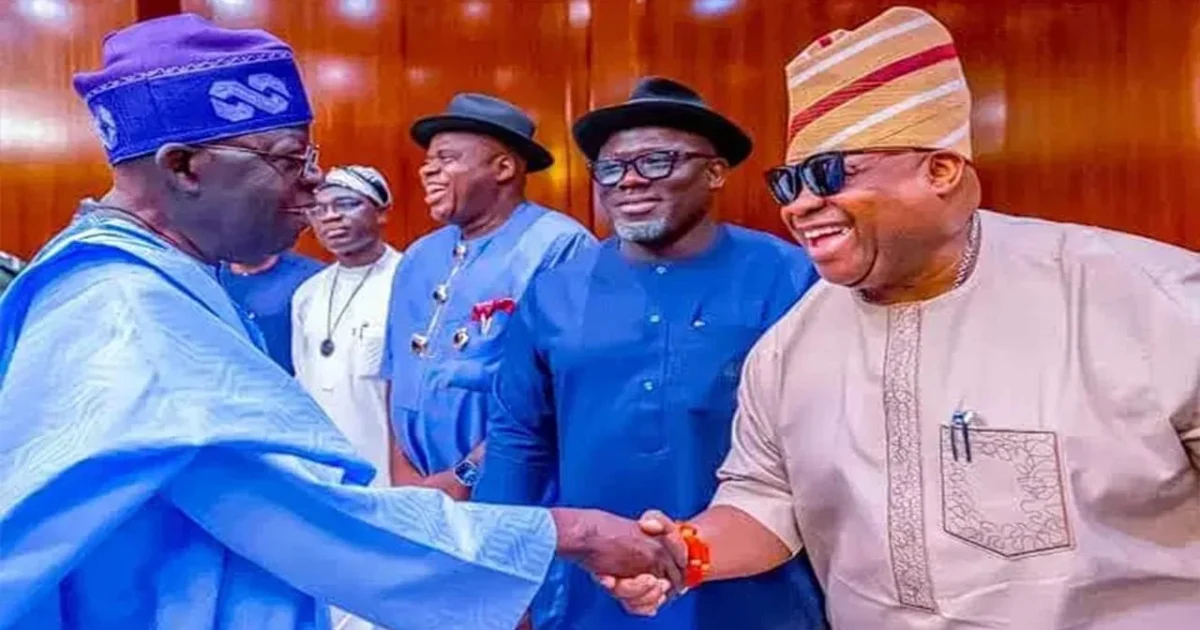
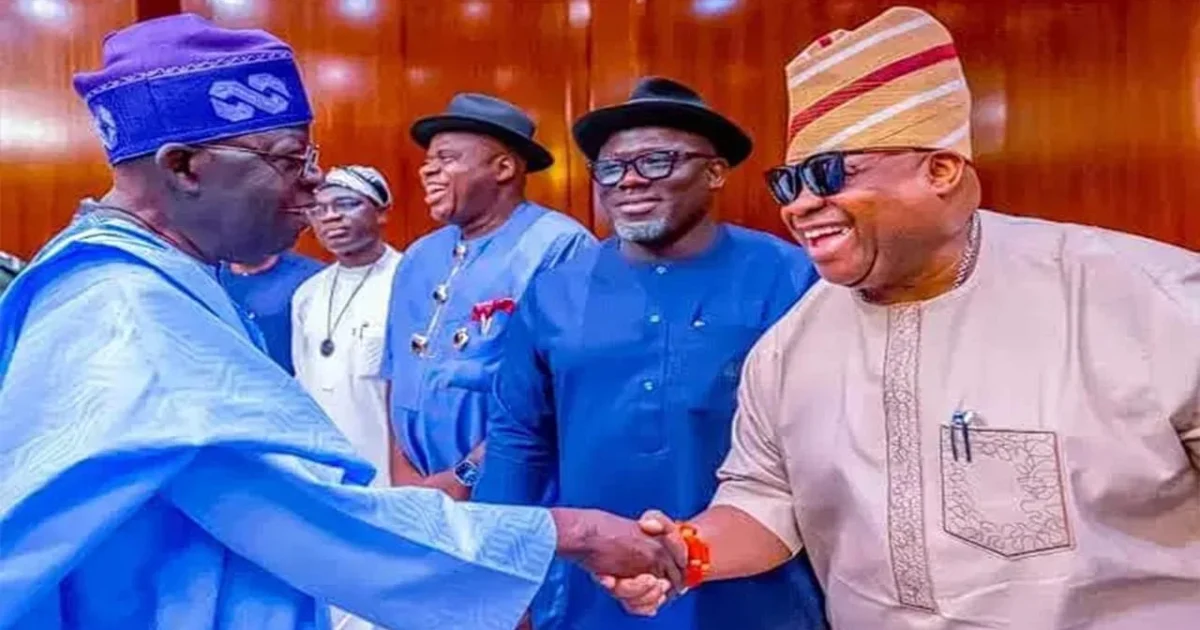
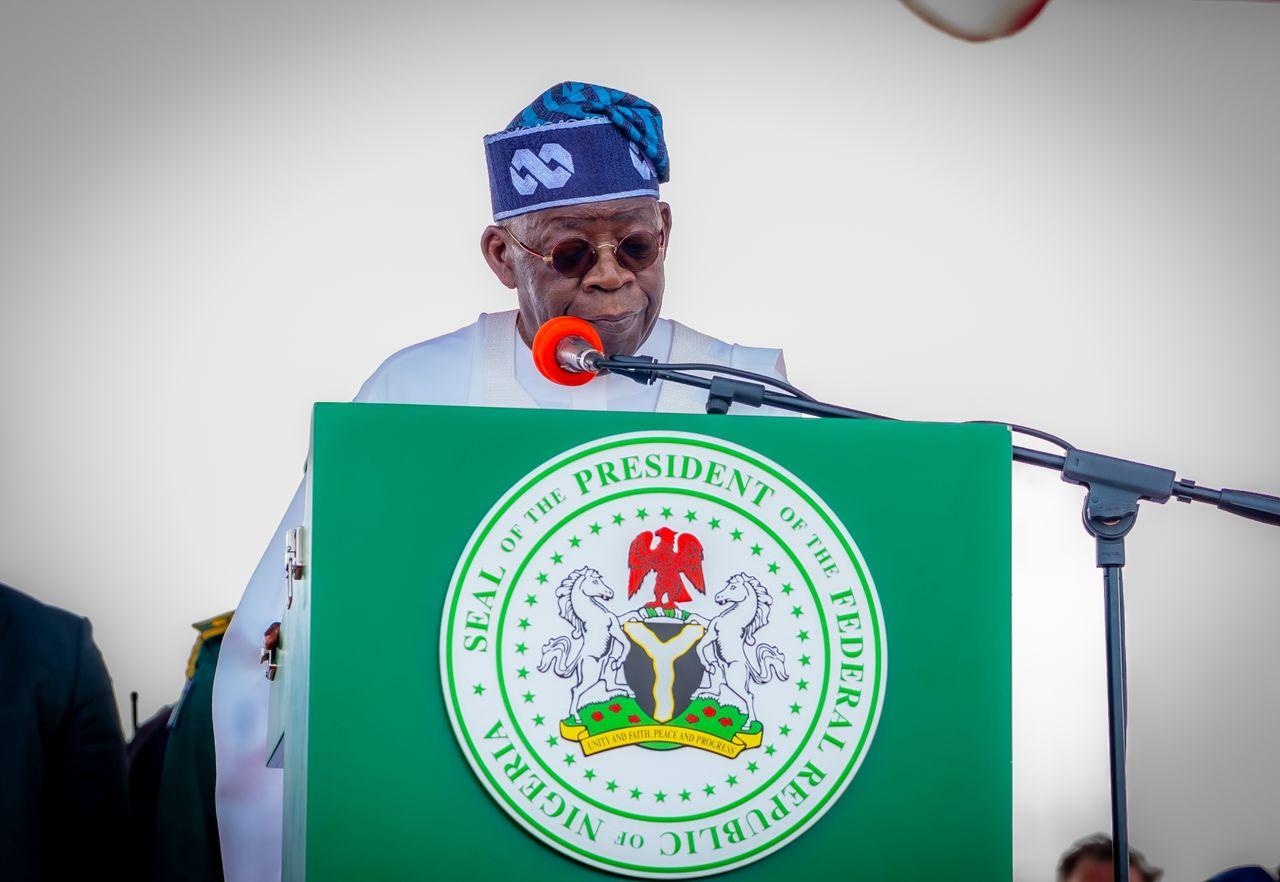
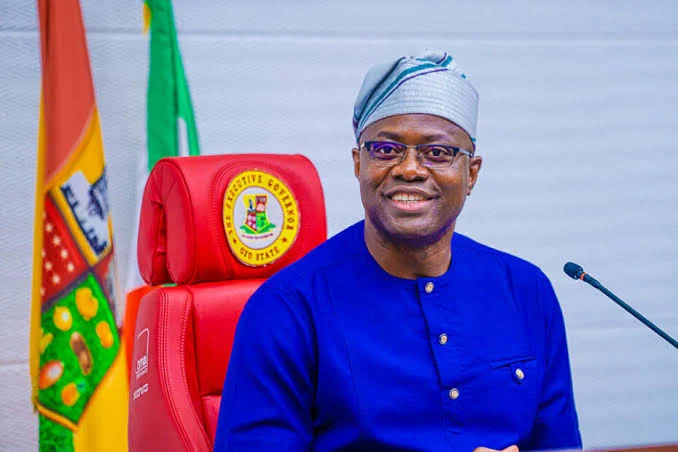
Governor Ademola Adeleke recently supported President Bola Tinubu’s 2027 re-election campaign. He called Tinubu “our own son, father and leader.” Adeleke stated, “I am the governor of the ancestral birthplace of Mr President. How can I have my own in the saddle and think twice before embracing him?” While he spoke, the election in Osun State was taking place, and the outcomes for both Adeleke and Osun were in the balance.
From Friday through the weekend, at least 25 states in the country had no commissioner of police. They were all sent to Osun State to support the president’s agenda. Reports showed that 32 Commissioners, 36 Deputy Commissioners, and 51 Assistant Commissioners were sent to a state with only 1,906,390 eligible voters. This was backed by powerful political figures, including the Senate President, ministers, governors, and aides, all showing the federal government’s strong presence aimed at weakening local opposition.
This was a clear show of federal power: 35,000 police officers and 10,000 Civil Defence staff were deployed, alongside heavily armed soldiers patrolling the area. Why would there be such fear among the people if the government was truly loved? As Yoruba elders say, one only stares blankly at the ceiling when Ifa divination seems completely strange, Àìgbọ’fá l’à ń wò’kè, Ifá kan ò sì ní párá.
During the election, a sad political connection appeared between Tinubu and Adeleke. The relationship between them reminds us of a warning from Chinua Achebe’s Things Fall Apart: “That boy calls you father; do not bear a hand in his death.” This warning was given by Ogbuefi Ezeudu, the oldest man in Umuofia, who was respected and wise. His advice was about Ikemefuna, Okonkwo’s foster child, who lived with him for three years. In that time, Okonkwo and Ikemefuna developed a strong bond, and Ikemefuna became close to Okonkwo’s son, Nwoye.
Like Okonkwo, who feared being seen as weak, Tinubu appeared anxious to show his political strength in Osun, where his umbilical cord is buried. He seemed unwilling to lose in the political battle to support his cousin, Gboyega Oyetola. Ezeudu’s warning held deep meaning: taking part in the death of someone who calls you “father” goes against basic humanity, no matter the political situation. Despite this, Okonkwo ignored the elder’s warning. He joined in the killing of Ikemefuna, and when the terrified boy ran to him, crying, “My father, they have killed me!”, Okonkwo dealt the final blow. Replace Okonkwo with Tinubu and Ikemefuna with Adeleke, and you'll see that what Tinubu did to Adeleke, who called him the father of Osun State, was a form of filicide.
A greater tragedy befell Okonkwo at Ezeudu’s funeral. As gunfire and cannon blasts filled the air, Okonkwo’s gun accidentally exploded. A piece of it struck Ezeudu’s sixteen-year-old son, killing him instantly. Chaos broke out. Okonkwo stood there, fully aware of the severe consequences that came with killing a clansman. Killing someone from your clan, even by accident, was a serious sin against the earth goddess, Ala. Okonkwo understood the cost of murder in Umuofia: he had to go into exile for seven years in Mbanta, his mother’s clan.
With what we saw in Osun, elections in Nigeria have become like the beat of the Gbedu drum. This drum carries a mournful sound, echoing the sadness of the people. When it beats like it did in Osun, the people ask in despair: what song can we sing to this strange drumming? The Gbedu is not just any drum; it symbolizes authority and connection to ancestors. Traditionally, it is wrong for outsiders to play the Gbedu, as its sound speaks to the gods during ceremonies. So, when outsiders play this sacred drum, the Yoruba people ask: “Orin wo laa ko si gbedu yi?”, What song do we sing to such a strange, ominous rhythm?
The Osun Gbedu comes with a warning of evil. William Shakespeare’s Brutus recognized danger early. He said, “It is the bright day that brings forth the adder, and that craves wary walking.” This saying highlights hidden dangers and tyranny. Just like those who could foresee the events of yesterday’s Osun election. Regardless of the outcome, this election will reflect the wild actions we took in the past months. This includes the president’s alarming statement that “all is fair in politics,” the 29 people killed in the 73 violent political incidents in Osun, and the serious injuries suffered by many in this political fight.
Brutus spoke these words as he walked through his orchard. The plan to assassinate Julius Caesar was in motion. The tension was palpable, just like in Nigeria today. Like Brutus, Nigeria is anxiously pacing through a time of uncertainty. The situation in Osun raises concerns about democracy. Violence and crime have been prevalent since the election process began. Just as Julius Caesar represented bad news for the conspirators, the sight of danger coming out in the open is a concern for those who cannot compete in a fair election. They seem to have won the day by trying to ignore the people's wishes. As the bright times fade, the Osun election is the snake slithering into view, and the decision has been made. Even if the current governor wins, Osun has already sent a message for the January and February 2027 elections. It appears even those who did not vote will have to face the consequences, a saying in Yoruba lingo.
Osun and Nigeria are marking an anniversary of political chaos, falling victim to George Santayana’s saying that “those who fail to learn from history are condemned to repeat it.” Exactly 43 years ago, the same chaos that marked this election affected the old Oyo State, of which Osun was a part, in August 1983. Just as the electoral violence in the Western Region signaled the end of the First Republic, the 1983 election violence in Osun ultimately ended the Second Republic.
I attended a Town Hall meeting in Osogbo, organized by Arise TV and the Nigerian Tribune for the governorship candidates. Key political figures were present, including Ademola Adeleke, Bola Oyebamiji, Najeem Salam, and others. Their supporters wore bright outfits that reminded me of Dolly Parton’s “Coat of Many Colours.” While others saw a colorful gathering, I noticed two things: an elephant and the tragedy of political propaganda called Aso Ebi. I saw a large elephant about to fall, surrounded by greedy people with knives ready to cut it into pieces. This brought to mind the Yoruba saying: “Orísiríṣi ọbẹ làá rí ní’jọ ikú erin”, On the day the elephant falls, knives of all shapes jostle for a share. Beyond the colorful Aso Ebi, a sad drama was unfolding.
No matter who wins, the wounds caused in Osun State and Nigeria’s election process may become what the Yoruba call ada’jina, a wound that never heals. Osun has always been a battleground state, with its political climate changing based on acceptance or rejection of authority. Violence before the election involved both the ruling party (APC) and the state-level actors from the Accord Party, following the usual destructive pattern of Nigerian elections. Both sides showed skill in intimidation, vote-buying, and electoral violence, turning Osun into a war zone.
The president indirectly caused the turmoil in Osun. This highlights a view of politics in Nigeria that sees opposition as a threat. It raises a serious question: how many others like Senator Francis Fadahunsi, who called for the elimination of opposition and told enforcement agents to target non-APC voters, are out there? While Fadahunsi’s words reveal his villainy, they also show how political violence is normalized in the system.
Even as the presidency issued soft press releases to distance itself from the tough actions in Osun, the public perception is clear: the government supported the harsh treatment that took place.
In 1983, the area now called Osun State also faced electoral violence. I lived in Ilesa at that time and saw the chaos firsthand. Angry voters who suspected fraud clashed with police in Ilesa. They burned the homes of political opponents, causing violence that shook Ijesaland and Nigeria. At least 49 people died in the week after results were announced by Ovie Whiskey’s FEDECO. The NPN, led by President Shehu Shagari, was accused of widespread ballot-rigging. While there were incidents of arson and killings, the worst hit states were the old Oyo and Ondo States, where unofficial counts showed 25 dead in Oyo and 24 in Ondo.
The violence in Ondo was particularly brutal, with bodies burned beyond recognition. This included Olaiya Fagbamigbe, a Member of the House of Representatives, and Awoleye Agunbiade, a former Majority Leader in Ondo State. NPN official RA Agbayewa and his wife were also killed and burned. An angry mob in Ile-Ife even set a police station on fire and stormed the prison to free hundreds of inmates. They also burned the federal election commission office in Akure, destroying ballots and ballot boxes. The governor-elect Akin Omoboriowo had to seek refuge to avoid their anger. Four months later, the republic fell as the army took control.
The historical electoral violence in Osun and previous events in the First and Second Republics reflect both Okonkwo’s tragic story and Christopher Marlowe’s Doctor Faustus. Marlowe tells the tale of Dr Faustus, a learned man who becomes dissatisfied with traditional knowledge. He turns to dark magic but is warned of the dangers that lie ahead. Undeterred, Faustus trades his soul for power but wastes his time on trivial pursuits. When time runs out, he is dragged into hell forever.
The events of the Osun election were not only bloody but also mirrored the tragedy in Marlowe’s work. It brings to mind the poignant words of poet David Diop in “The Vultures”: “their talons stained in blood / From where the wild current floods / A heavy weight upon the crest / No song of peace / No gentle nest.”
This leads us back to the Aso Ebi seen during the elections and what it represents. In Nigeria, textiles and politics are closely linked. They come in forms like ankara fabric, T-shirts, caps, and banners. Southwestern Nigeria has a long history of using textiles for political purposes. Adegoke Adelabu was one of the first to use this strategy during the 1954 and 1956 elections, creating propaganda cloths with his image. However, after his party lost, unsold fabrics left his partner with huge debts. On their way back from Lagos seeking help in March 1958, Adelabu’s car crashed, ending the life of the influential politician at just 43.
Since then, Aso Ebi has been a key tool in Nigerian elections.
In a way, those who become obsessed with power may find themselves failing. If power turns against them, those who caused destruction in Osun may face their own downfall. This reflects the Yoruba saying that wisdom can sometimes lead to harm. Therefore, the federal funds used to control Osun could lead to disaster, and Ikemefuna may escape the filicide attempt by Okonkwo.
Beyond Okonkwo, the Gbedu drum, Brutus, and the meaning of Aso Ebi, the Osun election is a lesson for 2027. Even if those in power fail in their attempts to show strength, it will serve as a measurement for the elections next January and February. It reminds us of the words of Muhammadu Odolaye Aremu, the famous Dadakuada musician from Ilorin. In his songs celebrating the power of Ilorin’s Sobi Hills, Aremu warned that all human power is temporary and every empire eventually falls.
In his poetry, Aremu cautioned that even Sobi Hills, despite its strength, eventually became neglected, allowing weeds to grow. This serves as a warning about the inevitable decline of leaders and governments. The results of the Osun elections may show powerful figures in Aso Rock that even when they think they have everything, they may actually have nothing. One can only hope someone is paying attention.

Drop your comment
No comments yet — be the first to drop the gist 👇